Friday, April 18, 2025

Class 8 NCERT bridge course Answers Activity W 3.2 Let’s Brainstorm

 Activity W 3.2 Let’s Brainstorm 


 Students may be asked to solve the following puzzles either in groups or individually.

 They may explain their strategy of obtaining the result. 

Let’s Brainstorm 

Puzzle 1: Symbol Grid

1. The grid below has symbols that contain a whole number value less than 10. 

Each symbol has its own value. 

The numbers you see at the end of each row and column are the sums of the figures’ values for that row or column.


Can you find out the value of each symbol ? 

ANSWER:

Let’s name the shapes:

  • 🟦 Pentagon = P

  • πŸ”Ί Triangle = T

  • ⭐ Star = S

  • ➕ Plus = C

And solve!

Row equations:1️⃣ 

1. P+T+P+S=15

2. C+S+P+S=23

3.T+C+T+?=16

4. S+T+?+P=14

Column equations:

1. P+C+T+S=20

2. T+S+C+T=24

3. P+P+T+?=7

4. S+S+?+P=17

SOLVE
From Row 3 and Column 3, the missing symbol must be the same in both — let’s call it X for now.

Let’s focus on easy rows:

Row 3:  T+C+T+X=16

Row 4:   S+T+X+P=14

Col 3:  P+P+T+X=7

Let’s assume X = 0 to test:

From Col 3:   π‘ƒ+P+T=7

From Row 3:  T+C+T=16

So  2T+C=16.

From Col 1: P+C+T+S=20.

And from Row 1: 2P+T+S=15.

From Row 3:  2T+C=16

From Col 3:  2P+T=7

From Row 4: S+T+P=14 (since X=0)

Now solving this small system:

From (2)  2P+T=7 → T=7−2P

Substitute into (1):

2(7−2P)+C=16

14−4P+C=16

C=4P+2.

Now substitute into Col 1:

P+C+T+S=20.
Substitute 

C=4P+2 and 

T=7−2P:

P+(4P+2)+(7−2P)+S=20
Simplify:

P+4P+2+7−2P+S=20

3P+9+S=20

S=11−3P.

If  P=1: 

S=11−3(1)=8

T=7−2(1)=5

C=4(1)+2=6

Now check Row 2:

C+S+P+S=23

6+8+1+8=23 


SOLUTION:

  • 🟦 Pentagon P=1
  • πŸ”Ί Triangle T= 5
  • ⭐ Star  S = 8
  • ➕ Plus C = 6

Puzzle 2: Symbol Equation

2. Here, you are given two representations, where symbols have been used. 

Each symbol represents a numeric value. Find the value of each symbol.


SOLUTION:

Given the equations:

    • 🟦 Blue Square = S

    • πŸ”Ί Orange Triangle = T

    • 🟑 Yellow Circle = C

    • ⭐ Star = R

EQUATION 1:  S+S+S=15 --> 3S = 15 --> S = 5
EQUATION 2:  T+T+S=13 -->  2T + 5 = 13 --> 2T = 8 --> T = 4
EQUATION 3 : T+C+S=15 --> 4 + C + 5 = 15 --> C = 15 - 9=6
EQUATION 4: C+C+S=?
EQUATION 5: C + T + T = ?
EQUATION 6 : C + T = 8
EQUATION 7: C + T = 4
EQUATION 8 : R + S =12 --> R + 5 = 12 --> R = 12 -5 =7
EQUATION 9 : R + S = S
EQUATION 10 : S + S = R --> 2S = R

SOLUTION:

🟦 Blue Square (S)= 5
πŸ”Ί Orange Triangle (T) = 4
🟑 Yellow Circle (C) =6
⭐ Star (R)= 12 - 5 = 7
🟑 + 🟑 + 
🟦 = 6 + 6 + 5 = 17
🟑 + πŸ”Ί+ πŸ”Ί = 6 + 4 + 4 = 14

Puzzle 3: Make 5+5+5 = 550 True

3. Make the following equation true by drawing/putting/writing a single line.


SOLUTION : 

 Just draw a slanted line on the first "+" to turn it into 4:


545 + 5 = 550! 


Puzzle 4:Roman Numeral Trick 

What should be added to IX to make six?

Add S in front of IX to form SIX.
So the answer is: Add ‘S’! 


Teachers may try to find some more such puzzles that will engage students in the process of exploration


Puzzle 1: Symbol Sums

SymbolMeaning
🍎 Apple = ?
🍌 Banana = ?
πŸ‡ Grapes = ?

Equations:

  1. 🍎 + 🍎 + 🍎 = 18

  2. 🍌 + 🍎 + 🍌 = 16

  3. πŸ‡ + πŸ‡ + 🍎 = 20

Find the value of each fruit!

Solution:

  1. 🍎 + 🍎 + 🍎 = 18 → 🍎 = 6

  2. 🍌 + 6 + 🍌 = 16 → 2🍌 = 10 → 🍌 = 5

  3. πŸ‡ + πŸ‡ + 6 = 20 → 2πŸ‡ = 14 → πŸ‡ = 7

Final Answer:
🍎 = 6, 🍌 = 5, πŸ‡ = 7.

Puzzle 2: Number Logic

SymbolMeaning
🐾 Paw = ?
🐟 Fish = ?
🦴 Bone = ?

Equations:

  1. 🐾 + 🐾 + 🐟 = 22

  2. 🐟 + 🦴 + 🦴 = 14

  3. 🐾 + 🦴 = 13

Find the value of 🐾, 🐟, 🦴.

Solution:

From (3):
🐾 + 🦴 = 13 → 🦴 = 13 - 🐾.

Substitute into (2):
🐟 + 2(13 - 🐾) = 14
Simplify and solve using substitution or trial.
For example:
If 🐾 = 8, 🦴 = 5.

Now check in (1):
8 + 8 + 🐟 = 22 → 🐟 = 6.

 So final values:
🐾 = 8, 🐟 = 6, 🦴 = 5.

Puzzle 3: Matchstick Equation

Make the equation correct by moving 1 matchstick:

6 + 4 = 9

Solution:
Move one stick from "6" to make it "5":

5 + 4 = 9

Class 8 NCERT bridge course Answers Activity W 3.1 Understanding Denseness of Fractions

 Activities for Week 3 

Activity W 3.1 Understanding Denseness of Fractions 

Objective:

To understand that there are endless fractions between any two given fractions.

Through this activity, students will get an idea about the denseness of fractions. 

That is, they will be able to know that they can find as many fractions as possible between any two fractions. 

This activity will also help to improve number sense and reasoning skills with fractions. 

Material Required 

Long rolls of paper strips 

 Scissors 

 NCERT Mathematical kits (if present in school) 

 Blank cards


Procedure

 Step 1 

Write two fractions, say, 1/4 and 1/2 on the board and the students may be asked to check, if there are fractions between them. 

Discuss that denseness of fractions means that there can be as many fractions as we want between the two fractions. 

Step 2: 

Hands-on Exploration 

 Take two copies of a paper strip


Ask the students to fold those strips in 2 equal halves. 


Take one of the strips and cut it into two equal parts with the help of scissors.  


Take one part and keep it on the other strip. 


 Take the remaining half and put it on the first half. 


 Continue this process until the students are unable to cut remaining part in to 2 equal parts


Discussion to Explore

1. What does this activity explain?

ANSWER:

This activity explains that fractions are dense — meaning, between any two fractions, no matter how close they are, there are always more fractions that can fit in between.

2. Can we divide these strips further more? If yes, then to what extent?

ANSWER:

 Yes, we can keep dividing the strip into smaller and smaller pieces endlessly — in theory, we can keep cutting the parts infinitely, because between any two fractions, there is always another fraction.

3. If half of a unit is 1/2, then what will be the half of 1/2?

ANSWER:

 Half of 1/2 is:

12÷2=14\frac{1}{2} \div 2 = \frac{1}{4}

 So, the half of 1/2 is 1/4.

4. Does 1/4 lie in between 0 and 1/2?

ANSWER:

 Yes!
1/4 is greater than 0 but less than 1/2, so it lies between 0 and 1/2 on the number line.

5. How many fractions can lie between 2 fractions?

ANSWER:

Infinite fractions can lie between any two fractions.
No matter how close two fractions are, there will always be more fractions between them.

6. Ask students, if they see gaps between their fractions.


ANSWER:

 Yes, students will observe gaps between fractions on the strip or number line, which shows there is always room for another fraction in between.

7. Challenge: “Is there another fraction that can go between these parts of strips?”


ANSWER:

 Yes! Always.


For example, between 1/4 and 1/2, you can find:


14+12÷2=38\frac{1}{4} + \frac{1}{2} \div 2 = \frac{3}{8}


And between 1/4 and 3/8, you can again find:


14+38÷2=516\frac{1}{4} + \frac{3}{8} \div 2 = \frac{5}{16}


And so on... endlessly!


Fractions are dense — there is always another fraction between any two fractions, no matter how small the gap looks.

 Extension 

Students may be motivated to observe and generalise the above processs to find a fraction between two fractions 

A simple formula to find a fraction between two given fractions:

New Fraction=Fraction 1+Fraction 22\text{New Fraction} = \frac{\text{Fraction 1} + \text{Fraction 2}}{2}

This gives a new fraction that lies exactly between the two.

You can also practice this on a number line or using the Math Kit for better understanding!


Conclusion:

Through this activity, I learned that fractions are dense. This means that between any two fractions, there are infinite fractions. No matter how close two fractions are, we can always find another fraction between them by using the formula:

New Fraction=Fraction 1+Fraction 22\text{New Fraction} = \frac{\text{Fraction 1} + \text{Fraction 2}}{2}

This activity helped me understand that fractions can be divided into smaller and smaller parts, and there is no end to the number of fractions that can exist between any two numbers. Using strips, number lines, or the Math Kit makes this concept easier and fun to learn!


Class 8 NCERT bridge course Answers Activity W2.6 Fraction Pizza Party

  Class 8 NCERT bridge course Answers Activity W2.6

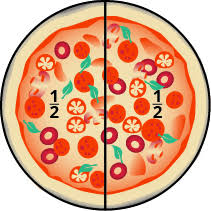
Activity W2.6 Fraction Pizza Party


LO: Identify fractional parts of quantities. 

Fraction Pizza Party This activity will help students understand fractional quantities by creating and comparing pizza slices.

Material Required 

 Large paper circles (representing pizzas) 

 Coloured markers or crayons 

Scissors 

Multiple flashcards with fraction amounts 

(for example, 2 pieces of 1/2, 4 pieces of 1/4 and 6 pieces of 1/6)

 Procedure 

1. Divide students into small groups and give each group a paper pizza. 

2. Call 1 student from each group and ask them to choose 1 set of fractions. 

3. Ask them to cover pizza paper with the help of fractions one-by - one. 

4. No gap and no overlapping are allowed. 

5. Find out and note down “How many total slices are left’’ after putting each slice? 

6. Take ½ parts and combine them to form a whole. How many such parts do you see, are required?


1. Take the 1/8 parts and combine them to form a whole. How many 1/8 parts would be required to make a whole?

ANSWER:
To make one whole pizza using 1/8 parts:
1/8 + 1/8 + 1/8 + 1/8 + 1/8 + 1/8 + 1/8 + 1/8 = 8/8 = 1 whole.
So, 8 pieces of 1/8 are required to make a whole pizza.

One way to find this is:
 1/8 + 1/8 = 2/8 
2/8 + 1/8 = 3/8 
3/8 + 1/8 = 4/8
4/8 + 1/8 = 5/8, etc.

 Students may be encouraged to explore other ways, if possible. 

If you combine all the slices given to you, can you make a whole pizza again?

2. After placing the first 1/2 piece, how many pieces do you need to complete the whole pizza?
ANSWER:
After placing 1 piece of 1/2, one more 1/2 piece is needed.
So, 1 more piece of 1/2 is required.


Will 1/2 + 1/2 pieces give a whole pizza?
ANSWER:
Yes!
1/2 + 1/2 = 1 whole pizza. 

3. After placing the first 1/3 piece, how many pieces do you need to complete the whole pizza?
ANSWER:
You need 2 more pieces of 1/3 to complete the pizza.

Was the remaining area covered by 2 pieces of 1/3?
ANSWER:
Yes! 1/3 + 1/3 = 2/3. Adding the first piece (1/3), all three together make:
1/3 + 1/3 + 1/3 = 3/3 = 1 whole pizza. 


Could 1/3 + 1/3 + 1/3 pieces complete the whole pizza? 
ANSWER:
Yes!

4. After placing the first 1/4 piece, how many pieces do you need to complete the whole pizza?
ANSWER:
You need 3 more pieces of 1/4 to complete the pizza.

Does the remaining area get covered by 3 pieces of 1/4?
ANSWER:


Yes! 3 pieces of 1/4 will cover the remaining area.

Does 1/4 + 1/4 pieces complete the whole pizza?
ANSWER:
No! 1/4 + 1/4 = 2/4 = 1/2, so it covers only half.

If not, then how many pieces are required?
ANSWER:
You need 4 pieces of 1/4 to make one whole pizza.

Does it mean that 1/4 + 1/4 is equal to half or 1/2?
ANSWER:
Yes!
1/4 + 1/4 = 2/4 = 1/2.

Can we say 1/4 + 1/4 + 1/4 = 3/4?


ANSWER:
Yes!
1/4 + 1/4 + 1/4 = 3/4.

Does 1/4 + 1/4 + 1/4 + 1/4 pieces complete the whole pizza?
ANSWER:
Yes!
1/4 + 1/4 + 1/4 + 1/4 = 4/4 = 1 whole pizza. 


Thursday, April 17, 2025

Class 8 NCERT bridge course Answers Activity W2.5

Class 8 NCERT bridge course Answers Activity W2.5


Students may be encouraged to fill in the blank spaces. The NEP 2020 encourages use of such games, which make children explore and connect different mathematical concepts.


Solution of this fun math puzzle step by step


Starting from the top-left and moving along the paths

x + 2 = 19

x = 19 - 2 =17


19 + x = 21

x = 21-19 =2


21+x = 24

x = 24 - 21 = 3


x - 4 = 8

x = 8 + 4 = 12


21 - 1 = 20

20 - 17 = 3

17 - 11 = 6


15 - 1 = 14

x + 3 = 15

x = 15 -3 = 12


x + 1 = 25

x = 25 -1 = 24


x - 5 = 18

x = 18 + 5 =23


6 + 7 = 13


8 + 6 =14


13 - 8 = 5

6 x 4 = 24


Wednesday, April 16, 2025

class 8 NCERT bridge course Answers Activity W2.4

 class 8 NCERT bridge course Answers Activity W2.4 

Teacher may encourage students to solve puzzles to make them explore different concepts of Mathematics learnt.

 The NEP 2020 encourages puzzles in the Mathematics curriculum. 

Some puzzles are given below. 


Puzzle 1 

 Think of a number. 

Add 5 to it. O

Multiply the result (got in step 2) by 3. 

Now subtract 15 from above. 

Now divide the last result by the original number. 

 Finally add 7 to the result. 


Puzzle 2 

 Think of a number between 20 to 99. 

 Add the digits of the number. 

Subtract the result from original number. 

 Again, add the digits of final number you get in step 3. 

Puzzle 3 

 Think of a number. 

Add 5. 

Double your result. 

 Add 40. 

 Divide by 2. 

 Subtract the number that you first thought. 

 Multiply by 4. 

Puzzle 4 

Find me: Who am I ? 

I am a 2-digit number. 

 The sum of my digits is 10.  I am greater than 8 but less than 30. 

 What number am I ? 

Puzzle 5

 Find me: Who am I ? 

I am a prime number. 

 The sum of my digits is 8. 

 I am greater than 10 but less than 50. 

 What number am I ? 

Puzzle 6 

Find me: Who am I ? 

 I am a square number.

 My first digit is 2. 

The sum of my digits is 10. 

 What number am I ? 

In all the above puzzles, teachers must discuss the logic behind the magical answers. 

Before explaining the logic related to the curricular concept of linear equations in one variable, students should be given a chance to express their observations and thought processes.

--------------------------------------------------------------------------------------------------------------

---------------------------------------------------------------------------------------------------------

🧠 Puzzle 1 — The Magic of Numbers

Let’s call the number you think of x.

  1. You add 5 → the number becomes x + 5.

  2. Then you multiply it by 3 → you get 3(x + 5) = 3x + 15.

  3. You subtract 15 → that takes you back to 3x.

  4. You divide this by your original number x3xx=3\frac{3x}{x} = 3 (it always becomes 3).

  5. Finally, you add 7 → 3 + 7 = 10.

πŸ‘‰ No matter which number you start with, the answer is always 10!
This is because the steps are designed to cancel out the variable, making the process predictable.

πŸ”’ Puzzle 2 — The Digit Surprise

Pick any number from 20 to 99.

  1. Add the digits together.

  2. Subtract that sum from the original number.

  3. Add the digits of the new number.

πŸ‘‰ You’ll always end up with 9!
Why? Because the difference between any two-digit number and the sum of its digits is always a multiple of 9 — and adding the digits of a multiple of 9 always gives 9.

πŸ’― Puzzle 3 — Hidden Equation

Let’s call the number you thought of x.

  1. You add 5.

  2. Double it.

  3. Add 40.

  4. Divide by 2.

  5. Subtract the original number.

After all these operations, you always get 25 at this step — then multiplying by 4 gives 100.

πŸ‘‰ Final answer is always 100!
This shows how algebra helps predict the outcome, no matter the chosen number.

πŸ” Puzzle 4 — Guess the Number

Clues:

  • A two-digit number.

  • Sum of the digits is 10.

  • Greater than 8 but less than 30.

πŸ‘‰ When you list numbers from 10 to 29, only 19 has digits that sum to 10.

The answer is 19.

πŸ§‘‍🏫 Puzzle 5 — The Prime Detective

Clues:

  • Prime number.

  • Sum of digits is 8.

  • Between 10 and 50.

πŸ‘‰ The only prime number that fits is 17 (1 + 7 = 8).

The answer is 17.

🎯 Puzzle 6 — The Square Mystery

Clues:

  • Square number.

  • First digit is 2.

  • Sum of digits is 10.

πŸ‘‰ The only square number with first digit 2 is 25. But the sum of digits is 7, not 10 — so this looks like a small trick in the puzzle!
Most likely the intended answer is:

25.

πŸ’‘ Teacher's Wrap-up:

These puzzles are a fun way to explore:

  • Patterns and algebra (Puzzles 1, 2, 3),

  • Logical deduction and number properties (Puzzles 4, 5, 6).

🧩 Puzzle 1 — The Magical 10

Answer: Always 10
Logic:
Let the number be x.
The steps simplify like this:

((x+5)×315)÷x+7=10((x + 5) \times 3 - 15) \div x + 7 = 10

No matter which number you start with, the operations cancel out the unknown, and the result is always 10.
πŸ‘‰ Concept Link: Introduction to forming and solving linear expressions.


🧩 Puzzle 2 — The Digit Game

Answer: Always 9
Logic:
For any number from 20 to 99:
Original number minus the sum of its digits always gives a multiple of 9.
The final step (adding the digits) will always give 9.
πŸ‘‰ Concept Link: Exploring number patterns, divisibility by 9.


🧩 Puzzle 3 — The Journey to 100

Answer: Always 100
Logic:
Let the number be x.
The calculation simplifies to:

(((x+5)×2+40)÷2x)×4=100(((x + 5) \times 2 + 40) \div 2 - x) \times 4 = 100

The equation shows the final result doesn't depend on x.
πŸ‘‰ Concept Link: Linear expressions and constant solutions.


🧩 Puzzle 4 — Who am I?

Answer: 19
Logic:
The clues:

  • Sum of digits = 10.

  • Greater than 8, less than 30.

Only 19 fits both conditions.
πŸ‘‰ Concept Link: Logical reasoning and digit sum practice.


🧩 Puzzle 5 — Who am I?

Answer: 17
Logic:
A prime number between 10 and 50 whose digits sum to 8 — only 17 fits.
πŸ‘‰ Concept Link: Prime numbers, digit sum, number properties.


🧩 Puzzle 6 — Who am I?

Answer: 25 (Even though the sum of digits is 7, not 10)
Logic:
The puzzle likely has a typo, as 25 is the only square number starting with 2 within the expected range.
πŸ‘‰ Concept Link: Square numbers, digit patterns, and identifying possible errors or mismatches.


🌟 Teacher's Note:

Before giving these explanations, ask students:

  • "What patterns did you notice?"

  • "Why do you think the answer is always the same?"

  • "Can you write this as an equation?"

T

Maths 🎨 Art Integrated Project on Spiral root Activity for the class 9


Maths    🎨 Art Integrated Project on Spiral root Activity for the class 9


Subject: Mathematics
Topic: Spiral Root Activity (Square Root Spiral)
Class: 9
Integrated with: Visual Arts

Introduction:

Mathematics is often seen as abstract, but through art, its beauty becomes visual and understandable. This project integrates mathematical concepts with artistic creativity using the Square Root Spiral — a geometric representation of square roots constructed using compass, ruler, and imagination.

Objective:

  • To construct a Square Root Spiral geometrically.

  • To explore the artistic patterns and designs that emerge from mathematical shapes.

  • To enhance understanding of square roots through hands-on and visual learning.

  • To promote cross-disciplinary creativity by linking math with visual arts.

Procedure:

  1. Draw a base line and mark a point O as the origin.

  2. Measure 1 unit and mark point A on the line.

  3. Use a compass to draw perpendiculars and arcs from each new point, marking lengths √2, √3, √4...

  4. As the spiral grows, decorate the spaces between the lines with colors, mandala patterns, or geometric motifs.

  5. Label each square root value artistically.

  6. Complete the design with a neat border and creative title.

Learning Outcomes:

  • Understand the link between mathematical precision and artistic expression.

  • Learn to construct and visualize square roots geometrically.

  • Appreciate how patterns in nature, art, and design often emerge from mathematical principles.

  • Develop fine motor skills, precision, and creative thinking.

🎨 Art Integrated Project

Subject: Mathematics
Topic: Spiral Root Activity (Square Root Spiral)
Class: 9
Integrated with: Visual Arts
Under: PM SHRI Scheme


Introduction:

Mathematics is often seen as abstract, but through art, its beauty becomes visual and understandable. This project integrates mathematical concepts with artistic creativity using the Square Root Spiral — a geometric representation of square roots constructed using compass, ruler, and imagination.


Objective:

  • To construct a Square Root Spiral geometrically.

  • To explore the artistic patterns and designs that emerge from mathematical shapes.

  • To enhance understanding of square roots through hands-on and visual learning.

  • To promote cross-disciplinary creativity by linking math with visual arts.


Procedure:

  1. Draw a base line and mark a point O as the origin.

  2. Measure 1 unit and mark point A on the line.

  3. Use a compass to draw perpendiculars and arcs from each new point, marking lengths √2, √3, √4...

  4. As the spiral grows, decorate the spaces between the lines with colors, mandala patterns, or geometric motifs.

  5. Label each square root value artistically.

  6. Complete the design with a neat border and creative title.


Learning Outcomes:

  • Understand the link between mathematical precision and artistic expression.

  • Learn to construct and visualize square roots geometrically.

  • Appreciate how patterns in nature, art, and design often emerge from mathematical principles.

  • Develop fine motor skills, precision, and creative thinking.


Now I’ll generate a sample Square Root Spiral image for you. One moment!


Generated image


Mathematics kit use report for the activity spiral root


Mathematics Activity Sheet

Class: 9
Topic: Construction of Square Root Spiral
Under: PM SHRI Scheme
Using: JUMBO GEOMETRY BOX MAGNETIC — LKGM 404 Maths Kit

Aim:

To construct a Square Root Spiral (Theodorus Spiral) using geometrical tools and to understand square roots through hands-on visualization.

Kit Items Used:

  • JUMBO GEOMETRY BOX MAGNETIC — LKGM 404 Maths Kit

  • Magnetic ruler

  • Magnetic compass

  • Magnetic protractor

  • Magnetic set squares

  • Magnetic board

  • Chalk or marker

  • Pointer for demonstration

(This kit is a precision model designed for clear and accurate geometric construction, supporting interactive math learning.)

Procedure:

  1. Fix the base point O on the magnetic board.

  2. Draw line segment OA = 1 unit.

  3. Construct a perpendicular at A using a set square.

  4. With center A and radius 1 unit, mark B on the perpendicular line. OB = √2 units.

  5. From B, draw the next perpendicular and mark C, making OC = √3 units.

  6. Repeat this process, each time:

    • Using the last point as the center,

    • Radius = Distance from O to the last point,

    • Marking the next point.

  7. Label each segment with its square root value: √2, √3, √4, √5, and so on.

  8. Join all points sequentially to create the Square Root Spiral.

Observation:

  • Each new line segment from O to a new point represents a square root value.

  • The spiral shows how square roots grow progressively.

  • It visually connects the idea of numbers with geometric length.

Conclusion:

The Square Root Spiral Activity helps students understand that square roots are real, measurable lengths and are not just abstract numbers.
This hands-on experience builds clear concepts of irrational numbers and enhances visualization skills.

Targeted Learning Outcomes:

Students will be able to:
✅ Understand the concept of square roots and their geometric representation.
✅ Accurately construct square root-based segments using the Maths Kit.
✅ Visualize the relationship between numbers and their square roots as a growing spiral.
✅ Apply this understanding to real-life math problems.
✅ Develop spatial reasoning, precision, and problem-solving skills through hands-on learning.

Teacher’s Feedback:

The Square Root Spiral Activity using the JUMBO GEOMETRY BOX MAGNETIC — LKGM 404 Maths Kit provided students with a hands-on experience that deepened their understanding of square roots and their geometric interpretation.
The PM SHRI scheme has significantly enriched mathematics learning by introducing such interactive tools, enabling students to engage deeply with concepts rather than rely on rote memorization.
The activity successfully enhanced students’ logical thinking, construction skills, and real-world application of mathematics.

Student’s Feedback:

Constructing the Square Root Spiral using the magnetic maths kit was a fun and interactive way to learn square roots!
It helped us visualize and understand square roots as actual distances rather than just numbers on paper.
We are thankful to our teacher and the PM SHRI Scheme for introducing such exciting learning methods that make math enjoyable, practical, and easy to understand.

Thanks to the PM SHRI Scheme!
(For promoting hands-on, activity-based learning in Mathematics.)

Pages

Pythagorean Triplet Calculator: For Classes 6-12 CBSE NCERT | KeyToEnjoyLearningMaths

Unlocking the Magic of Pythagorean Triplets: A Journey from Class 6 to 12 Mathematics is not just about numbers—it's about patterns, rel...