Friday, April 18, 2025

Class 8 NCERT bridge course Answers Activity W 3. 4: Packing a Suitcase

Activity W 3.4: Packing a Suitcase

 In this activity, students may be made to explore the concept of volume by packing objects into a given space, helping them understand how shape, size and arrangement affect capacity. 

Material Required 

 A box (representing a suitcase) 

Various small objects (for example, cubes, balls, books, folded paper, toy blocks, foam, pieces) 

 Paper and pencils for recording observations.

 Step 1: Observation & Thinking

 Show students the box (supposed to be a suitcase) and the small objects. 

Ask: 

Q: What do you think will happen if we try to fit all these objects into the box?

ANSWER: 

Some objects will fit, but not all of them, because the box has limited space.

 Q: Will all the objects fit? Why or why not?

A: No, all the objects may not fit because each object takes up space and the box has a fixed volume.

 Q: What do we need to consider while packing a suitcase in real life?

A: We need to consider the size, shape, and arrangement of objects so that they fit well and make full use of the space.

Step 2: Exploration During Packing

 Divide the students into small groups and give each group a box and a set of objects. 

 Ask them to try different ways of packing the objects inside the box. 

Encourage them to think critically by asking them: 

 Q: Which objects fit easily and why?

A: Small or regularly shaped objects (like cubes or folded paper) fit easily because they can be arranged neatly without leaving gaps.

Q: Which objects take up the most space?

A: Large or round objects (like balls) take up more space because their shape leaves gaps around them when packed.

 Q: Does the order or arrangement of the objects affect how much fits?

A: Yes! If objects are arranged properly, more items can fit. Poor arrangement wastes space.

 Step 3: Counting and Understanding Volume 

 Let the students count the objects they successfully fit into the box.

 Ask them to remove the objects and estimate which object has more space and which has less. 

 Introduce the idea of volume as the total space an object occupies. 

 Explain how different shapes and arrangements affect and how space/volume of the box/suitcase is used. 

How Different Shapes and Arrangements Affect Space and Volume in a Box or Suitcase

The shape of an object and the way it is arranged inside a box or suitcase decides how much space is used and how many objects can fit.

  • Shapes:
    Objects that have flat sides, like cubes or books, fit together tightly with less empty space in between.
    Objects with curved or round shapes, like balls, leave gaps around them when packed — so even though the object itself is small, it can waste space because of the gaps.

  • Arrangements:
    If objects are arranged neatly, like placing big or flat items first and filling the gaps with smaller ones, the space is used more wisely and more things can fit.
    But if objects are placed randomly or carelessly, a lot of empty space gets wasted, even though the total volume of the box stays the same.

In short:
The volume of the box doesn’t change, but the way we choose the shape of objects and the way we arrange them makes a big difference in how much we can pack into the box.

This is the same reason why, in real life, packing a suitcase properly, arranging groceries, or designing storage shelves always needs smart use of space!

Ask: 

Q: If two objects have the same height and width but different shapes, do they take up the same amount of space?

A: Not always. Shape affects how much space is used. Some shapes leave gaps even if their height and width are the same. 

Q: If we had a bigger box, would we be able to fit double the objects? Why or why not?

A: Not always. It depends on how the objects are arranged. Even in a bigger box, bad arrangement can waste space.

Step 4: Real-Life Connection 

 Discuss how this applies to real-life situations, such as: 

 Packing a suitcase efficiently for travel 

 Fitting groceries into a bag or fridge 

Storing books in a bookshelf 

Real-Life Applications of Shape, Arrangement, and Volume

Understanding how shapes and arrangements affect the use of space is very useful in daily life! Here are some examples:

🧳 Packing a Suitcase for Travel
When you pack for a trip, you can’t just throw clothes and things into a suitcase randomly.
If you fold clothes neatly and place flat or large items first, then fill small gaps with socks, belts, or chargers, you can fit more items.
Arranging items properly saves space and prevents the suitcase from overflowing!

🛒 Fitting Groceries into a Bag or Fridge
When placing groceries into a shopping bag or fridge, the shape of the items matters.

  • Boxes and cartons stack easily because of their flat sides.

  • Round fruits or bottles leave gaps, so you must arrange them smartly to use the space fully.
    Using the right order and arrangement helps fit more groceries into the same bag or fridge.

📚 Storing Books in a Bookshelf
Books are usually rectangular, so they fit neatly side by side on a shelf.
If books are placed upright, one after another, the shelf holds more books. But if books are placed lying flat or randomly, there’s wasted space, and fewer books will fit.
So, the shape of books and arrangement help use the full space of the shelf.

Summary:

In real life, understanding volume and arrangement helps us organize things better, save space, and carry more without wasting room — whether it’s in bags, suitcases, shelves, or storage rooms!

 Ask: 

 Q: Why is understanding volume important in everyday life?

A: Understanding volume helps us pack, store, and arrange things efficiently — like when packing luggage, filling a fridge, or stacking boxes. 

Q: How do packers or architects use the idea of volume to maximize space?

A: Packers arrange items to fit as many as possible, using the least space. Architects design rooms, shelves, and storage to hold more things comfortably by calculating the volume.

 Reflections 

Summarise that volume is the amount of space an object takes up. 

Reflection Summary

Volume means the total space an object occupies.
Different shapes and arrangements affect how well things fit in a given space.
This helps in real-life situations like:

  • Packing for a trip

  • Stacking books or boxes

  • Designing shelves, rooms, and storage spaces.

Also, different shapes and arrangements can affect how things fit together in a given box. 

 Encourage students to think about other real-life situations, where understanding volume is useful 

(for example, arranging furniture, stacking boxes, designing storage spaces). 

 In each of the above steps, teachers may frame more questions that would not only lead to the concept of volume but also allow students to play with this idea joyfully. 

 Students may also be allowed to frame questions and ask other groups or students

Fun & Curious Questions for Exploring Volume

While Packing a Suitcase:

1️⃣ If you fold clothes smaller, can you fit more in the suitcase? Why?
Answer: Yes! Folding clothes reduces their shape size, allowing them to fit more neatly and take up less space — so more clothes fit.

2️⃣ If two objects are the same weight, do they always take up the same space?
Answer: No. Weight and volume are different. A heavy metal ball and a pile of feathers could weigh the same but take up very different amounts of space.

3️⃣ Can you fit more soft things like clothes or hard things like toys into the suitcase? Why?
Answer: Soft things like clothes can be squeezed and folded, so usually more soft things can fit compared to hard, rigid toys.

4️⃣ Does changing the order of packing make more space or less space?
Answer: Changing the order can create more space. Packing flat items first and placing smaller ones in gaps uses space more efficiently.

5️⃣ If the suitcase was twice as tall, would it hold twice as many things?
Answer: Yes, if the base area stays the same, doubling the height would double the volume, so it could hold twice as many items.

🛒 While Fitting Groceries in a Bag:

1️⃣ Which type of items take more space — round fruits or flat boxes?
Answer: Round fruits usually waste space between them, while flat boxes stack better and use space more efficiently.

2️⃣ Can you fit more if you remove the packaging from items? Why or why not?
Answer: Yes, packaging often adds extra space around items. Removing it can make the items fit better.

3️⃣ Why do shopkeepers arrange items neatly on shelves?
Answer: Neat arrangement saves space and makes it easier to find and display more products.

4️⃣ If all the items were packed in cube shapes, would you save more space?
Answer: Yes, cubes fit together perfectly without gaps, so space is used most efficiently.

5️⃣ Why do we sometimes use big bags even when the items are few?
Answer: Sometimes the shape of the items is odd, or they are fragile and need space, even if they are few.

📚 While Storing Books in a Bookshelf:

1️⃣ Which way do books take less space — standing or lying flat? Why?
Answer: Standing books side by side usually uses less space because there are fewer gaps compared to stacking them flat.

2️⃣ If the shelf was made deeper, would you be able to store double the books?
Answer: If the books fit perfectly, yes! A deeper shelf could hold more rows of books, depending on their size.

3️⃣ Can a shelf with less height hold more books if the books are smaller?
Answer: Yes! If books are shorter in height, even a low shelf can hold more books in total.

4️⃣ Do all books with the same height and width take up the same volume? Why not?
Answer: No. Thickness also matters — two books of the same height and width could have different thickness, so their volumes would differ.

5️⃣ How do libraries save space when arranging thousands of books?
Answer: By arranging books upright, using adjustable shelves, and grouping similar-sized books together to reduce gaps.

Summary:

Understanding the relationship between shape, size, arrangement, and volume helps us use space wisely — whether packing for travel, storing groceries, arranging books, or designing storage spaces!

Participation of Special Children 

 Use lightweight objects, like foam blocks or paper cubes that are easy to grasp. 

 Ensure that materials are placed at an accessible the height for students using wheelchairs. 

 Allow students to work in pairs or small groups, so tasks can be shared based on ability and comfort. 

 Encourage discussions, where all students share their ideas


Student Challenge Questions:

  1. Can you create your own object-packing puzzle for another group?

  2. What’s the smallest object in the room that takes up the most space compared to its weight?

  3. Can you think of a place where volume matters more than area? (e.g. water tank, swimming pool)

  4. If two containers have the same shape but different sizes, how does their volume compare?

  5. Why is it important for architects and designers to understand volume when building houses or rooms?

1️⃣ Can you create your own object-packing puzzle for another group?
Answer: Yes! You can collect different-shaped classroom items like erasers, pencils, chalk boxes, and toy blocks. Give them to another group and challenge them to fit all the items into a box, bag, or container using the least amount of space. The puzzle can include rules, like "no stacking" or "must fit in 2 minutes."

2️⃣ What’s the smallest object in the room that takes up the most space compared to its weight?
Answer: A balloon or a foam ball!
A balloon is very light but takes up a lot of space because it’s full of air. Foam blocks are also light but big in size.

3️⃣ Can you think of a place where volume matters more than area? (e.g., water tank, swimming pool)
Answer:

  • Water tanks — the more volume, the more water can be stored.

  • Swimming pools — the depth adds volume so people can swim.

  • Shipping containers — need enough volume to store lots of goods.

  • Fridge or cupboard — the inside space (volume) matters more than the outside area.

4️⃣ If two containers have the same shape but different sizes, how does their volume compare?
Answer: The bigger container will have more volume even if the shape is the same.
If one is a scaled-up version of the other, the volume increases much faster than the size — it grows in all three dimensions (length, width, and height).

5️⃣ Why is it important for architects and designers to understand volume when building houses or rooms?
Answer:

  • They need to calculate the space for people, furniture, and air circulation.

  • Knowing volume helps design rooms that are comfortable, safe, and useful.

  • It also helps with heating, cooling, and lighting — a room that looks big in area might feel small if the volume is low (for example, low ceiling).

  • Storage spaces like cupboards, shelves, and attics are designed by understanding volume.


Class 8 NCERT bridge course Answers Activity W 3.3 Difference between Volume and Area

 Activity W 3.3 


Students will get an opportunity to explore the difference between Volume and Area, through this activity.

 This will be done by comparing how much space different containers occupy and how much they can hold

Material Required 

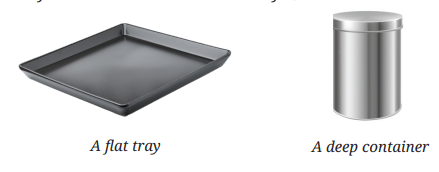
Two flat trays. 

 Two deep containers (different shapes). 


 Rice or small beans or sand. 

 Small cups (to be taken as measuring cups). 

(The teacher can try arranging one deep container with a base approximately the same as one of the trays.)


Procedure 

Step 1: Observation

 Show students the flat trays and deep containers (of different shapes). 

 Ask: 

Q: What do you notice about these things (trays and containers)?

ANSWER: The trays are flat and wide, while the containers are deep and can hold more things inside.

 Q: How are the trays different from the deep containers?

A: Trays are shallow and only have surface space, while deep containers have depth and can store more material.

Q: Which ones do you think will hold more rice/sand? Why?

A: The deep containers will hold more rice or sand because they have more depth and space inside.

Step 2 : Measuring Area

 Sprinkle a thin layer of rice or sand on the flat trays until the surface is fully covered. 

(The teacher needs to ensure that there is only one layer of the rice or sand on the trays.) 

 Use measuring cups to measure how much rice or sand each tray holds. 

 Ask:

Q: Did the rice or sand cover the entire tray?

A: Yes, the rice or sand covered the entire surface in a single, thin layer.

Q: Without changing the shape the rice or sand takes on the tray, would the tray be able to ‘hold’ more of it?(We cannot make a heap of rice or sand.) 

A: No, because a tray only has a flat surface and no depth, so it cannot hold more without spilling.

Q: How can we measure the space covered by the rice or sand?

A: We can measure the area by using square units (like cm²) to cover the surface.

Q: Can you think of other examples where we use area in daily life?(for example, carpets, tiles, painting walls)?

A: Yes — laying carpets, painting walls, tiling floors, covering tables, or making posters.


Step 3: Measuring Capacity (Volume)

Measuring Capacity 

 Fill the deep containers with rice or sand to the top. 

 Use measuring cups to measure how much rice or sand each container holds. 

 Ask: 

 Q: Why do the deep containers hold more rice or sand than the trays?

A: Because the containers have depth, which allows them to store more in the same surface area.

Q: What changed when we measured volume instead of area?
A: Instead of just covering the surface, we now measured the full space inside the container, including depth.

 Q: How many layers of rice or sand would we need to make the trays hold the same amount as the deep containers? Estimate.

A: It would take many thin layers (depending on the depth of the container), for example, if the container is 5 cm deep and the rice layer is 0.5 cm thick, it would take around 10 layers.

 Q: How is volume different from area?

A:

  • Area measures the flat surface space.

  • Volume measures the total space inside an object.

Step 4: 

Making Real-world Connections 

Discuss examples from real life: 

 Q: Why do water bottles and storage boxes have depth?

A: Because depth allows them to hold more water or items — volume is important for storage.

Q: Would a swimming pool be useful, if it only had area but no depth?

A: No, because without depth, it couldn’t hold water for swimming.

Q: Do architects and builders use volume when designing rooms and buildings? How?
A: Yes, they calculate volume to make sure there is enough space for air, furniture, and people inside a room.

Reflections 

 Summarise that area measures surface coverage, while volume measures the total space inside an object or a container. 

SUMMARY

Area measures the surface coverage of an object — it tells us how much flat space is covered, like when we lay a carpet or paint a wall.

Volume measures the total space inside an object or a container — it tells us how much material or liquid it can hold, like water in a bottle or rice in a jar.

In simple words:
👉 Area = Surface covered
👉 Volume = Space filled inside

 Encourage students to think about other objects, where area and volume play a role in real life. 

 Let students predict, which objects in the classroom have a large area but small volume and vice versa. 

 Let students predict situations, where Area is used and situations, where Volume is used. Participation of Special Children— 

Use lightweight containers and trays that are easy to handle. 

 If students have difficulty lifting or pouring, provide pre-measured cups of rice or sand so they can still participate. 

 Arrange the activity on lower tables or surfaces so all students, including those using wheelchairs, can comfortably access the materials.

Pair students so they can work together, allowing those with mobility challenges to observe, instruct and record findings, while their peers assist with pouring and measuring.

CONCLUSION:

  • Area is about measuring how much surface something covers (like the top of a tray or the floor for a carpet).

  • Volume is about measuring how much space an object can hold inside (like filling a bottle, a bucket, or a container).

  • Objects with the same area can have different volumes, and vice versa.
  • Area is used when covering something flat, like painting walls or laying tiles.
  •  Volume is used when filling something, like a water bottle, swimming pool, or a storage box.

When I sprinkled rice or sand on the flat tray, it only covered the surface — that is area. But when I filled the deep containers, they could hold much more rice because of their depth — that is volume.

Class 8 NCERT bridge course Answers Activity W 3.2 Let’s Brainstorm

 Activity W 3.2 Let’s Brainstorm 


 Students may be asked to solve the following puzzles either in groups or individually.

 They may explain their strategy of obtaining the result. 

Let’s Brainstorm 

Puzzle 1: Symbol Grid

1. The grid below has symbols that contain a whole number value less than 10. 

Each symbol has its own value. 

The numbers you see at the end of each row and column are the sums of the figures’ values for that row or column.


Can you find out the value of each symbol ? 

ANSWER:

Let’s name the shapes:

  • 🟦 Pentagon = P

  • 🔺 Triangle = T

  • ⭐ Star = S

  • ➕ Plus = C

And solve!

Row equations:1️⃣ 

1. P+T+P+S=15

2. C+S+P+S=23

3.T+C+T+?=16

4. S+T+?+P=14

Column equations:

1. P+C+T+S=20

2. T+S+C+T=24

3. P+P+T+?=7

4. S+S+?+P=17

SOLVE
From Row 3 and Column 3, the missing symbol must be the same in both — let’s call it X for now.

Let’s focus on easy rows:

Row 3:  T+C+T+X=16

Row 4:   S+T+X+P=14

Col 3:  P+P+T+X=7

Let’s assume X = 0 to test:

From Col 3:   𝑃+P+T=7

From Row 3:  T+C+T=16

So  2T+C=16.

From Col 1: P+C+T+S=20.

And from Row 1: 2P+T+S=15.

From Row 3:  2T+C=16

From Col 3:  2P+T=7

From Row 4: S+T+P=14 (since X=0)

Now solving this small system:

From (2)  2P+T=7 → T=7−2P

Substitute into (1):

2(7−2P)+C=16

14−4P+C=16

C=4P+2.

Now substitute into Col 1:

P+C+T+S=20.
Substitute 

C=4P+2 and 

T=7−2P:

P+(4P+2)+(7−2P)+S=20
Simplify:

P+4P+2+7−2P+S=20

3P+9+S=20

S=11−3P.

If  P=1: 

S=11−3(1)=8

T=7−2(1)=5

C=4(1)+2=6

Now check Row 2:

C+S+P+S=23

6+8+1+8=23 


SOLUTION:

  • 🟦 Pentagon P=1
  • 🔺 Triangle T= 5
  • ⭐ Star  S = 8
  • ➕ Plus C = 6

Puzzle 2: Symbol Equation

2. Here, you are given two representations, where symbols have been used. 

Each symbol represents a numeric value. Find the value of each symbol.


SOLUTION:

Given the equations:

    • 🟦 Blue Square = S

    • 🔺 Orange Triangle = T

    • 🟡 Yellow Circle = C

    • ⭐ Star = R

EQUATION 1:  S+S+S=15 --> 3S = 15 --> S = 5
EQUATION 2:  T+T+S=13 -->  2T + 5 = 13 --> 2T = 8 --> T = 4
EQUATION 3 : T+C+S=15 --> 4 + C + 5 = 15 --> C = 15 - 9=6
EQUATION 4: C+C+S=?
EQUATION 5: C + T + T = ?
EQUATION 6 : C + T = 8
EQUATION 7: C + T = 4
EQUATION 8 : R + S =12 --> R + 5 = 12 --> R = 12 -5 =7
EQUATION 9 : R + S = S
EQUATION 10 : S + S = R --> 2S = R

SOLUTION:

🟦 Blue Square (S)= 5
🔺 Orange Triangle (T) = 4
🟡 Yellow Circle (C) =6
⭐ Star (R)= 12 - 5 = 7
🟡 + 🟡 + 
🟦 = 6 + 6 + 5 = 17
🟡 + 🔺+ 🔺 = 6 + 4 + 4 = 14

Puzzle 3: Make 5+5+5 = 550 True

3. Make the following equation true by drawing/putting/writing a single line.


SOLUTION : 

 Just draw a slanted line on the first "+" to turn it into 4:


545 + 5 = 550! 


Puzzle 4:Roman Numeral Trick 

What should be added to IX to make six?

Add S in front of IX to form SIX.
So the answer is: Add ‘S’! 


Teachers may try to find some more such puzzles that will engage students in the process of exploration


Puzzle 1: Symbol Sums

SymbolMeaning
🍎 Apple = ?
🍌 Banana = ?
🍇 Grapes = ?

Equations:

  1. 🍎 + 🍎 + 🍎 = 18

  2. 🍌 + 🍎 + 🍌 = 16

  3. 🍇 + 🍇 + 🍎 = 20

Find the value of each fruit!

Solution:

  1. 🍎 + 🍎 + 🍎 = 18 → 🍎 = 6

  2. 🍌 + 6 + 🍌 = 16 → 2🍌 = 10 → 🍌 = 5

  3. 🍇 + 🍇 + 6 = 20 → 2🍇 = 14 → 🍇 = 7

Final Answer:
🍎 = 6, 🍌 = 5, 🍇 = 7.

Puzzle 2: Number Logic

SymbolMeaning
🐾 Paw = ?
🐟 Fish = ?
🦴 Bone = ?

Equations:

  1. 🐾 + 🐾 + 🐟 = 22

  2. 🐟 + 🦴 + 🦴 = 14

  3. 🐾 + 🦴 = 13

Find the value of 🐾, 🐟, 🦴.

Solution:

From (3):
🐾 + 🦴 = 13 → 🦴 = 13 - 🐾.

Substitute into (2):
🐟 + 2(13 - 🐾) = 14
Simplify and solve using substitution or trial.
For example:
If 🐾 = 8, 🦴 = 5.

Now check in (1):
8 + 8 + 🐟 = 22 → 🐟 = 6.

 So final values:
🐾 = 8, 🐟 = 6, 🦴 = 5.

Puzzle 3: Matchstick Equation

Make the equation correct by moving 1 matchstick:

6 + 4 = 9

Solution:
Move one stick from "6" to make it "5":

5 + 4 = 9

Class 8 NCERT bridge course Answers Activity W 3.1 Understanding Denseness of Fractions

 Activities for Week 3 

Activity W 3.1 Understanding Denseness of Fractions 

Objective:

To understand that there are endless fractions between any two given fractions.

Through this activity, students will get an idea about the denseness of fractions. 

That is, they will be able to know that they can find as many fractions as possible between any two fractions. 

This activity will also help to improve number sense and reasoning skills with fractions. 

Material Required 

Long rolls of paper strips 

 Scissors 

 NCERT Mathematical kits (if present in school) 

 Blank cards


Procedure

 Step 1 

Write two fractions, say, 1/4 and 1/2 on the board and the students may be asked to check, if there are fractions between them. 

Discuss that denseness of fractions means that there can be as many fractions as we want between the two fractions. 

Step 2: 

Hands-on Exploration 

 Take two copies of a paper strip


Ask the students to fold those strips in 2 equal halves. 


Take one of the strips and cut it into two equal parts with the help of scissors.  


Take one part and keep it on the other strip. 


 Take the remaining half and put it on the first half. 


 Continue this process until the students are unable to cut remaining part in to 2 equal parts


Discussion to Explore

1. What does this activity explain?

ANSWER:

This activity explains that fractions are dense — meaning, between any two fractions, no matter how close they are, there are always more fractions that can fit in between.

2. Can we divide these strips further more? If yes, then to what extent?

ANSWER:

 Yes, we can keep dividing the strip into smaller and smaller pieces endlessly — in theory, we can keep cutting the parts infinitely, because between any two fractions, there is always another fraction.

3. If half of a unit is 1/2, then what will be the half of 1/2?

ANSWER:

 Half of 1/2 is:

12÷2=14\frac{1}{2} \div 2 = \frac{1}{4}

 So, the half of 1/2 is 1/4.

4. Does 1/4 lie in between 0 and 1/2?

ANSWER:

 Yes!
1/4 is greater than 0 but less than 1/2, so it lies between 0 and 1/2 on the number line.

5. How many fractions can lie between 2 fractions?

ANSWER:

Infinite fractions can lie between any two fractions.
No matter how close two fractions are, there will always be more fractions between them.

6. Ask students, if they see gaps between their fractions.


ANSWER:

 Yes, students will observe gaps between fractions on the strip or number line, which shows there is always room for another fraction in between.

7. Challenge: “Is there another fraction that can go between these parts of strips?”


ANSWER:

 Yes! Always.


For example, between 1/4 and 1/2, you can find:


14+12÷2=38\frac{1}{4} + \frac{1}{2} \div 2 = \frac{3}{8}


And between 1/4 and 3/8, you can again find:


14+38÷2=516\frac{1}{4} + \frac{3}{8} \div 2 = \frac{5}{16}


And so on... endlessly!


Fractions are dense — there is always another fraction between any two fractions, no matter how small the gap looks.

 Extension 

Students may be motivated to observe and generalise the above processs to find a fraction between two fractions 

A simple formula to find a fraction between two given fractions:

New Fraction=Fraction 1+Fraction 22\text{New Fraction} = \frac{\text{Fraction 1} + \text{Fraction 2}}{2}

This gives a new fraction that lies exactly between the two.

You can also practice this on a number line or using the Math Kit for better understanding!


Conclusion:

Through this activity, I learned that fractions are dense. This means that between any two fractions, there are infinite fractions. No matter how close two fractions are, we can always find another fraction between them by using the formula:

New Fraction=Fraction 1+Fraction 22\text{New Fraction} = \frac{\text{Fraction 1} + \text{Fraction 2}}{2}

This activity helped me understand that fractions can be divided into smaller and smaller parts, and there is no end to the number of fractions that can exist between any two numbers. Using strips, number lines, or the Math Kit makes this concept easier and fun to learn!


Class 8 NCERT bridge course Answers Activity W2.6 Fraction Pizza Party

  Class 8 NCERT bridge course Answers Activity W2.6

Activity W2.6 Fraction Pizza Party


LO: Identify fractional parts of quantities. 

Fraction Pizza Party This activity will help students understand fractional quantities by creating and comparing pizza slices.

Material Required 

 Large paper circles (representing pizzas) 

 Coloured markers or crayons 

Scissors 

Multiple flashcards with fraction amounts 

(for example, 2 pieces of 1/2, 4 pieces of 1/4 and 6 pieces of 1/6)

 Procedure 

1. Divide students into small groups and give each group a paper pizza. 

2. Call 1 student from each group and ask them to choose 1 set of fractions. 

3. Ask them to cover pizza paper with the help of fractions one-by - one. 

4. No gap and no overlapping are allowed. 

5. Find out and note down “How many total slices are left’’ after putting each slice? 

6. Take ½ parts and combine them to form a whole. How many such parts do you see, are required?


1. Take the 1/8 parts and combine them to form a whole. How many 1/8 parts would be required to make a whole?

ANSWER:
To make one whole pizza using 1/8 parts:
1/8 + 1/8 + 1/8 + 1/8 + 1/8 + 1/8 + 1/8 + 1/8 = 8/8 = 1 whole.
So, 8 pieces of 1/8 are required to make a whole pizza.

One way to find this is:
 1/8 + 1/8 = 2/8 
2/8 + 1/8 = 3/8 
3/8 + 1/8 = 4/8
4/8 + 1/8 = 5/8, etc.

 Students may be encouraged to explore other ways, if possible. 

If you combine all the slices given to you, can you make a whole pizza again?

2. After placing the first 1/2 piece, how many pieces do you need to complete the whole pizza?
ANSWER:
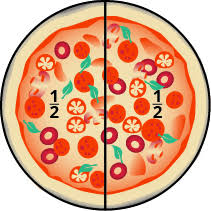
After placing 1 piece of 1/2, one more 1/2 piece is needed.
So, 1 more piece of 1/2 is required.


Will 1/2 + 1/2 pieces give a whole pizza?
ANSWER:
Yes!
1/2 + 1/2 = 1 whole pizza. 

3. After placing the first 1/3 piece, how many pieces do you need to complete the whole pizza?
ANSWER:
You need 2 more pieces of 1/3 to complete the pizza.

Was the remaining area covered by 2 pieces of 1/3?
ANSWER:
Yes! 1/3 + 1/3 = 2/3. Adding the first piece (1/3), all three together make:
1/3 + 1/3 + 1/3 = 3/3 = 1 whole pizza. 


Could 1/3 + 1/3 + 1/3 pieces complete the whole pizza? 
ANSWER:
Yes!

4. After placing the first 1/4 piece, how many pieces do you need to complete the whole pizza?
ANSWER:
You need 3 more pieces of 1/4 to complete the pizza.

Does the remaining area get covered by 3 pieces of 1/4?
ANSWER:


Yes! 3 pieces of 1/4 will cover the remaining area.

Does 1/4 + 1/4 pieces complete the whole pizza?
ANSWER:
No! 1/4 + 1/4 = 2/4 = 1/2, so it covers only half.

If not, then how many pieces are required?
ANSWER:
You need 4 pieces of 1/4 to make one whole pizza.

Does it mean that 1/4 + 1/4 is equal to half or 1/2?
ANSWER:
Yes!
1/4 + 1/4 = 2/4 = 1/2.

Can we say 1/4 + 1/4 + 1/4 = 3/4?


ANSWER:
Yes!
1/4 + 1/4 + 1/4 = 3/4.

Does 1/4 + 1/4 + 1/4 + 1/4 pieces complete the whole pizza?
ANSWER:
Yes!
1/4 + 1/4 + 1/4 + 1/4 = 4/4 = 1 whole pizza. 


Thursday, April 17, 2025

Class 8 NCERT bridge course Answers Activity W2.5

Class 8 NCERT bridge course Answers Activity W2.5


Students may be encouraged to fill in the blank spaces. The NEP 2020 encourages use of such games, which make children explore and connect different mathematical concepts.


Solution of this fun math puzzle step by step


Starting from the top-left and moving along the paths

x + 2 = 19

x = 19 - 2 =17


19 + x = 21

x = 21-19 =2


21+x = 24

x = 24 - 21 = 3


x - 4 = 8

x = 8 + 4 = 12


21 - 1 = 20

20 - 17 = 3

17 - 11 = 6


15 - 1 = 14

x + 3 = 15

x = 15 -3 = 12


x + 1 = 25

x = 25 -1 = 24


x - 5 = 18

x = 18 + 5 =23


6 + 7 = 13


8 + 6 =14


13 - 8 = 5

6 x 4 = 24


Wednesday, April 16, 2025

class 8 NCERT bridge course Answers Activity W2.4

 class 8 NCERT bridge course Answers Activity W2.4 

Teacher may encourage students to solve puzzles to make them explore different concepts of Mathematics learnt.

 The NEP 2020 encourages puzzles in the Mathematics curriculum. 

Some puzzles are given below. 


Puzzle 1 

 Think of a number. 

Add 5 to it. O

Multiply the result (got in step 2) by 3. 

Now subtract 15 from above. 

Now divide the last result by the original number. 

 Finally add 7 to the result. 


Puzzle 2 

 Think of a number between 20 to 99. 

 Add the digits of the number. 

Subtract the result from original number. 

 Again, add the digits of final number you get in step 3. 

Puzzle 3 

 Think of a number. 

Add 5. 

Double your result. 

 Add 40. 

 Divide by 2. 

 Subtract the number that you first thought. 

 Multiply by 4. 

Puzzle 4 

Find me: Who am I ? 

I am a 2-digit number. 

 The sum of my digits is 10.  I am greater than 8 but less than 30. 

 What number am I ? 

Puzzle 5

 Find me: Who am I ? 

I am a prime number. 

 The sum of my digits is 8. 

 I am greater than 10 but less than 50. 

 What number am I ? 

Puzzle 6 

Find me: Who am I ? 

 I am a square number.

 My first digit is 2. 

The sum of my digits is 10. 

 What number am I ? 

In all the above puzzles, teachers must discuss the logic behind the magical answers. 

Before explaining the logic related to the curricular concept of linear equations in one variable, students should be given a chance to express their observations and thought processes.

--------------------------------------------------------------------------------------------------------------

---------------------------------------------------------------------------------------------------------

🧠 Puzzle 1 — The Magic of Numbers

Let’s call the number you think of x.

  1. You add 5 → the number becomes x + 5.

  2. Then you multiply it by 3 → you get 3(x + 5) = 3x + 15.

  3. You subtract 15 → that takes you back to 3x.

  4. You divide this by your original number x3xx=3\frac{3x}{x} = 3 (it always becomes 3).

  5. Finally, you add 7 → 3 + 7 = 10.

👉 No matter which number you start with, the answer is always 10!
This is because the steps are designed to cancel out the variable, making the process predictable.

🔢 Puzzle 2 — The Digit Surprise

Pick any number from 20 to 99.

  1. Add the digits together.

  2. Subtract that sum from the original number.

  3. Add the digits of the new number.

👉 You’ll always end up with 9!
Why? Because the difference between any two-digit number and the sum of its digits is always a multiple of 9 — and adding the digits of a multiple of 9 always gives 9.

💯 Puzzle 3 — Hidden Equation

Let’s call the number you thought of x.

  1. You add 5.

  2. Double it.

  3. Add 40.

  4. Divide by 2.

  5. Subtract the original number.

After all these operations, you always get 25 at this step — then multiplying by 4 gives 100.

👉 Final answer is always 100!
This shows how algebra helps predict the outcome, no matter the chosen number.

🔍 Puzzle 4 — Guess the Number

Clues:

  • A two-digit number.

  • Sum of the digits is 10.

  • Greater than 8 but less than 30.

👉 When you list numbers from 10 to 29, only 19 has digits that sum to 10.

The answer is 19.

🧑‍🏫 Puzzle 5 — The Prime Detective

Clues:

  • Prime number.

  • Sum of digits is 8.

  • Between 10 and 50.

👉 The only prime number that fits is 17 (1 + 7 = 8).

The answer is 17.

🎯 Puzzle 6 — The Square Mystery

Clues:

  • Square number.

  • First digit is 2.

  • Sum of digits is 10.

👉 The only square number with first digit 2 is 25. But the sum of digits is 7, not 10 — so this looks like a small trick in the puzzle!
Most likely the intended answer is:

25.

💡 Teacher's Wrap-up:

These puzzles are a fun way to explore:

  • Patterns and algebra (Puzzles 1, 2, 3),

  • Logical deduction and number properties (Puzzles 4, 5, 6).

🧩 Puzzle 1 — The Magical 10

Answer: Always 10
Logic:
Let the number be x.
The steps simplify like this:

((x+5)×315)÷x+7=10((x + 5) \times 3 - 15) \div x + 7 = 10

No matter which number you start with, the operations cancel out the unknown, and the result is always 10.
👉 Concept Link: Introduction to forming and solving linear expressions.


🧩 Puzzle 2 — The Digit Game

Answer: Always 9
Logic:
For any number from 20 to 99:
Original number minus the sum of its digits always gives a multiple of 9.
The final step (adding the digits) will always give 9.
👉 Concept Link: Exploring number patterns, divisibility by 9.


🧩 Puzzle 3 — The Journey to 100

Answer: Always 100
Logic:
Let the number be x.
The calculation simplifies to:

(((x+5)×2+40)÷2x)×4=100(((x + 5) \times 2 + 40) \div 2 - x) \times 4 = 100

The equation shows the final result doesn't depend on x.
👉 Concept Link: Linear expressions and constant solutions.


🧩 Puzzle 4 — Who am I?

Answer: 19
Logic:
The clues:

  • Sum of digits = 10.

  • Greater than 8, less than 30.

Only 19 fits both conditions.
👉 Concept Link: Logical reasoning and digit sum practice.


🧩 Puzzle 5 — Who am I?

Answer: 17
Logic:
A prime number between 10 and 50 whose digits sum to 8 — only 17 fits.
👉 Concept Link: Prime numbers, digit sum, number properties.


🧩 Puzzle 6 — Who am I?

Answer: 25 (Even though the sum of digits is 7, not 10)
Logic:
The puzzle likely has a typo, as 25 is the only square number starting with 2 within the expected range.
👉 Concept Link: Square numbers, digit patterns, and identifying possible errors or mismatches.


🌟 Teacher's Note:

Before giving these explanations, ask students:

  • "What patterns did you notice?"

  • "Why do you think the answer is always the same?"

  • "Can you write this as an equation?"

T

Pages

CH - 2 THE BAUDHĀYANA- PYTHAGORAS THEOREM GANITA PRAKASH PART 2 FIGURE IT OUT QUESTIONS & ANSWERS

 CH - 2 THE BAUDHĀYANA-  PYTHAGORAS THEOREM  GANITA PRAKASH PART 2  FIGURE IT OUT QUESTIONS & ANSWERS 2.1 Doubling a Square Doubling a S...