Thursday, May 15, 2025

Class 8 NCERT bridge course Answers Activity W6.9 Number Puzzles and Pattern Talk

 Activity W 6.9  Number Puzzles and Pattern Talk

This activity develops number sense, understanding of multiples, special numbers, and pattern recognition.

Teacher may give these situations to students and ask them to discuss about them. 


1. Common Multiples Puzzle

1. In the diagram below, 

"Anant has erased all the numbers except the common multiples."


Find out what those numbers could be and fill in the missing numbers in the empty regions. 

Given common multiples: 72, 48, 24
We need to find two numbers whose common multiples include 72, 48, and 24.

Step 1: Find the LCM of 24, 48, and 72.
Since 72 is a multiple of 24 and 48, we know:

  • Possible pair: Multiples of 6 and Multiples of 8 


Answer:

  • Multiple of 6

  • Multiple of 8

  • Common Multiples: 24, 48, 72

  •  Students can verify this:

  • LCM(6,8) = 24

  • 48 and 72 are higher common multiples


2. Special Numbers in Each Box

There are some boxes with four numbers in each box given below. 

"Within each box, say how each number is special compared to the rest."

Let’s look at each set:

Box 1:

5, 7, 12, 35

  • 5 and 7 are primes

  • 12 is sum of 5 and 7

  • 35 is product of 5 and 7

Special: 12 (sum), 35 (product)

Box 2:

3, 8, 11, 24

  • 3 + 8 = 11

  • 3 × 8 = 24

Special: 11 (sum), 24 (product)

Box 3:

27, 3, 123, 31

  • 27 ÷ 3 = 9

  • 123 − 31 = 92

  • 41 x 3 = 123


Box 4:

17, 27, 44, 65

  • 17 + 27 = 44

  • 17 × 27 = 459

  • 44 + 21 = 65


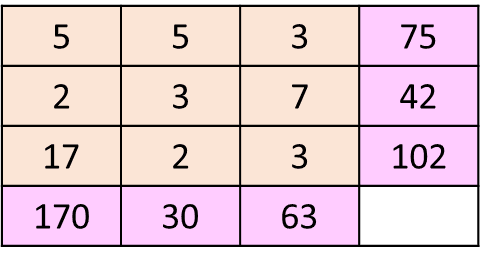
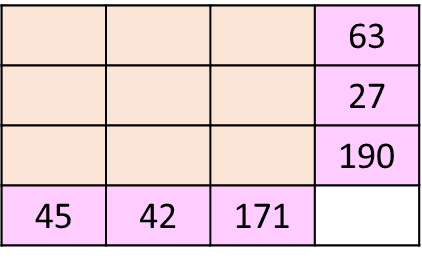
 3.  The figure on the left shows the puzzle. 

The figure on the right shows the solution of the puzzle. 

Think what the rules can be to solve the puzzle.

Rules

Fill the grid with prime numbers only, so that the product of each row is the number to the right of the row and the product of each column is the number below the column—


(a) Prime Factorization Table

From the solution table (right side), these values are:

We already see the factorization of the numbers in the rightmost column (75, 42, 102):

  • The 3 columns before 75/42/102 show the prime factors:

    • 75 → 5 × 5 × 3

    • 42 → 2 × 3 × 7

    • 102 → 17 × 2 × 3

    • 170 → 5 x 2 x 17

    • 30 → 5 x 3 x 2

    • 63 → 3 x 7 x 3

b)  

Solution

  • Row products:

    • 7 x 5 x 3 = 105 

    • 2 x 5 x 2 = 20

    • 2 x 5 x 3 = 30

  • Column products:

    • 7 x 2 x 2 = 28

    • 5 x 5 x 5 = 125

    • 3 x 2 x 3 = 18


Solution

Solution
Solution 


Class 8 NCERT bridge course Answers Activity W6.8 The Idli-Vada Number Game!

 Activity W 6.8: The Idli-Vada Number Game!

A fun and educational game blending math with movement and memory!

Game! Students may be asked to sit in a circle and play a game of numbers. 

Game Rules Recap:

  • Say numbers in order starting from 1.

  • Say "idli" instead of numbers that are multiples of 3.

  • Say "vada" instead of numbers that are multiples of 5.

  • Say "idli-vada" if the number is a multiple of both 3 and 5.

  • Mistakes = Out! The game continues until one student is left.

 One of the children starts by saying ‘1’. 

The second player says ‘2’, and so on. 

But when it is the turn of 3, 6,9, … (multiples of 3), the player should say ‘idli’ instead of the number.

 When it is the turn of 5, 10, … (multiples of 5), the player should say ‘vada’ instead of the number. 

When a number is both a multiple of 3 and a multiple of 5, the player should say ‘idli-vada’! 

If a player makes any mistake, they are out. 

The game continues in rounds till only one person remains. 

Teacher/Students may ask such questions for this game— 

1. For which numbers should players say “idli”instead of saying the number?

 All multiples of 3:
3, 6, 9, 12, 18, 21, 24, ..., etc.
 Exclude numbers also divisible by 5 (those are "idli-vada").

2. For which numbers should players say “vada”?

All multiples of 5:
5, 10, 20, 25, ..., etc.
Exclude numbers also divisible by 3.

3. What is the first number for which players say “idli-vada”?

15 (First common multiple of 3 and 5)
LCM(3, 5) = 15


4. At what number is “idli-vada” said for the 10th time?

 These occur at: 15, 30, 45, 60, 75, 90, 105, 120, 135, 150
 So, 150 is the 10th occurrence.

If the game is played for the numbers 1 to 90, 

Analysis for Numbers 1 to 90

  • Multiples of 3 from 1 to 90:
    ⟶ 3, 6, ..., 90 → Total = 30 numbers

  • Multiples of 5 from 1 to 90:
    ⟶ 5, 10, ..., 90 → Total = 18 numbers

  • Multiples of 15 (i.e. both 3 and 5):
    ⟶ 15, 30, ..., 90 → Total = 6 numbers

 So:

find out: 

How many times would the children say ‘idli’ (including the times they say ‘idli-vada’)? 

  • "idli" is said: 30 times (includes 6 “idli-vada”)
    ⟶ Only “idli” = 30 - 6 = 24

How many times would the children say ‘vada’ (including the times they say ‘idli-vada’)?

  • "vada" is said: 18 times (includes 6 “idli-vada”)
    ⟶ Only “vada” = 18 - 6 = 12

How many times would the children say ‘idli-vada’? 

  • "idli-vada" is said: 6 times

The teacher may ask students to play the game for the following pairs of numbers

— Idli Vada 

2 5 

3 7 

4 6 


Idli (A) Vada (B) First "idli-vada" Next few
2 5 10 20, 30, 40...
3 7 21 42, 63, 84...
4 6 12 24, 36, 48...


Class 8 NCERT bridge course Answers Activity W6.7 Math Logic Puzzle Challenge

Class 8 NCERT bridge course Answers Activity W6.7 Math Logic Puzzle Challenge

Students may be asked to solve the following puzzles. 

They may explain their logic of getting the solution

Supercell Swap Puzzle

 There is only one supercell (number greater than all its neighbours) in the following grid. If you exchange two digits from one of the numbers, there will be 4 supercells. Figure out which digits to swap.”

Answer:

Swap the digits 6 and 2 in 62,871 → it becomes 26,871.

Logic:

  • Initially, only 62,871 is a supercell (greater than all 8 neighbors).

  • After the swap, 62,871 becomes 26,871, which is no longer the greatest.

  • Now, four different cells become local maxima (supercells), satisfying the condition.

2. Students may be asked ‘How many rounds does your birth year take to reach the kaprekar constant?

2. Kaprekar Constant Puzzle

“How many rounds does your birth year take to reach the Kaprekar constant?”

Instructions for students:

  • Use your birth year (e.g., 1998).

  • Rearrange digits to make the largest and smallest possible 4-digit numbers.

  • Subtract the smaller from the larger.

  • Repeat until you reach 6174 (Kaprekar's constant).

Example (for 1998):

  1. 9981 − 1899 = 8082

  2. 8820 − 0288 = 8532

  3. 8532 − 2358 = 6174 
    Answer: 3 rounds


3. Students may be asked ‘Write one 5-digit number and two 3-digit numbers, such that their sum is 18,670.

3. Sum to 18,670

“Write one 5-digit number and two 3-digit numbers, such that their sum is 18,670.”

Answer Example:

  • 5-digit number: 15,432

  • 3-digit numbers: 1,765 and 1,473

Check:
15,432 + 1,765 + 1,473 = 18,670


Wednesday, May 14, 2025

Class 8 NCERT bridge course Answers Activity W6.6 Estimation Nation – Numbers All Around Us!

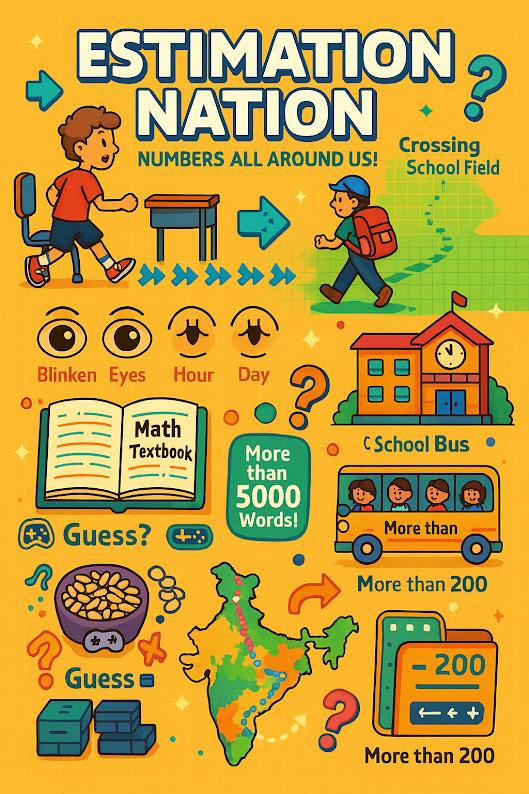
 Activity W 6.6 Estimation Nation – Numbers All Around Us!

 Students may be asked to do some simple estimates. 

It is a fun exercise, and they may find it amusing to know the various numbers around them.

 Remember, exact numbers are not required for the following questions. 

Students may share their methods of estimation with the class. 

 Steps you would take to walk— 

Steps Estimation

  1. From desk to classroom door → ~20 steps

  2. Across school ground → ~150 steps

  3. Classroom to school gate → ~300 steps

  4. School to home (walking) → ~3,000–5,000 steps (depends on distance)

 From the place you are sitting to the classroom door. 

Across the school ground from start to the end. 

 From your classroom door to the school gate. 

 From your school to your home.

Some other places may be also thought of. 

 Number of times you blink your eyes or the number of breaths you take— 

In a minute 

In an hour

 In a day 

Blinks and Breaths Estimation

  1. Blinks per minute → ~15–20

  2. Blinks per hour → ~900–1,200

  3. Blinks per day → ~15,000–20,000

  4. Breaths per minute → ~12–16

  5. Breaths per hour → ~720–960

  6. Breaths per day → ~17,000–24,000

 Name some objects around you that are— 

 A few thousand in number 

 More than ten thousand in number 

Object Estimation

  • A few thousand: grains of rice in a lunchbox, sand particles in a small cup, strands of hair on your head

  • More than 10,000: bricks in a school building, ants in an anthill, pages in a library

Try to guess within 30 seconds. Check your guess with your friends. 

 Number of words in your Maths textbook— 

a. More than 5000 

b. Less than 5000 

  • Words in your math textbook: More than 5,000 ✅

  • Students traveling by bus: More than 200 (depends on school size) ✅

Number of students in your school who travel to school by bus— 

a. More than 200

 b. Less than 200 


Travel Time Estimations (Walking)

  • To a nearby favorite place → 15–30 minutes

  • To a neighboring state’s capital → ~10–20 days (walking 30 km/day)

  • From Kanyakumari to Kashmir → ~2,500 km = ~80–90 days walking

Earlier, people used to walk long distances as they had no other means of transport. 

Suppose you walk at your normal pace. 

Approximately, how long would it take you to go from:

a. Your current location to one of your favourite places nearby. 

b. Your current location to any neighbouring state’s capital city. 

c. The southernmost point in India to the northernmost point in India. 

 Make some estimation questions and challenge your classmates.

Estimation Questions You Can Create

  • How many pencils in your classroom?

  • How many tiles on the floor?

  • How many liters of water used in your school each day?

Class 8 NCERT bridge course Answers Activity W6.5 Patterns in Time, Dates, and Numbers

 Activity W 6.5 Patterns in Time, Dates, and Numbers

Students may be engaged in discussing these puzzles. 

This will make them observe how mathematics is spread all around them.

Procedure 

1. Students may try and find out all possible times on a 12-hour clock of each of the type 4:44, 10:10, etc.

 Part 1: Clock Patterns (e.g., 4:44, 10:10)

Find all times where hour and minutes form a pattern:

Examples:

  • 1:11

  • 2:22

  • 3:33

  • 4:44

  • 5:55

  • 10:10

  • 12:21 (palindromic)

✅ These are fun to spot on digital clocks—repetition or mirror-like symmetry.

2. They may try to find some dates from the past that obey a certain pattern. 

Part 2: Patterned Dates

Manish has his birthday on 20/12/2012, where the digits ‘2’, ‘0’, ‘1’and ‘2’ repeat in that order. 3. 

It could also be, Meghana, has her birthday on 11/02/2011, where the digits read the same from left to right and from right to left. 

Examples of cool dates:

  • 20/12/2012 → digits: 2, 0, 1, 2 repeat

  • 11/02/2011 → palindromic date

  • 02/02/2020 → perfect palindrome

  • 22/11/2022 → repeating pairs

  • 01/01/1010 → alternating 0s and 1s

✅ Activity: Students can find birthdays or historical events with date patterns.

4. Some numbers may be given to the students. 

Part 3: Number Construction Puzzle

Given numbers:
40,000, 7,000, 300, 1,500, 12,000, 800

Example Target: 39,800

✅ Solution: 40,000 – 800 + 300 + 300

Try more:

  • 45,000 = 40,000 + 7,000 – 1,500 + 1,500

  • 5,900 = 7,000 – 1,500 + 300 + 100

  • 17,500 = 12,000 + 7,000 – 1,500

  • 21,400 = 12,000 + 7,000 + 1,500 + 900

✅ This encourages flexible arithmetic reasoning—use of both + and – with estimation.

They may be allowed to use both addition and subtraction to get the required number. 

For example, 40,000 7,000 300 1,500 12,000 800 


 Suppose the given numbers are— 

 To form a number 39800. 

We can write 39,800 = 40,000 – 800 + 300 + 300. 

Try for other numbers, such as 45000, 5900, 17500, 21400… 

 Teacher may change the set of given numbers and the required numbers. 

Students may try to do that.

Change the Number Set

Use different sets like:

  • [5000, 1200, 150, 8500, 30000]

  • [100, 200, 500, 1000, 2500]

  • [750, 1250, 2750, 3200, 4100]

This introduces new challenges and encourages deeper number sense.

Change the Target Numbers

Ask students to create or solve for:

  • Specific Targets: e.g., “Make 15,000 using 3 of these numbers.”

  • Mystery Challenges: e.g., “I used three numbers to get 29,250. Can you guess which?”

Student-Generated Challenges

Let students:

  • Choose a new number set.

  • Create their own target numbers.

  • Swap puzzles with classmates.

This boosts ownership and creative thinking.


Extension Ideas

  • Use a different set of numbers each time (e.g., multiples of 100 or 1,000).

  • Allow multiplication or division for advanced students.

  • Have students make "mystery numbers" that others must recreate.


Class 8 NCERT bridge course Answers Activity W6.4 Pretty Palindromic Patterns

 Activity W 6.4 Pretty Palindromic Patterns 

 Engaging students in these puzzles will make them more observant about numbers. 

Pretty Palindromic Patterns 


Procedure 

The numbers that can be read the same from left to right and from right to left are called palindromes or palindromic numbers. 

Part I: Forming Palindromes from Given Digits

Given digits: 3, 4, 5

Palindromes you can form:

  • 2-digit: 33, 44, 55

  • 3-digit: 343, 454, 353, 535, 445, 544, 333, 444, 555

  • 5-digit: 34543, 35453, 34343, 44444, etc.

 The game challenge:

  • ❗ Most palindromes formed → Winner

  • ❗ Longest palindrome formed → Winner

For example, 232, 444, 54645, etc. 

1. Students may be asked to write all palindromes using certain number of digits.

 For example, using the digits 3, 4, 5 we can form palindromes 343, 454, 34543, 333, etc. 

Students may form as many palindromes using the given digits. 

2. A game can be played, based on this. 

 The one who forms maximum number of palindromes using the given digits will be the winner. 

Or 

The one who forms the longest palindrome will be the winner, etc.

Procedure 

1. Students may write a 2-digit number and reverse the order of the digits. 

Add these two numbers. 

Part II: Reverse and Add Process

2. They may check whether the addition is a palindrome. 

If not, continue the process of reversing the digits and adding them. 

3. They may check, if they get a palindrome at some stage or not. 

For example, 

Example 1:

  • Start with: 36 → 36 + 63 = 99 

  •  Palindrome in 1 step

36 + 63 = 99 (a palindrome!) 

Example 2:

  • Start with: 39 → 39 + 93 = 132

  • 132 + 231 = 363 

  • Palindrome in 2 steps

39 + 93 = 132 (not a palindrome) 

132 + 231 = 363 (a Palindrome!) 

Example 3:

  • Start with: 89

    • 89 + 98 = 187

    • 187 + 781 = 968

    • 968 + 869 = 1837

    • 1837 + 7381 = 9218

    • 9218 + 8129 = 17347

    • 17347 + 74371 = 91718

    • 91718 + 81719 = 173437

    • 173437 + 734371 = 907808

    • 907808 + 808709 = 1716517 

    •  Palindrome (10 steps!)

4. Students may be asked to do this for different numbers. 

Students may explore and tell, for which numbers it took only one step, few steps or large number of steps. 

5. Students may explore whether reversing and adding numbers repeatedly, starting with a 2-digit number, always give a palindrome? 

Do All Numbers Reach a Palindrome?

  •  For 2-digit numbers, almost all lead to a palindrome within a few steps.

  • For some large numbers (like 196), it’s unknown if they ever reach a palindrome — this is an unsolved math mystery.

Observation: Most numbers do reach a palindrome, but some take many steps

III. Procedure

 tth th h t u 

Write the number in words: 

I am a 5-digit palindrome. 

 I am an odd number. 

 My ‘t’ digit is double of my ‘u’ digit. 

 My ‘h’ digit is double of my ‘t’ digit. 

 Who am I? _________________ 

Since it’s a palindrome, its structure is:

less
A B C B A (tthth = palindrome structure)

Let’s use:

  • A = 1 (odd)

  • u = 1 → t = 2 × 1 = 2

  • t = 2 → h = 2 × 2 = 4

So we have:

  • u = 1

  • t = 2

  • h = 4

Therefore, the number is:
→ A B C B A → 1 2 4 2 1 

Answer: 12421

 Teacher/students may create more such puzzles and give others to solve.

Palindromic Puzzles for Students

Puzzle 1:

I am a 3-digit palindrome.
I am less than 500.
My middle digit is the smallest possible odd number.
Who am I?
Answer: 101, 303, etc. (Middle digit = 1, smallest odd)

Puzzle 2:

I am a 4-digit palindrome.
The sum of my digits is 22.
My outer digits are the same and even.
What could I be?
Answer: 2662 (2 + 6 + 6 + 2 = 16), 4774, 6446 (check sums)

 Puzzle 3:

Form the longest 7-digit palindrome using only two digits: 2 and 5.
Answer: 2552552 or 2225222, etc.

 Puzzle 4:

Start with 65. Reverse and add.
Continue the process until you get a palindrome.
How many steps does it take?
65 + 56 = 121 ✅ 1 step only!

Puzzle 5:

I am a 5-digit palindrome.
The sum of all my digits is 25.
My digits include only 3 different digits.
What could I be?
Answer: 35853, 46964, etc.


Class 8 NCERT bridge course Answers Activity W6.3 Digit Sum Detectives — The Mystery of 14

 Activity W 6.3 Digit Sum Detectives — The Mystery of 14

Engaging students in these puzzles will make them more observant about numbers. 


Procedure 

1. Students may be given numbers of 3 or 4 digits. 

2. They may add the digits of the number to get a two-digit number. 

3. They may then find other numbers which will give the same sum. 

Example: 

Take the number 176. 1 + 7 + 6 = 14. 

The other number is 545 5 + 4 + 5 = 14. 

Find some more such numbers that give the sum of the digits as 14. 

Extension 

 There could be variations in the puzzle. 

For example, the sum could be a one- digit number, etc.

Find different 3- or 4-digit numbers whose digit sum = 14
Examples:

  • 176 → 1 + 7 + 6 = 14

  • 545 → 5 + 4 + 5 = 14

  • 905 → 9 + 0 + 5 = 14

  • 590 → 5 + 9 + 0 = 14

  • 410 → 4 + 1 + 9 = 14

  • 680 → 6 + 8 + 0 = 14

  • 275 → 2 + 7 + 5 = 14

  • 8006 → 8 + 0 + 0 + 6 = 14

Students can discover many such combinations.

Numbers of more number of digits can also be thought of.

 Students may try to find this. 

For the sum 14, we may ask the following— 


1. What is the smallest number whose digit sum is 14?
59 → 5 + 9 = 14 (Smallest 2-digit option)

2. What is the largest 5-digit number whose digit sum is 14?
99991 → 9 + 9 + 9 + 9 + 1 = 37 (Too big!)
 Try 98000 → 9 + 8 + 0 + 0 + 0 = 17
Let’s try 99950 → 9 + 9 + 9 + 5 + 0 = 32 → still high

Highest 5-digit with sum = 14 = 95000
→ 9 + 5 + 0 + 0 + 0 = 14


3. How big a number can you form with digit sum = 14?

 No limit to digits — you could do 1400000000000000 → 1 + 4 + many 0s = 5 — too small
 Try 9992 → 9 + 9 + 9 + 2 = 29 → too large
Try numbers like 9990000000000000000005 where total digit sum = 14
→ So yes, very large numbers are possible

4. Can you make an even bigger number?
 Yes! Just keep adding zeroes after a number with digit sum 14.


Students may think and discuss about such different digit sums. 

 Find out the digit sums of all the numbers from 40 to 70. 

NumberDigit Sum
404
415
426
437
......
5914
606
617
......
707
 You’ll notice that the digit sum increases until 59, then drops again at 60 (6+0=6), creating a V-shape pattern.

Calculate the digit sums of 3-digit numbers, whose digits are consecutive 

(for example, 345). 

Do you see a pattern? Will this pattern continue?

Digit Sums of 3-digit Numbers with Consecutive Digits (e.g., 345):

  • 123 → 1 + 2 + 3 = 6

  • 234 → 2 + 3 + 4 = 9

  • 345 → 3 + 4 + 5 = 12

  • 456 → 4 + 5 + 6 = 15

  • 567 → 5 + 6 + 7 = 18

Pattern: Increases by 3 as digits increase
Linear increase pattern


Class 8 NCERT bridge course Answers Activity W6.2 What Makes a Super Cell?" — A Logical Number Puzzle

  Activity W 6.2 
What Makes a Super Cell?" — A Logical Number Puzzle

Understanding the Activity


Students are shown a table of numbers. Some of the numbers are colored, and students must reason out why.

We define the colored cells as super cells — but the rule behind why they're super cells is hidden. Students must infer the logic.

Students may observe and discuss the reason, behind these activities. 

Procedure 

 Students may be asked to observe the numbers written in the table below. 

 They may tell, why some numbers are coloured. Discuss.


Possible Rule Behind Super Cells:

  • Prime numbers

  • Palindromes (e.g. 626)

  • Numbers divisible by 3 or 7

  • Numbers with repeated digits

  • Numbers where the sum of digits equals 10

  • Even numbers above 500

Encourage students to come up with creative or patterned rules, then challenge peers to figure them out.

Let us call the cells that are coloured as super cells. 

Students may be asked to create their own tables and ask the other students to reason it out. 

They may be allowed to use some other variations in this puzzle, as well.

Extension 

Students may create their own tables and ask their friends to colour or mark super cells in it. 

For example 


6828 670 9435 3780 3708 7308 8000 5583 52 

 Students may discuss on the following: 

 Fill the table below such that we get as many super cells as possible. 

Fill a table with as many super cells as possible (100–999, no repeats).

→ Use a clear rule like “multiples of 11” or “numbers ending in 7.” Example:


121 132 143 154 165 176 187 198

Here, all could be super cells based on a consistent rule.

Use numbers between 100 and 1000 without any repetition. 


 Can you fill a supercell table, without repeating numbers, such that there are no supercells? Why or why not? 

Yes, you can fill a supercell table without repeating numbers such that there are no supercellsbut only if the numbers you choose do not satisfy the supercell rule.

Explanation:

A supercell is defined by a hidden rule (like being prime, a multiple of 5, a palindrome, etc.). If you intentionally choose numbers that do not satisfy the rule, then there will be no supercells.

Example:

Suppose the rule is:
"A supercell is any number that is divisible by 3."

Now fill your table with numbers between 100 and 999 that are not divisible by 3:

101 103 104 106  

107 110 112 113 115 118 121 122 124 127 128 131
  • No numbers here are divisible by 3.

  • Therefore, no supercells appear, and the rule is preserved.

  •  No numbers are repeated.

Why This Is Possible:

Because the supercell status depends entirely on the rule, you can avoid it by carefully choosing numbers that break the rule.


 Yes, it is possible — if you know or guess the rule and avoid it intentionally.


2. Can you fill a table with no super cells?

Yes — if you choose a rule that no number in the table meets.
Example: Rule = “Palindromes only”, but you don’t include any palindromes (e.g., no 121, 131, etc.)


 Will the cell with the largest number always be a super cell?

No — only if your rule involves being "the largest" or exceeding a threshold.


Can the smallest number be a super cell? Why or why not?

 Yes — if it fits the rule. For instance, if 109 is prime or has a digit sum of 10, it could be a super cell.


Fill a table where the 2nd largest number is not a super cell.

 Yes — make sure the rule excludes it.
E.g., if the rule is “even numbers,” and the 2nd largest number is odd.

 Fill a table such that the cell having the second largest number is not a supercell but the second smallest number is a supercell. Is it possible?


Yes, it is possible to fill a table such that:

  • The second largest number is not a supercell, and

  • The second smallest number is a supercell.

How This Works:

Whether a number is a supercell depends on a specific rule, such as:

  • Is it a prime number?

  • Is it divisible by 5?

  • Is the sum of digits equal to 10?

  • Is it a palindrome?

You can select numbers carefully so that:

  • The second largest number does not satisfy the rule (so it's not a supercell),

  • The second smallest number does satisfy the rule (so it is a supercell).

Example Table (Rule: Supercell = Number is a Prime Number)


[127, 118, 199, 305] [109, 134, 211, 187] [149, 203, 101, 299] [97, 223, 158, 293]
  • Sorted values: 97, 101, 109, 118, 127, 134, 149, 158, 187, 199, 203, 211, 223, 293, 299, 305

  • Second smallest = 101 →  Prime → Supercell

  • Second largest = 299 →  Not Prime → Not a Supercell

So this satisfies the condition.

Yes, it's entirely possible. You just need to:

  • Choose a supercell rule,

  • Ensure the second smallest value fits the rule, and

  • Ensure the second largest value doesn’t.

Can the 2nd largest number not be a super cell but the 2nd smallest number is?

Yes — just choose numbers accordingly and apply a rule that includes one and excludes the other.


Class 8 NCERT bridge course Answers Activity W6.1 Discovering Patterns Through Arrangements

 Activities for Week 6

Activity W 6.1

Discovering Patterns Through Arrangements 


Students may be encouraged to perform these activities. 

They may observe the patterns and explain about it. 

Objective:
To help students recognize and analyze patterns using real-life variables such as height, weight, or other attributes, and connect them to numbers through reasoning and logic.

Procedure 

1. Look at this picture. You can see that some children are standing in a line in a park. Each one is saying a number. 

2. Ask the students to tell what these numbers might mean. 

3. Does it have something to do with their heights? 

Students should discuss and try to find out as to how it could be related to their heights. 

4. The children then re-arrange themselves again and each of them says a number based on the new arrangement.

Students may be motivated to think and try to answer the following questions with their reasoning.


Q1: Can the children re-arrange themselves so that the children standing at the ends say ‘2’?
ANSWER:
 Yes
, if there are 5 children, and “2” represents the number of children shorter than that person, then placing a middle-height child (3rd tallest) at both ends would give both ends the value “2”.

  • Example: Heights in order → 1, 2, 3, 4, 5

  • Arrangement: [3, 1, 5, 2, 4] → First and last are "3rd tallest", so 2 kids shorter than them.


Q2: Can we arrange the children in a line so that all say only 0’s?

ANSWER:

 Yes, if “0” means there are 0 children shorter than me (i.e., I am the shortest), then all children would need to be the same height.
But since it’s said they’re all of different heights:
 No, unless 0 represents something else like distance from a reference point, which isn’t the case here.


Q3: Can two children standing next to each other say the same number?
ANSWER:

 Yes, if the numbers represent how many children are shorter than them, or relative position, it’s possible that two children of different heights can still have the same number if others in the group are taller or shorter equally.


Q4: There are 5 children in a group, all of different heights. Can they stand such that four of them say ‘1’ and the last one says ‘0’?  Why or why not? 
ANSWER:

 No, this is not possible if the numbers represent unique rankings or counts of shorter children.
Only one child can be the shortest (say ‘0’), and only two children can have exactly one shorter child below them. So four saying ‘1’ cannot happen logically.


 For this group of 5 children, is the sequence 1, 1, 1, 1, 1 possible? 

Q5: For this group of 5 children, is the sequence 1, 1, 1, 1, 1 possible?
ANSWER: 

 No, again, this is not possible if the numbers represent unique rankings. You can’t have 5 children each with exactly one person shorter than them—it violates basic order.

Q6: Is the sequence 0, 1, 2, 1, 0 possible? Why or why not?

ANSWER: 

 Yes, this is possible if the numbers represent distance from the tallest child in the center.

  • This pattern is symmetric: the middle child is tallest, others decrease outwardly.

  • Think of it as:

    • Child 1: shortest → 0

    • Child 2: a bit taller → 1

    • Child 3: tallest → 2

    • Child 4: a bit taller than 1 → 1

    • Child 5: shortest → 0

 How would you re-arrange the five children, so that the maximum number of children say ‘2’?

Q7: How would you re-arrange the five children so that the maximum number of children say ‘2’?
ANSWER:

If the number "2" represents number of children shorter than me, then the middle child in height (3rd tallest) would have two people shorter than them.
To maximize the number of children saying '2', we need as many children as possible to have exactly two children shorter than them.

Best possible:

  • Heights (in increasing order): A, B, C, D, E

  • Arrangement: [C, B, D, A, E]

  • Those with value "2" = C, B, D (middle 3 children)

 Maximum of 3 children can say ‘2’. More than that is not possible with unique heights.

 Extension 

 Based on their weights or some other features, students may draw diagrams associating them with the numbers. 

They may present them to other students and ask them to guess it 

Pages

CH - 2 THE BAUDHĀYANA- PYTHAGORAS THEOREM GANITA PRAKASH PART 2 FIGURE IT OUT QUESTIONS & ANSWERS

 CH - 2 THE BAUDHĀYANA-  PYTHAGORAS THEOREM  GANITA PRAKASH PART 2  FIGURE IT OUT QUESTIONS & ANSWERS 2.1 Doubling a Square Doubling a S...