🧠 BRAIN-TEASER 07
Mangoes, Peculiar Numbers & Sequences
📐 Step-by-Step Explanation (Working Backwards)
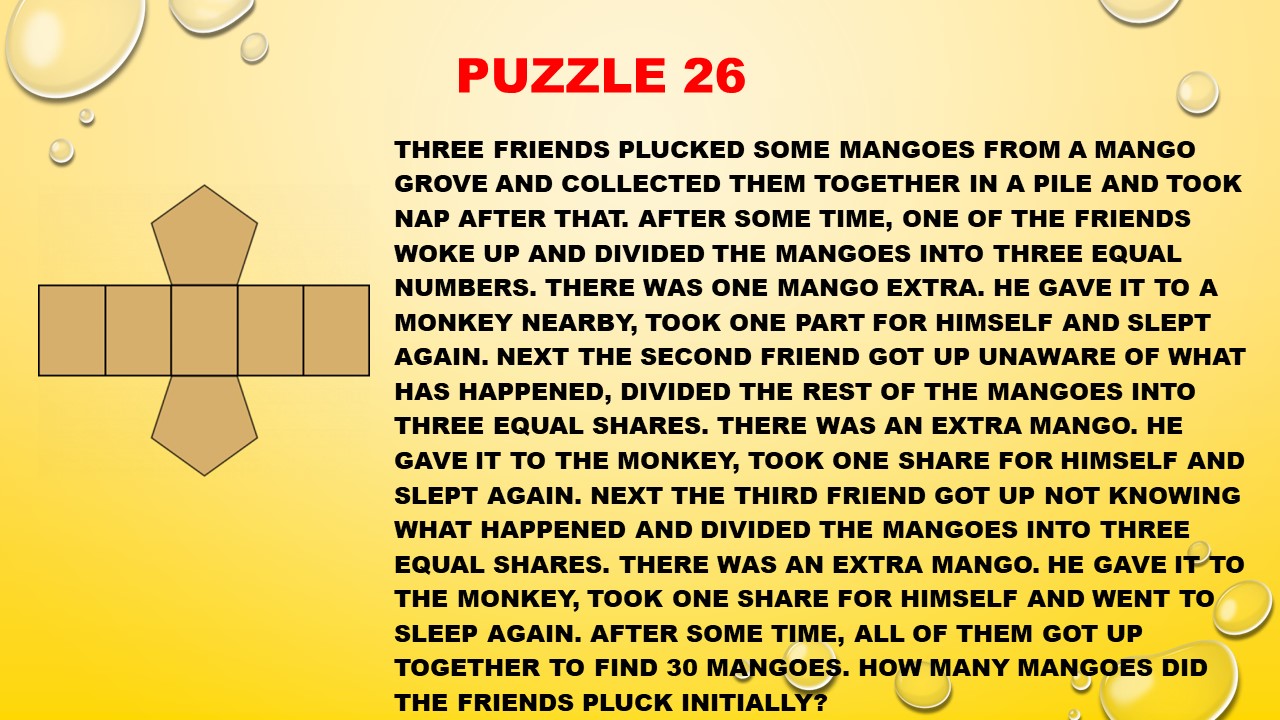
Step 1 (Third friend's division):
Before the third friend took his share, there were N₃ mangoes.
He divided into 3 equal parts with 1 extra to monkey → N₃ = 3x + 1, and he took x mangoes.
Remaining = 2x = 30 → x = 15 → N₃ = 3×15 + 1 = 46 mangoes.
Step 2 (Second friend's division):
Before second friend, N₂ mangoes. He gave 1 to monkey, took one share, left 46.
N₂ = 3y + 1, and remaining = 2y = 46 → y = 23 → N₂ = 3×23 + 1 = 70 mangoes.
Step 3 (First friend's division):
Before first friend, N₁ mangoes (initial). He gave 1 to monkey, took one share, left 70.
N₁ = 3z + 1, and remaining = 2z = 70 → z = 35 → N₁ = 3×35 + 1 = 106 mangoes.
✅ Initial mangoes = 106. This is a classic "working backwards" problem that teaches reverse thinking!

🔢 The Peculiar Number
Problem: There is a number which is three times the sum of its digits. Can you find the number?
Let the number be 10a + b (two-digit number, as single-digit won't work).
Condition: 10a + b = 3(a + b)
10a + b = 3a + 3b → 10a - 3a = 3b - b → 7a = 2b → b = (7/2)a
Since a and b are digits (1-9 and 0-9), a must be even. Try a=2 → b=7 → Number=27.
Check: 2+7=9, 3×9=27 ✓. a=4 → b=14 invalid. So only 27 works.
💡 This is a fun digit puzzle that uses simple algebra!


🌱 Ten Saplings Planting Puzzle
Problem: Ten saplings are to be planted in straight lines such that each line has exactly four saplings. Find an arrangement.
A pentagram has 5 points and 5 inner intersection points (total 10 points). Each line of the star contains 4 saplings (2 outer vertices and 2 inner intersections).
This classic puzzle demonstrates that geometry can solve seemingly impossible arrangement problems!


📊 Number Sequences
Problem: Find the next number in each sequence:
(b) 2, 7, 12, 17, 22, ... → 27 (add 5 each time)
(c) 2, 6, 12, 20, 30, ... → 42 (n×(n+1): 1×2=2, 2×3=6, 3×4=12, 4×5=20, 5×6=30, 6×7=42)
(d) 1, 2, 3, 5, 8, 13, ... → 21 (Fibonacci: each term is sum of previous two)
(e) 1, 3, 6, 10, 15, ... → 21 (triangular numbers: n(n+1)/2: 1, 3, 6, 10, 15, 21)


🔄 Digit Reversal Pairs
Problem: Observe: 31 × 39 = 13 × 93. Both sides have reversed digits. Find more such pairs where numbers are co-prime.
• 12 × 42 = 21 × 24
• 24 × 84 = 42 × 48
• 13 × 93 = 31 × 39
💡 These are called "reversible multiplication pairs" and work because of the property: (10a+b) × (10c+d) = (10b+a) × (10d+c) when certain conditions hold.


🌟 Why These Puzzles Matter 🌟
• The mangoes puzzle teaches working backwards — a powerful problem-solving strategy.
• The peculiar number connects algebra with digit properties.
• The saplings puzzle shows geometry can solve arrangement problems.
• Number sequences build pattern recognition essential for higher math.
• Reversal pairs reveal surprising symmetries in multiplication.
Every puzzle builds a stronger, more flexible mind. Keep going!
📘 WATCH IT ON FLIPBOOK
🔗 CLICK HERE FOR INTERACTIVE FLIPBOOKAll the best!
Thank You 🙏🏻
