Thursday, August 10, 2023

Class 08 Activity – Area of Trapezium

 Class 08 Activity – Area of Trapezium

Objective: 

To verify the formula for area of a trapezium. Or to verify the following formula Area of a trapezium = 1/2 sum of the parallel sides x distance between them.

Materials Required: 

Squared paper, a pair of scissors, colour pencils, geometry box, etc.

Procedure: 

1. On a squared paper, draw a trapezium ABCD in which AB || CD and AB = 8 cm, CD = 4 cm and distance between them is 5 cm. 

Using a pair of scissors, cut it out. Colour it green. 

2. On another squared sheet draw one more copy of the parallelogram ABCD. Cut it out and colour it red.

3. Take a white sheet of paper and paste the green coloured trapezium ABCD on it. Paste the red coloured trapezium ABCD next to the green coloured trapezium such that A falls at D and AD falls along DA as shown below.


Observations:

In figure, we observe that the resulting shape is a parallelogram as its one pair of opposite sides is parallel and equal, each equal to (8 + 4) cm.

2. The parallelogram in figure is made up of two congruent trapeziums ABCD.


So, area of trapezium ABCD 

= 1/2 x area of parallelogram in figure 

= 1/2x base x height

= 1/2 x (8 + 4) x 5 cm

= 1/2 x sum of parallel sides x distance between them.

Conclusion: 

From the above activity, it is verified that:

Area of a trapezium = 1/2 x sum of parallel sides x distance between them.

Do Yourself: Verify the formula for area of a trapezium by drawing three different trapeziums on squared papers.


Class 08 Activity – Volumes and Surface Areas

 Based on CHAPTERs 10. Visualizing Solid shapes 11. Mensuration 5. Data Handling 15. Introduction to Graphs

Class 08 Activity – Volumes and Surface Areas


Objective: 

To explore the relationship between
(i)  length (in cm ) and perimeter (in cm)
(ii) length (in cm) and area (in cm²) 
Of 5 squares of different dimensions drawn on a squared paper.

Materials Required:  

Squared paper, colour pencils, geometry box,  etc.

Procedure 

On a squared paper, draw five squares of different dimensions. Name these squares as1 2 3 4 5. 


Now, measure the perimeter of each square. Also, count the number of small squares (the area of each small square being 1 cm²) enclosed by each square to get their areas. 
Complete the following table.


Observations:

 From the table, we observe that:
Perimeter of a square is four times its length. Or side of a square is one fourth of its perimeter. 
So, for а square,  "Perimeter" /"Length" =4. 


2. Area of a square of length l is l x l = l ². Or side of a square of area A square units is √A units.
 So, for a square, "Area" /"Length" = Length
Conclusion: 
From the above activity, we observe that for a square of length l :
Perimeter = 4 x l 
2. Area = l x l = l ² 
Do Yourself: On a squared paper, draw four different squares and explore the relationship between:
1. length and perimeter
2. length and area.

Class 08 Activity – Visualizing Solid Shapes

 Class 08 Activity – Visualizing Solid Shapes

Objective:

 To verify Euler's formula for different polyhedral : Prism, Pyramid and Octahedron.

Materials Required: 

Chart papers, pencil, a pair of scissors, tape, scale, gum etc.

Procedure:1. 

Draw/ prepare the following nets (as shown in the figures 1 (a), 2 (a), 3 (a), 8 (a) on chart paper.

2. Cut out these nets.


3. Fold the above nets along the line and join them by gum or tape.

4. Obtain the different models of Right Prisms and Right Pyramids.

Fig. 1 (a), shows the net of a Right Triangular Prism.

Bases are congruent equilateral triangles and the lateral faces are congruent rectangles.

Fig. 2 (a), shows the net of a Right Rectangular Prism. The base and top of one prism are congruent squares and the lateral faces are congruent rectangles.


Fig. 3 (a), shows the net of a Right Pentagonal Prism.

Bases are congruent regular pentagons and the lateral faces are congruent rectangles [Breadth of rectangle = side of regular pentagon]

Fig. 4 (a), shows the net of a Right Hexagonal Prism.

The bases are congruent hexagon and the lateral faces are congruent rectangles [breadth of rectangle = side of regular hexagon]


Fig. 5 (a), shows the net of a Triangular Pyramid. 

Base is an equilateral triangle and the lateral faces are conguent isosceles triangle with base equal to the side of the equilateral triangle.

Fig. 6 (a), shows the nets of a Rectangular Pyramid.

The base is a square and the lateral faces are congruent isosceles triangles with base equal to the side of square.


Fig. 7 (a), shows the net of a Pentagonal Pyramid.

The base is a regular pentagon and the lateral faces are congruent isosceles triangles with base equal to the side of the pentagon.

Observations:

Draw the following observation table and complete with the help of the models of polyhedra obtained. 


Fig. 8 (a), show the net of a Hexagonal Pyramid. 

The base is a regular hexagon and the lateral faces are congruent isosceles triangles with base equal to the side of hexagon.


Conclusion:

Students will find that in each case of the relation F-E + V has value 2.Hence, the Euler's formula F + V-E = 2 is verified.

2. In a prism the number of faces = n + 2, number of edges = 3n, number of vertices = 2n.

3. In a pyramid, the number of faces = n + 1, number of edges = 2n, number of vertices = n +1.


Class 08 Activity – Comparing Quantities

 Class 08 Activity – Comparing Quantities

Objective: 

To compare the interests earned on Saving Bank Accounts applying simple interest and compound interest methods, respectively.

Materials Required: Paper, pencil, envelopes and play money.

Procedure: 

Divide the students into four groups. 

Give each group an envelope with Rs 100 play money in it, as the initial deposit money. 

Each group will have the same depositing pattern, however, two groups will have simple interest account and the other two will have compound interest account.

 Students will calculate the interests over five deposit cycles.

 The rate of interest for the four groups can be taken as below: 

Group I: Simple interest of 20 % per cycle 

Group II: Compound interest of 20 % per cycle

Group III: Simple interest of 40 % per cycle 

Group  IV: Compound interest of 40 % per cycle

After every cycle, each group will receive its next deposit and its interest.

The simple interest groups will keep aside the interests received after each cycle. They will add the initial deposit and the total balance obtained after fifth cycle to get the gross total amount. 

While the compound interest groups will deposit the total amount received in the next cycle and therefore, will get the gross total automatically after the fifth cycle. 

Now each group will fill the following tables. 

Group I (Simple Interest of 20 %)

Group II (Compund Interest of 20 %)

Group III (Simple Interest of 40 %)

Group IV (Compound Interest of 40 %)


After the completion of five cycles, the pair of group with 20 % rate of interest will fill the table given below to compare the gross amount earned by the rate of simple interest and rate of compound interest. 


Similarly, the pair of group with 40% rate of interest will fill the table given below.


Now based on the above table, ask the students the type of Saving Bank Accounts they should be opening


Class 08 Activity – Comparing Quantities

 Class 08 Activity – Comparing Quantities

Objective:

 To find out prices of different items after discount and tax. 

Materials Required: 

Rate list of different stores, paper money and pencil.

Procedure: 

Divide the class into four groups. Give each group rate list of different stores. 

Remember that there must be some items in every rate list that has discount. 

Give paper money of Rs 500 to each group. 

They have to purchase 5-10 items present on the list with the help of this money. 

They are free to choose items from the rate list of any store. 

They are free to choose items from the rate list of any store. 
They should be recording their purchases in the table below. 
The group that will buy maximum number of items with minimum amount of money will be the winner.


Class 08 Activity – Understanding Quadrilaterals

 Class 08 Activity – Understanding Quadrilaterals

Objective:

 To make the following by paper folding and cutting.(a) Kite (b) Rhombus

Materials Required:

 White sheets of paper, a pair of scissors, glue stick, geometry box, etc.

Procedure: 

(a) To make a kite

1. Take a white sheet of paper and fold it once from the middle as shown below.


2. Draw two line segments AB and BC of different lengths as shown.


3. Cut along the line a segments AB and BC and unfold the cut –out . Draw a dotted line along the  fold and mark the two other vertices as C and D.


(b) To make a rhombus

Take a sheet of paper and fold it from the middle as shown below. 


2. Draw two line segments AB and BC such that AB = BC as shown.
3. Cut along the line segments AB and BC and and unfold the cut out. Draw a dotted line along the fold and mark the two other vertices as C and D.

Observations:

On measuring the sides AB, BC, CD and DA in figure 3, we find that AB = AD and BC = DC.

Hence, ABCD in figure 3 is a kite.

2. On measuring the sides AB, BC, CD and AD in figure, we find that AB = BC = CD = AD.

Hence, ABCD  in figure 6 is a rhombus.

Class 08 Activity – Understanding Quadrilaterals2

 Class 08 Activity – Understanding Quadrilaterals2

Objective: 

To verify that the sum of the measures of the exterior angles of any polygon is 360 ° by paper cutting and pasting.

Materials Requried : 

White sheets of paper, colour pencils, a pair of scissors, glue stick, geometry box, etc.

Procedure: 

(a) Triangle

On a white sheet of paper, draw a triangle ABC and produce its each side in order as shown below. Shade the exterior angles so formed using different colours.


2. Using a pair of scissors, cut out the shaded angular regions.


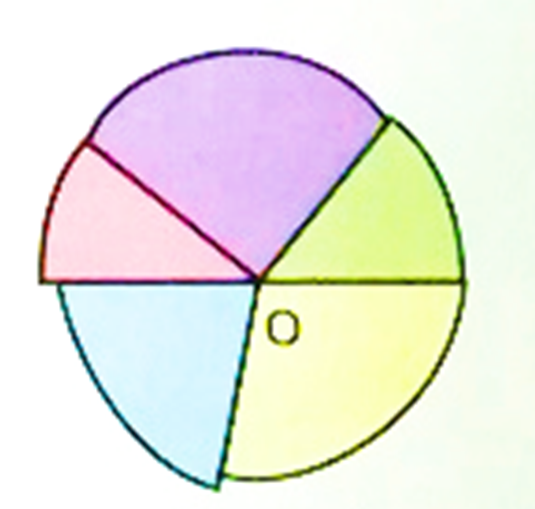
3. Mark a point O on a white sheet of paper. Paste the three cut-outs such that the vertices of these angles coincide at O, as shown below.
While pasting these cut outs, it should be noted that no two cuts should overlap and there should not be any gap between them.

(b) Quadrilateral

1. On a white sheet of paper, draw a quadrilateral ABCD and produce its sides in order as shown below. Shade the exterior angles so formed using different colours.


2. Using a pair of scissors, cut out the four shaded angular regions.
3. Mark a point on a white sheet of paper. Paste the four cut-outs such that the vertices of these angles (A, B, C, D,) coincide at O, as shown.

(c) Pentagon

On a white sheet of paper, draw a five sided polygon (pentagon) ABCDE and produce its sides in order. Shade of the exterior angles so formed using different colours. 
2. Using a pair of scissors, cut out the five shaded angular regions.
3. Mark a point O on a white sheet of paper. Paste the five cut-outs such that the vertices of these angles (A, B, C, D, E) coincide at O as shown.


(d) Hexagon

On a white sheet of paper, draw a 6 sided polygon (hexagon) ABCDEF and produce its sides in order. Shade the exterior angles so formed using different colours. 


2. Using a pair of scissors, cut out the six shaded angular regions.
3. Mark a point O of white sheet of paper.  Paste the six cut outs such that the vertices of these angles (A , B, C , D, E, F) coincide at O as shown in the fig.

Observations:

In figure, the three angular cut-outs together form a complete angle.
Thus, sum of the exterior angles of a triangle (3 sided polygon) is 360 °.
2. In figure, the four angular cut-outs together form a complete angle.
So, we can say that the sum of the exterior angles of a quadrilateral (four sided polygon) is 360°.
3. In figure, the five angular cut-outs together form a complete angle.
So, we can say that the sum of the exterior angles of a pentagon (5 sided polygon) is 360°.
4. In figure, the six angular cut-outs together form a complete angle.
So, we can say that the sum of the exterior angles of a hexagon (6 sided polygon) is 360°.

Conclusion: 

From the above activity, it is verified that the sum of the exterior angles of a polygon is 360°


Class 08 Activity – Understanding Quadrilaterals

 Based on CHAPTERs 8. Comparing Quantities 13. Direct and Inverse Proportions 3. Understanding Quadrilaterals 4. Practical Geometry

Activity – Understanding Quadrilaterals

Objective: 

To verify that the sum of the interior angles of a quadrilateral is 360 ° by paper cutting and pasting.

Materials Requried:

 White sheets of paper, colour pencils, a pair of scissors, gluestick, geometrybox, etc.

Procedure:

1. On a white sheet of paper, draw a quadrilateral ABCD. Colour its angles as shown. 
2. Using a pair of scissors, cut out the angular regions as shown below.
3. Mark a point 0 on a sheet of paper. Paste the four angular cut-outs so that the vertex of each falls at O, as shown in the figure.


Observations: 

In figure, we see that the angular cut-outs neither overlap nor leave any gap between them, i.e., the angles together form a complete angle.
∠A + ∠ B + ∠ C + ∠ D = a complete angle = 360 °
or sum of the angles of a quadrilateral is 360 °


Conclusion:

 From the above activity, it is verified that the sum of the interior angles of a quadrilateral is 360 °

Do Yourself: 

On a white sheet of paper, draw three different quadrilaterals. 
In each case, verify the angle sum property of a quadrilateral by paper cutting and pasting.


Class 08 MAZE

 Class 08 MAZE


A maze is a tour puzzle in the form of a complex branching path through which the person must find a route. 

Begin with the square marked ' start' and follow the pattern 2, 3, 4, 2, 3, 4 etc., until you get to the ' Finish'. You can only go onto a square once. 

You cannot go diagonally.


Look at the following maze. This maze has doors with operations written on them.
Start from any number and go through the doors, doing operation indicated. You can only exit with a total of 15.
Suppose we start with 4 and following path: 4 + 3 = 7 x 5 = 35 + 1 = 36 - 8 = 28
We can not exit. 
Let us try with other number.


Class 08 Activity – CROSSNUMBER PUZZLE

 Class 08 Activity – CROSSNUMBER PUZZLE


Copy the cross number puzzle.

Complete it by solving the equation given 


Class 08 CRYPTOGRAM OR CRYPTARITHMETIC

 Class 08 CRYPTOGRAM OR CRYPTARITHMETIC

A mathematical puzzle written by using alphabets in place of digits is called a Cryptogram. Every letter of the English alphabet stands for a different digit throughout the problem. 

Solve this interesting Cryptogram.

Solution: 

If left hand digit in the sum is a single digit, it must be 1. ∴ M = 1  


2. S + M should be at least 10.

M = 1, therefore, S can either be 9 or 8. 

S = 9 if there is no carry over from E + 0. 

S = 8, if there is a carry over from E + 0.

If S = 8 or 9, S + M can be 10 or 11.

11 can be rejected because then O will be 1

O cannot take the same value as M.


O = 0 .. we have S = 9
M = 1,0 = 0
3. E + 0 = N and O = 0
But, E cannot be equal to N.
 There must be a carry over from previous column. 
N must be = E + 1. Let E = 5 :: N = 6
4. N + R = E
6 + R = ends at 5 = 15 
R = 9 (or 8, if carry over from previous column is there) 
R cannot be 9 (QS = 9). Therefore, R = 8
5. The digit left with us are 2, 3, 4, 7D cannot be taken as 2 or 3 or 4 because, D + 5 has to be greater than 10 (1 is to be carried over to next column)
 D = 7


And the final solution is:

So, we have S = 9, E = 5, N = 6, D = 7, M = 1, 0 = 0, R = 8, Y = 2

Do Yourself:

Replace each of the letters with one of the digits 0, 1, 2, 3, 4, 5, 6, 7, 8, 9, so that the additions are correct


Is there more than one possible answer?
 2. Replace each of the letters by one of the digits 0, 1, 2, 3, 4, 5, 6, 7, 8, 9 so that the subtractions are correct.
Is there more than one possible answer?


Pages

CH - 2 THE BAUDHĀYANA- PYTHAGORAS THEOREM GANITA PRAKASH PART 2 FIGURE IT OUT QUESTIONS & ANSWERS

 CH - 2 THE BAUDHĀYANA-  PYTHAGORAS THEOREM  GANITA PRAKASH PART 2  FIGURE IT OUT QUESTIONS & ANSWERS 2.1 Doubling a Square Doubling a S...