Monday, April 14, 2025

class 8 NCERT bridge course Answers Activity W2.2: A Mathematical Tambola

 Activity W2.2: A Mathematical Tambola


Each student gets a tambola ticket with 15 numbers randomly selected from 1 to 90. 

 Instead of directly calling out numbers, the host will give a math-based clue for each number. 

For example, instead of saying 2, it may be said ‘An even prime number’. 

 Players are required to solve the clue to mark the correct number on their ticket. 

 Winning rules: 

1. Early five: first to mark any 5 numbers. 

2. Top row/middle row/bottom row: First to mark all numbers in a row. 

3. Full house: first to mark all 15 numbers. 

4. Students will mark question numbers on each strike out for later verification

Some Sample Clues 

S.No.                         Clue                                 Number 

1.                                                                         

2. The sum of intirior angles in a triangle             180 

3.                                     Half of 130                     65 

Suggestions for the Teacher 

 You can create more such clues based on basic arithmetic, geometry, prime numbers, factors, multiples, etc. 

 Teacher can give questions in written or can announce as per convenience. 

 Teacher may change the difficulty level of the clues as per students’ comprehension level.


Instructions for Students:

  • Each student will receive a Tambola ticket.

  • When the teacher announces a math clue, solve it and mark the correct number on your ticket.

  • Winning categories: Early Five, Top Row, Middle Row, Bottom Row, Full House. 

Sample Tambola Ticket:

                                    
129654033
75736152
42590850


Host's Clue Sheet:

S.No.Clue DescriptionAnswer
13 squared9
2Sum of interior angles in a triangle180
3Half of 13065
4Smallest even prime number2
58 times 540
6A dozen12
7Number of sides in a pentagon5
87 times 642
9Square root of 819
10Sum of first five natural numbers15
11Perimeter of a square with side 1040
12Product of 9 and 436
13Total days in a week7
14A century minus a quarter century75
1511 times 333


129654033
75736152
42590850

Reflection Questions:

  1. Which type of clues did you find easiest?

  2. Were there any clues you solved using a shortcut?

  3. How do patterns and numbers help in everyday life?


Teacher's Note:

  • Adjust the difficulty of clues based on student understanding.

  • Allow discussions after each round for reinforcement.

  • Special children can use a buddy system for support.

Happy Learning! ЁЯМЯЁЯеЗ


class 8 NCERT bridge course Answers Activity W2.1: Let us Brainstorm

 Activities for Week 2 

Activity W2.1: Let us Brainstorm

 Students may be given these puzzles to solve. 

They may do it individually or in pairs. 

They may be asked to justify their answers. 

A. Determine the missing value in the puzzle below


☆❒☆❒☆❒☆❒ = 16

☆❒☆❒☆❒☆ = 13

☆❒☆❒ = 8

☆☆☆❒❒❒ = ?


SOLUTION
Let:

  • ☆ = x


  • ❒= y

4 stars + 4 squares = 16
4x + 4y = 16
Divide both sides by 4:
x + y = 4(Equation 1)

4 stars + 3 squares = 13
4x + 3y = 13 — (Equation 2)

Subtract Equation 1 from Equation 2:
(4x + 3y) - (4x + 4y) = 13 - 16
4x + 3y - 4x - 4y = -3
Simplifies to:
-y = -3
So:
y = 3 (Square = 3)
Substitute into Equation 1:
x + 3 = 4
So:
x = 1 (Star = 1)
 Now solve the last expression:
☆ + ☆ + ☆ + ❒ + ❒ + ❒
= 3x + 3y
= 3(1) + 3(3)
= 3 + 9 = 12


FINAL ANSWER 

☆☆☆❒❒❒ = 12


a) x² - 1 - ( x² + 1) 

= 6² - 1 - (5² +1)

= 36 - 1 - (25 +1)

= 35 - 26
= 9


b) x² - 1 + ( x² + 1) 

= 8² - 1 + (5² +1)

= 64 - 1 + (25 +1)

= 63 + 26
= 89


class 8 NCERT bridge course Answers Activity 1W1.5: Pattern Observation

 Activity W1.5: Pattern Observation 

In this activity, students explore, identify and generalise patterns using physical movements. 

They, then, connect it to number patterns. 

Step 1: Students may be asked to perform a simple body movement sequence without explaining the pattern. 

ЁЯТб Example 1: Clap, Clap, Clap, Clap...

Q1: What do you notice about the movement?
ANSWER

 The same action (clap) is repeated again and again without changing. It’s a simple, repeating pattern.

Q2: Can you predict what comes next? Why?
ANSWER

The next movement will be a clap — the pattern never changes, so it will always be a clap.


Q3: If I stop at the 7th movement, what should the 8th movement be?
ANSWER

The 8th movement will also be a clap, because the same action is repeated.

 Step 2: Change the movements to 

ЁЯТб Example 2: Clap, Clap, Jump, Clap, Clap, Jump...

Possible questions could be— 

Q1: How is this different from movements in Example 1?

ANSWER
 In this pattern, there are two claps followed by a jump, so the actions change. It’s not just repeating the same movement like in Example 1.

Q2: Can you describe the rule?
ANSWER

 The rule is: After every two claps, there is one jump. The pattern repeats this sequence: Clap, Clap, Jump.

Q3: If the first jump is at 3, the second jump is at 6; then at what number do we get the third jump?
ANSWER

The jumps happen every 3rd move. So the third jump will be at 9.

 Many such different body movements can be thought of 

Questions followed by discussions should be done. 

Step 3: Connecting to numbers 

ЁЯТб Example 3: Clap, clap clap, clap clap clap, clap clap clap, clap, … 

We may write the corresponding sequence of numbers as 1, 2, 3, 4 … 

Q: What sequence of numbers can we assign to Example 2?

ANSWER 

If Clap = 1, 2 and Jump = 0, the number sequence is: 1, 2, 0, 1, 2, 0, 1, 2, 0...

 Students may be given a number sequence, such as 1, 3, 5, 7,… and may be asked to assign corresponding body movements that justify this pattern. 

We may ask students to assign their own numbers and create a sequence of numbers.

 This is an odd number sequence. Students could choose a movement like:

  • Jump for odd numbers (1, 3, 5, 7…)

  • Clap for even numbers (if extended to 2, 4, 6, 8...)
    In this case, the pattern only shows odd numbers, so maybe only jumping is used.

 Step 4: Students may think of many such movements and their corresponding number patterns. 

Examples of Movements and Corresponding Number Patterns

Example 1:

Movement Pattern:
Tap, Tap, Snap, Tap, Tap, Snap...

Number Pattern:
1, 2, 0, 1, 2, 0, 1, 2, 0, ...

Explanation:

  • Tap is represented by 1, 2.

  • Snap is represented by 0.

  • The pattern repeats every 3 moves.

Example 2:

Movement Pattern:
Jump, Clap, Jump, Clap, Jump, Clap...

Number Pattern:
0, 1, 0, 1, 0, 1, ...

Explanation:

  • Jump = 0

  • Clap = 1

  • Alternates between the two actions.

Example 3:

Movement Pattern:
Clap, Jump, Spin, Clap, Jump, Spin...

Number Pattern:
1, 2, 3, 1, 2, 3, ...

Explanation:

  • Clap = 1

  • Jump = 2

  • Spin = 3

  • Repeats every 3 steps.

Example 4:

Movement Pattern:
Step forward, Step backward, Step forward, Step backward...

Number Pattern:
1, -1, 1, -1, 1, -1, ...

Explanation:

  • Step forward = 1

  • Step backward = -1

  • Alternates like a simple plus-minus pattern.

Example 5:

Movement Pattern:
Clap, Clap, Jump, Jump, Clap, Clap, Jump, Jump...

Number Pattern:
1, 1, 0, 0, 1, 1, 0, 0, ...

Explanation:

  • Clap = 1

  • Jump = 0

  • Two claps, two jumps, repeating.

Example 6:

Movement Pattern:
Touch head, Touch shoulders, Touch knees, Touch toes...

Number Pattern:
1, 2, 3, 4, 1, 2, 3, 4, ...

Explanation:

  • Each action is numbered from 1 to 4 in a cycle.

  • Helps connect actions with counting sequences.

Students to invent their own movement patterns like:
ЁЯСЙ spin, stomp, wave
ЁЯСЙ blink, clap, nod
and match them to any number sequence want!

Reflections on the Activity

 Discussion may be held on questions, such as: 

Q: How do patterns help us make predictions?

ANSWER:

Patterns show regularity and repetition, so once we recognize the rule, we can guess what comes next without seeing the full sequence.

Q: Where do we see patterns like this in real life?


ANSWER:

 Patterns are everywhere!

  • Days of the week (Monday, Tuesday...)

  • Traffic lights (Red, Yellow, Green)

  • Music beats and dance steps

  • Shapes in tiles or floor designs

  • Plant growth (leaf arrangement)

  • Numbers like even/odd, multiplication tables.


Participation of Special Children- ADAPTATION 

 Instead of requiring physical movement (for example, clapping, jumping), allow students with mobility disabilities to use gestures, verbal cues, or assistive devices.

 Provide alternative options, such as— 

  • Hand tapping or finger snapping instead of clapping. 
  • Nodding, blinking, or pointing instead of jumping.
  •  Using small objects (counters, flashcards, or digital tools) to represent movements. 
  • Pair students with physical disabilities with a peer buddy who can perform the movements on their behalf while they identify, predict, and describe the pattern

class 8 NCERT bridge course Answers Activity 1W1.4: Recreational Puzzles

 Activity W1.4: Recreational Puzzle

Bridge Programme for Grade 8


 Students may be asked to play this game either individually or in pairs. 


1. Locate the following mathematical terms in the above grid. 

2. Encircle them in the grid. 

3. These could be found vertically, horizontally or diagonally. 

4. Time may be allotted for doing this. 

5. Marks may be decided accordingly. 


Words are: 

Circle, 

Octagon,

 Square, 

Parallelogram, 

Star, 

Hexagon, 

 Quadrilateral, 

Triangle, 

Kite and 

Rectangle.


class 8 NCERT bridge course Answers Activity 1W1.3: Recreational Puzzles

 Activity W1.3: Recreational Puzzles 


Students may be asked to play this game either individually or in pairs. 

They may be motivated to disclose their strategy before the class. 


Fill in the missing numbers

 1. The missing values are the whole numbers between 1 and 9. 

2. Each number is used only once.

3. Each row is an arithmetic equation. 

4. Each column is an arithmetic equation. 

5. Remember that multiplication and division are performed before addition and subtraction


Solve the 2nd Column

The equation is:  − A +3=2    

-A = 2-7

A = 5

Automatically the 2nd Row solved 

2 x 5 + 8 = 18

Solve the 1st column

A + 2 + B = 15

Solve the 3rd column

C + 8 - D = 0
C - D = -8

The numbers C and D must differ by -8. Possible pairs (from 1-9 without repeats):


  •  (from 1-9 without repeats so not possible)

  • A=0,C=8   (from 1-9 without repeats so not possible)

  • So only possible answer is C=1,D=9

Solve the 1st Row

A - 4 - C = 1
A - C = 1 +4
A - C = 5

The numbers A and C must differ by 5. Possible pairs (from 1-9 without repeats):


  • A = 6, B = 1

Solve the 3rd Row

B - 3 X D = -20
D = 9
B - 3 x 9 = - 20
B - 27 = -20
B = -20 + 27
B = 7


Solution for the puzzle


class 8 NCERT bridge course Answers Activity 1W1.2: Dice Math Challenge

 Activity W1.2 Dice Math Challenge 


 Material Required:

  • Two large dice (these can be made using cubical cardboard boxes)

Instructions for the Teacher:

  • Divide the class into two teams. You can choose creative team names (e.g., “The Math Wizards” and “The Number Ninjas”).
  • Draw a line to split the blackboard into two sections and write the team names on each side.
  • Each student will take turns throwing the dice for their team.

Steps to Play:

  • A student from Team A throws the dice and announces the number that appears on the top.

  • The team will multiply the number by itself 3 times (i.e., calculate number×number×numbernumber \times number \times number) and the result will be written under Team A's column on the board.

  • A student from Team B takes their turn, following the same steps.

  • After each throw, both teams add their new result to their team’s total score on the board.

  • Continue until each team has had the set number of turns (e.g., 10 or 12 turns).

  • The team whose total score is closest to the target number (500 or 1000, as decided) at the end wins!


SL NOTEAM ACUBETEAM BCUBE
1512528
2116216
36216464
4464327
52811
6512528
762165125
8327327
93275125
104645125
11116216
122811
1346428
1432711
15464327
TOTAL1037TOTAL979

TEAM A IS THE WINNER

Based on the above activity, 

Some reflective questions may be discussed, such as: 

  1. Number Observation:
    Look at the scores written on the board. Try to find numbers other than seen on the board that are square/cube numbers. 

ЁЯСЙ Question: Can you name a square or cube number that wasn’t written on the board during the game?

ANSWER:
Square numbers (Example: 4,9,16,25,36,49,64,81,100,4, 9, 16, 25, 36, 49, 64, 81, 100, \dots)

Cube numbers (Example: 1,8,27,64,125,216,343,512,729,1000,1, 8, 27, 64, 125, 216, 343, 512, 729, 1000, \dots)

2. Cube Building Challenge:

 Students may be given some number of unit cubes say, 8, 10, 25, 27, 30, 50, 64. 

They may be asked to make a bigger cube out of these given number of cubes. 

They may be asked, for which number of cubes they could make a bigger cube and which they could not. Ask them to explain.

You are given unit cubes: 8, 10, 25, 27, 30, 50, 64.

A perfect cube means the total number of cubes can be arranged into a shape where length = width = height (all sides equal). The total must be n3n^3 — a cube number.

Let’s check each one:

Number of CubesCan Form a Perfect Cube?                        Reason
8Yes2×2×2=8
  
                     232^3.
10No10 is not a cube number. 23=82^3 = 8 and33=273^3 = 27. 10 falls between.

25No25 is not a cube number. 23=82^3 = 8, 33=273^3 = 27. 25 is not in the list.

27Yes3×3×3=273 \times 3 \times 3 = 27. It is 333^3.

30No30 is not a cube number. 33=273^3 = 27 and 43=64. 30 falls between.


50No
50 is not a cube number. 33=273^3 = 27 and 43=644^3 = 64. 50 falls between.

64Yes4×4×4=64. It is 434^3.


ANSWER: 

You can make a perfect cube with: 8, 27, and 64. these numbers can form a larger cube.

ANSWER:

 You cannot make a perfect cube with: 10, 25, 30, 50 — these numbers cannot form a larger cube because these numbers are not cube numbers.

 3. Rubik’s Cube Mystery:

Look at a Rubik’s Cube. Guess:
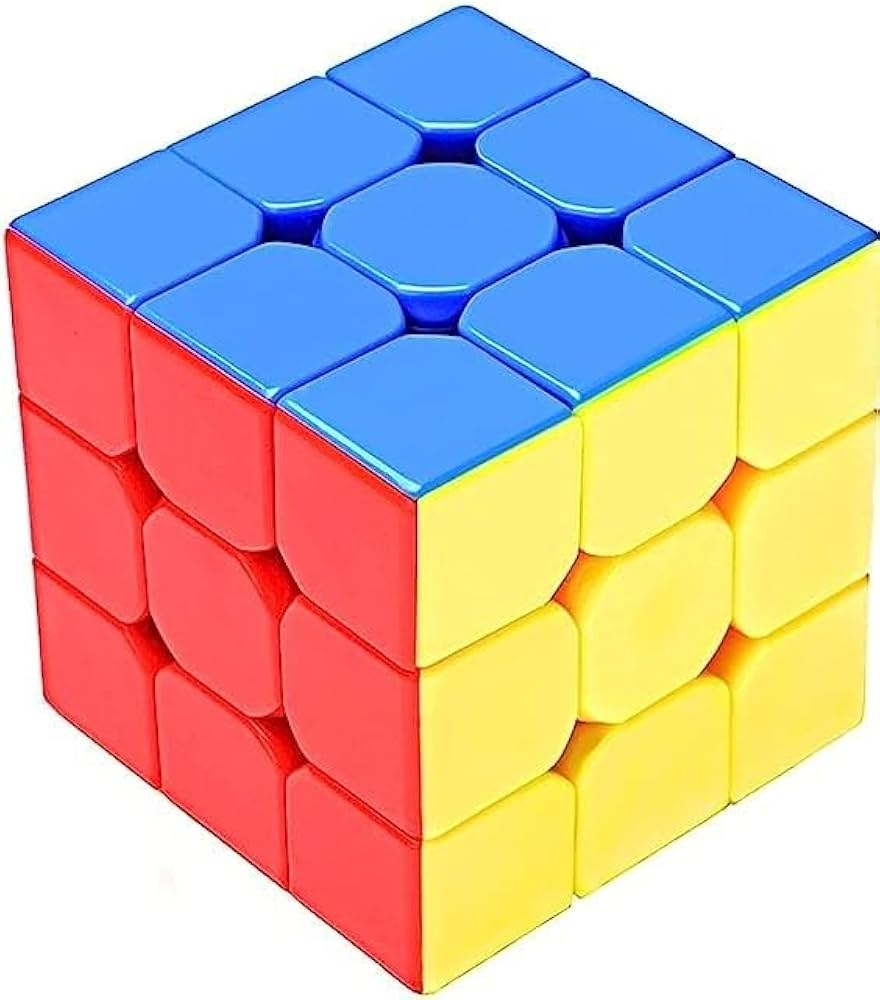
ЁЯСЙ How many small unit cubes make up a complete Rubik’s Cube?

ЁЯТб Hint: A Rubik's Cube is usually a cube with equal sides — try imagining how many little cubes fit along each edge and then multiply!

A rubik cube may be shown to students to guess how many small unit cubes have been used to make it.

ANSWER: 

A standard Rubik’s Cube is a 3×3×3 cube.

So, 27 small unit cubes are used to make one complete Rubik's Cube! 

??? Extra Challenge:
If you could design your own cube puzzle, how many small cubes would you choose, and why?

Inclusion of Special Children:

  • Pair special children with supportive peer buddies for guidance.

  • Encourage them to take active roles: throwing the dice, multiplying the numbers, or writing the scores on the board.

  • This teamwork helps build confidence and fosters participation.

Monday, April 7, 2025

class 8 NCERT bridge course Answers Activity 1W1.1: Recreational Puzzle

 Bridge Programme Content: Detailed Activity 

Activities for Week1

Activity W1.1: Recreational Puzzle 

Material Required: 

A calendar of any month, coloured sketch pens and sheet of paper

May 2025


A calendar may be given to students in pairs. 

They have to observe the calendar keenly and write their observations in the notebook.

Let the students do on their own. 

Teacher can suggest question but should not reveal the conclusions before taking responses of students’ observations. 

Teacher may ask students to do the following: 

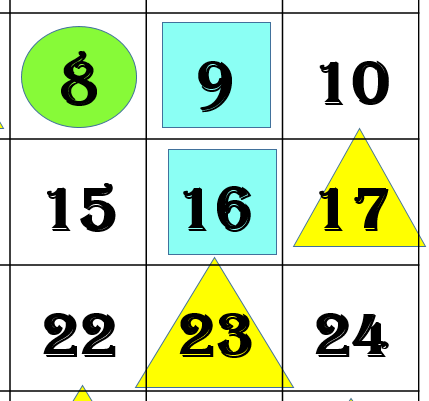
Draw boxes around square numbers (number obtained when a number is multiplied to itself two times. 9 = 3 × 3 is a square number) and colour them with a single colour. 

Draw circles around cube numbers (number obtained when a number is multiplied to itself three times. 8 = 2 × 2 × 2 is a cube number.) and colour them with a new colour. 

Draw triangle around prime numbers. O Students may be asked to choose any 2 by 2 number square grid from the calendar they have. 


Instructions for Students

1. Observing the Calendar:

Students are given a calendar (in pairs). For example, May 2025 starts on Thursday and has 31 days.

They are asked to observe patterns in the calendar and note down their own observations.
Examples of what students might observe:

  • The month starts on a Thursday.

  • All weeks have 7 days.

  • The 1st, 8th, 15th, 22nd, and 29th are all Thursdays.

  • The numbers in the same column increase by 7.

2. Marking Specific Numbers:

Using coloured pens, students mark special types of numbers:

Square Numbers (draw boxes around and colour with one colour):
→ 1, 4, 9, 16, 25

Cube Numbers (draw circles around and colour with a second colour):
→ 1, 8, 27

Prime Numbers (draw triangles around):
→ 2, 3, 5, 7, 11, 13, 17, 19, 23, 29, 31

3. Choose any 2x2 number square from the calendar
(For example: Choose the block with 8, 9, 15, 16)

They should try to answer the following questions: 

What is the sum of the numbers in the diagonals of the grid? 


What is the sum of numbers in the diagonals?

  • Diagonal 1 (8 + 16) = 24

  • Diagonal 2 (9 + 15) = 24


 What magic do you observe? 

 Observation / Magic:

  • The sum of both diagonals is the same in a 2x2 grid.

Based on the above activity, some reflective questions may be discussed, such as: 

Reflective Questions & Sample Student Responses

Q1: How do you differentiate between square and cube numbers?

  • A square number is a number multiplied by itself once (e.g., 4 = 2 × 2).

  • A cube number is a number multiplied by itself twice more (e.g., 8 = 2 × 2 × 2).

Q2: How do you identify prime numbers?

  • Prime numbers have exactly two factors: 1 and itself.

  • They are not divisible by any other number.

Q3: Why is the sum of diagonals always same in a 2x2 grid?

  • Because the opposite corners in a 2x2 square are symmetrical and balance each other.

  • The sums (top-left + bottom-right) and (top-right + bottom-left) are always equal due to arithmetic symmetry.


Extension of the Activity 

 Teacher can extend this activity by suggesting students to take a 3 by 3 grid. 

Extension Activity (3x3 Grid)

Take a 3x3 grid (e.g., from 8 to 16):

Why is the sum of diagonals always same for any 2 by 2 grid? 


They may find— 

1. The sum of diagonal numbers. 

Sum of diagonals:

  • Diagonal 1 (8 + 16 + 24) = 48

  • Diagonal 2 (10 + 16 + 22) = 48

2. The mean of all numbers. 

Mean of all numbers in the grid:
Sum of all numbers: 8+9+10+15+16+17+22+23+24 = 144
Mean = 144 ÷ 9 = 16

Special Observations:

  • The center number (16) is the mean.

  • Diagonals again have equal sums.

  • There is a symmetry in the calendar numbers.


They may be asked to see what special thing they observed. 

Teacher may encourage students to explore more such patterns in the calendar

Encouragement for Exploration

Students can be encouraged to:

  • Try different-sized grids (like 4x4).

  • Observe symmetry across weeks.

  • Explore patterns in odd/even numbers.

  • Make their own puzzles from the calendar.

Saturday, March 22, 2025

Circumference of the circle

Today we all use the formulas 2╧Аr or ╧Аd to calculate the circumference of a circle. Can you believe it if I tell you that this is a Tamil invention??? Look below and you will definitely be surprised.

The formula for calculating the circumference of a circle is set in the Kanakathikaram, Kakkai Padinium etc.

 Crow Patinium
******************************
Song :-
"Vitamore seven, add four to the circle
Sattena Irati Chain
Thikaipana Churtthane"

Setting :-
(Perimeter - P, Diameter - V, Radius - Aa)

= (Vitamore seven) = V/7 
= (Add four to the circle) = V+4V/7
= (Double chain) = 2[V + 4V/7]
(Thikaipana Churtthane)

= 2[V + 4V/7
= 2[11V/7]
= 2x11V/7
= 22/7 x V

According to the present, if 22/7 = ╧А and V=d (diameter)...
Circumference of the circle = 22/7 x V
= ╧Аd
(d = 2r) Circumference = 2╧Аr

So today  It is a matter of pride for Tamils ​​that a Tamil has calculated the formulas used to find the circumference of a circle without using ╧А.....

✍ Tamil Forum


Circumference of the circle 

роЗрой்ро▒ு роиாроо் роЕройைро╡ро░ுроо் ро╡роЯ்роЯрод்родிрой் роЪுро▒்ро▒ро│ро╡ை роХрогிрок்рокродро▒்роХு 2╧Аr роЕро▓்ро▓родு ╧Аd роОройுроо் роЪூрод்родிро░роЩ்роХро│ை рокாро╡ிроХ்роХிрой்ро▒ோроо். роЗродு родрооிро┤ро░ிрой் роХрог்роЯுрокிроЯிрок்рокு роОрой்ро▒ு роЪொрой்ройாро▓் роЙроЩ்роХро│ாро▓் роироо்рок рооுроЯிропுрооா??? роХீро┤ே рокாро░ுроЩ்роХро│் роиிроЪ்роЪропроо் роЖроЪ்роЪро░ிропрок்рокроЯுро╡ீро░்роХро│்.

ро╡роЯ்роЯрод்родிрой் роЪுро▒்ро▒ро│ро╡ை роХрогிрок்рокродро▒்роХு роХрогроХ்роХродிроХாро░роо், роХாроХ்роХை рокாроЯிройிропроо் рокோрой்ро▒ро╡ро▒்ро▒ிро▓் роЪூрод்родிро░роо் роЕрооைроХ்роХрок்рокроЯ்роЯுро│்ро│родு.

роХாроХ்роХை рокாроЯிройிропроо்
****************************
рокாроЯро▓் :-
"ро╡ிроЯ்роЯрооோро░் роПро┤ு роЪெроп்родு
родிроХைро╡ро░ роиாрой்роХு роЪேро░்род்родு
роЪроЯ்роЯெрой роЗро░роЯ்роЯி роЪெропிрой்
родிроХைрок்рокрой роЪுро▒்ро▒ுрод்родாройே"

роиிро▒ுро╡ро▓் :-
(рокро░ிродி - рок, ро╡ிроЯ்роЯроо் - ро╡ி, роЖро░ை - роЖ роОрой ро╡ைрод்родாро▓்)

= (ро╡ிроЯ்роЯрооோро░் роПро┤ு роЪெроп்родு) = ро╡ி/7 
= (родிроХைро╡ро░ роиாрой்роХு роЪேро░்род்родு) = ро╡ி+4ро╡ி/7
= (роЪроЯ்роЯெрой роЗро░роЯ்роЯி роЪெропிрой்) = 2[ро╡ி + 4ро╡ி/7]
(родிроХைрок்рокрой роЪுро▒்ро▒ுрод்родாройே)

= 2[ро╡ி + 4ро╡ி/7
= 2[11ро╡ி/7]
= 2x11ро╡ி/7
= 22/7 x ро╡ி

родро▒்роХாро▓род்родிрой் рокроЯி 22/7 = ╧А роОройро╡ுроо் ро╡ி=d (ро╡ிроЯ்роЯроо்) роОройро╡ுроо் роХொрог்роЯாро▓்...
ро╡роЯ்роЯрод்родிрой் роЪுро▒்ро▒ро│ро╡ு = 22/7 x ро╡ி
= ╧Аd
(d = 2r роЖроХ) роЪுро▒்ро▒ро│ро╡ு = 2╧Аr

роЖроХ роЗрой்ро▒ு ро╡роЯ்роЯрод்родிрой் роЪுро▒்ро▒ро│ро╡ு роХாрог рокропрой்рокроЯுрод்родрок்рокроЯுроо் роЪூрод்родிро░роЩ்роХро│ை родрооிро┤рой் ╧А рокропрой்рокроЯுрод்родாрооро▓ே роХрогிрод்родுро│்ро│ாрой் роОрой்рокродு родрооிро┤ро░ுроХ்роХு рокெро░ுрооைропே.....

✍ родрооிро┤் роХро░ுрод்родுроХ்роХро│роо்

Pages

CH - 2 THE BAUDH─АYANA- PYTHAGORAS THEOREM GANITA PRAKASH PART 2 FIGURE IT OUT QUESTIONS & ANSWERS

 CH - 2 THE BAUDH─АYANA-  PYTHAGORAS THEOREM  GANITA PRAKASH PART 2  FIGURE IT OUT QUESTIONS & ANSWERS 2.1 Doubling a Square Doubling a S...