SOLVE SUDOKU
what to do
Fill in the grid so that
every row,
every column and
every 3 x 3 box contains the digits 1 to 9.
Every Puzzle has only one correct solution.
Art Comes Alive on the Coordinate Plane

In this engaging and hands-on math activity, students explored the beauty hidden within numbers by plotting a series of coordinates across all four quadrants of the Cartesian plane. With careful attention to each point and the connections between them, a stunning image emerged — revealing how mathematics can create more than just answers; it can create art. This activity not only reinforced their understanding of coordinate geometry and graph interpretation, but also sparked creativity and excitement in learning. It's a perfect example of how math and imagination can come together to form something truly memorable.
To apply coordinate geometry concepts by plotting points in all four quadrants and visually interpreting geometric relationships through line segments.
Students will understand how plotting ordered pairs (x, y) on a Cartesian plane creates visual structures.
They will gain skills in scaling, graph interpretation, and shape recognition.
Students enhance spatial reasoning by visualizing patterns and designs formed through sequential plotting.
Plot the following points on a graph sheet. Connect them one by one. The moment you finish, you must have a beautiful picture.
1. Start at
(4.2) → (5,2) → (6,0)→(0,0)→(1, 2)→(4, 2)→(4, 8)→(1,8)→(4, 16)→(22, 16)→(26,8)→(23, 8)→(23,6)→(21,7)→(16,7)→(14,6)→(12, 8)→(10,8)→(9,7)→(9, 5)→(6,3)→(6,1) → (7,0) → (9,0)→(11,2)→(12, 1)→(11, 1)→(10,0)→(17,0)→(17, 1)→(16, 2) → Break.


Begin again at (9, 5)→ (10.5, 5) → Break
Begin again at (20, 4)→(20, 3)→(22, 1)→ (20, 1)→(19,1.5)→(18, 1)→(18,0)→(23,0)→(25, 1)→(25, 3)→(24, 5)→(23, 6) → Break.
Begin again at (24, 5)→(28, 1)→(27,0)→(25,0)→(27, 1)→(25, 3) → Break
Begin again at (11,6)→(12, 5)→(11,4)→(11,2)→ (12, 1)→(14, 1)→(15,2)→(15,4)→(14, 6) → Break.
Begin again at (7, 0)→ (9, 1)→ (10, 2) → STOP
I Quadrant.
Scale
X axis 1 cm 2 units
y axis 1 cm 1 unit
(or as you please)
II. Begin at
(4, 4)→(0,0)→(-3,0)→(-2,2.5)→(4, 4)→(-3,7) → (-3.5,9.5)→(0,10)→(4, 4)→(3,9)→(5, 11)→(6, 9)→(4, 4)→(9, 9)→(11,8)→(10,6)→(4, 4)→(12, 4)→(14, 2)→(11,0)→(4, 4)→(8,-2) → (7,-5) → (4,-3)→(4, 4)→(-1,-11)→(-4,-6)→(-7, -5)→(-6, -8)→(-1,-11)→(3,-21) → Break


Begin again at (1, -16)→ (4, -11)→ (8, -10)→ (7,-13)→ (1, -16) → STOP
All the 4 quadrants are needed.
[scale:x axis 1 cm → 2 units, y axis: 1 cm → 2 units]
(or as you please)
Sudoku is a logic-based number-placement puzzle. The objective is to fill a 9×9 grid so that each column, row, and 3×3 box contains the digits 1 through 9 exactly once.
You can access a vast collection of Sudoku puzzles across various difficulty levels


Max marks: 40 Duration 1hr 30 min
Answer the following
One mark questions (1 x 15 = 15 marks)
1. Choose the correct option.
(i) The probability of getting a number less than or equal to 6 when a die is rolled is:
(a) 0 (b) 6 (c) 16 (d) 1
(ii) If a day is selected at random, what is the probability it is not Monday?
(a) 17 (b) 27 (c) 67 (d) 76
(iii). Which of the following is a random experiment?
(a) Tossing a coin (b) Rolling a single 6-sided die
(c) Choosing a marble from a jar (d) All of the above
(iv) Which of the following is an outcome?
(a) Rolling a pair of dice (b) Coin landing on heads
(c) Choosing 2 marbles from a jar (d) None of the above
(v) Which of the following experiments does not have equally likely outcomes?
(a) Choosing a number at random from 1 to 7 (b) Tossing a coin
(c) Choosing a letter at random from the word SCHOOL (d) None of the above
(vi) The arithmetic mean of the first four natural numbers is:
(a) 2 (b) 2.5 (c) 3 (d) 3.5
(vi) The median of the first ten natural numbers is:
(a) 5 (b) 5.5 (c) 6 (d) 6.5
(viii) What is the mode of the given data? (10, 8, 11, 11, 7, 8, 10, 11, 7, 7, 11}
(a) 4 (b) 10 (c) 11 (d) 7
(ix) The probability of any event cannot exceed:
(a) 12 (b) 1 (c) 10 (d) 100
(x) The probability of getting an even number when a die is rolled is
(a) 12 (b) 14 (c) 34 (d) 1
(xi) A month is selected at random. What is the probability that it has 31 days?
(xii) Find the mean of the given data. 40, 90, 40, 20, 100
(xiii) Find the median of the given data. 900, 1300, 1200, 1000, 1100
(xiv) Find the mode of the given data. 46, 106, 4, 46, 134, 86, 86.5
(xv) If a date is randomly selected from April, what is the probability that it is divisible by 7?
Two marks questions (5 x 2 =10 marks)
1. Find the mean, median and mode of the following set of data: 16, 40, 44, 16, 40, 40, 80, 17, 64, 60, 100
2.Suppose that the letter cards for the word MATHEMATICS were put face down and mixed up and a card is picked up at random. What is the probability of picking up a vowel?
3.Find the most popular pizza topping from the list of orders: cheese, cheese, black olives, mushrooms, onions, cheese, mushrooms, black olives, onions, cheese, mushrooms, cheese.
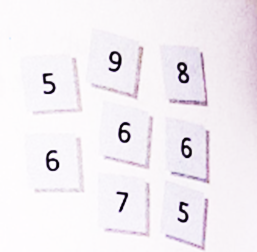
4. A number tile is randomly selected.
(i) How many possible outcomes are there?
(ii) What are the favourable outcomes of choosing a prime?
(iii) In how many ways can choosing a composite number occur?
5. Find the probability of getting a sum of 8 when 2 dice are rolled.
Three mark questions (5 x 3 = 15 marks)
1.10. A die is rolled once. Find the probability of getting a number:
(i) less than 4
(ii) less than or equal to 4
(iii) greater than 4
(iv) greater than or equal to 4
2. A bag contains 4 blue, 4 red, 6 yellow and 10 white marbles. What is the probability of drawing the following? Which of these is a certain event?
(i) a blue marble (iii) a red marble
(ii) a yellow marble (iv) a white marble
(v) a blue or a yellow marble (vii) A red, yellow or white marble
(vi) a red or a white marble (viii) A red, blue, yellow or white marble.
3.
4.
5.
Grade 7 DataHandling Chapter Test 2025-26
(i) The probability of getting a number ≤ 6 on a die (all outcomes 1 to 6):
Answer: (d) 1
(ii) Probability of not Monday = 6/7 (since there are 7 days)
Answer: (d) 6/7 (likely meant “6⁄7” — option marked as 76 is a typo)
(iii) A random experiment has uncertain outcomes.
Answer: (d) All of the above
(iv) An outcome is a single possible result.
Answer: (b) Coin landing on heads
(v) “SCHOOL” has letters with unequal frequency.
Answer: (c) Choosing a letter at random from the word SCHOOL
(vi) First four natural numbers: 1, 2, 3, 4 → Mean = (1+2+3+4)/4 = 2.5
Answer: (b) 2.5
(vii) First ten natural numbers: 1 to 10 → Median = (5 + 6)/2 = 5.5
Answer: (b) 5.5
(viii) Data: 10, 8, 11, 11, 7, 8, 10, 11, 7, 7, 11 → Mode = 11 (occurs 4 times)
Answer: (c) 11
(ix) Probability cannot exceed 1
Answer: (b) 1
(x) Even numbers on a die: 2, 4, 6 → 3 outcomes out of 6 = 3/6 = 1/2
Answer: (a) 1/2
(xi) Months with 31 days: Jan, Mar, May, Jul, Aug, Oct, Dec = 7/12
Answer: 7/12
(xii) Mean of 40, 90, 40, 20, 100 = (40+90+40+20+100)/5 = 58
Answer: 58
(xiii) Data: 900, 1300, 1200, 1000, 1100 → Sorted: 900, 1000, 1100, 1200, 1300 → Median = 1100
Answer: 1100
(xiv) Mode: 46, 106, 4, 46, 134, 86, 86.5 → 46 appears twice
Answer: 46
(xv) Dates in April = 30. Numbers divisible by 7: 7, 14, 21, 28 → 4 outcomes → 4/30 = 2/15
Answer: 2/15
1. Data: 16, 40, 44, 16, 40, 40, 80, 17, 64, 60, 100
Mean = sum/11 = (577)/11 = 52.45
Median (sorted): 16,16,17,40,40,40,44,60,64,80,100 → middle = 40
Mode = 40 (appears 3 times)
2. MATHEMATICS → Letters: M, A, T, H, E, M, A, T, I, C, S → vowels: A, E, A, I → 4/11
Answer: 4/11
**3. Pizza toppings: cheese (5), black olives (2), mushrooms (3), onions (2)
Answer: Cheese
4. Assume tiles = numbers 1–10:
(i) 10 possible outcomes
(ii) Primes = 2, 3, 5, 7 → 4 favourable outcomes
(iii) Composites = 4, 6, 8, 9, 10 → 5 outcomes
5. Getting a sum of 8 with two dice:
(2,6), (3,5), (4,4), (5,3), (6,2) → 5 favourable outcomes
Total = 36 → Probability = 5/36
1. Die rolled once (numbers 1–6):
(i) < 4 → {1,2,3} → 3/6 = 1/2
(ii) ≤ 4 → {1,2,3,4} → 4/6 = 2/3
(iii) > 4 → {5,6} → 2/6 = 1/3
(iv) ≥ 4 → {4,5,6} → 3/6 = 1/2
2. Marbles: 4 blue, 4 red, 6 yellow, 10 white = 24 total
(i) Blue: 4/24 = 1/6
(ii) Yellow: 6/24 = 1/4
(iii) Red: 4/24 = 1/6
(iv) White: 10/24 = 5/12
(v) Blue or Yellow = (4+6)/24 = 10/24 = 5/12
(vi) Red or White = (4+10)/24 = 14/24 = 7/12
(vii) Red, Yellow or White = (4+6+10)/24 = 20/24 = 5/6
(viii) All colors = 24/24 = 1 → This is the certain event