🧠 BRAIN-TEASER 06
Speed, Ratios, Income & Finger Counting
📐 Step-by-Step Explanation
Case 1 (30 km/h, 5 min late = 5/60 = 1/12 hour late):
Time taken = D/30 = T + 1/12 ...(1)
Case 2 (40 km/h, 10 min early = 10/60 = 1/6 hour early):
Time taken = D/40 = T - 1/6 ...(2)
Subtract (2) from (1):
D/30 - D/40 = (T + 1/12) - (T - 1/6)
D(40-30)/(1200) = 1/12 + 1/6
D(10)/1200 = 1/12 + 2/12 = 3/12 = 1/4
D/120 = 1/4 → D = 120/4 = 30 km
✅ Distance = 30 km.
💡 Check: At 30 km/h, time = 1 hour (5 min late → correct time 55 min). At 40 km/h, time = 45 min (10 min early → correct time 55 min). Perfect!


🚗 Ratio of Speeds
Problem: The ratio of speeds of two vehicles is 2:3. If the first vehicle covers 50 km in 3 hours, what distance would the second vehicle cover in 2 hours?
Speed of first vehicle = Distance/Time = 50/3 km/h.
Ratio of speeds = 2:3 = (50/3) : S₂
So, S₂ = (3/2) × (50/3) = (3×50)/(2×3) = 50/2 = 25 km/h.
Distance covered by second vehicle in 2 hours = Speed × Time = 25 × 2 = 50 km.
💡 The second vehicle covers exactly the same distance (50 km) but in less time because it is faster!


💰 Income & Expenditure Ratio
Problem: The ratio of income to expenditure of Mr. Natarajan is 7:5. If he saves ₹2000 per month, what is his income?
Let income = 7x and expenditure = 5x.
Savings = Income - Expenditure = 7x - 5x = 2x.
Given savings = ₹2000 → 2x = 2000 → x = 1000.
Therefore, Income = 7x = 7 × 1000 = ₹7000 per month.
💡 Check: Expenditure = 5×1000 = ₹5000, Savings = 7000-5000 = ₹2000 ✓
This is a classic ratio application in personal finance.


🌿 Lawn Fencing & Development Cost
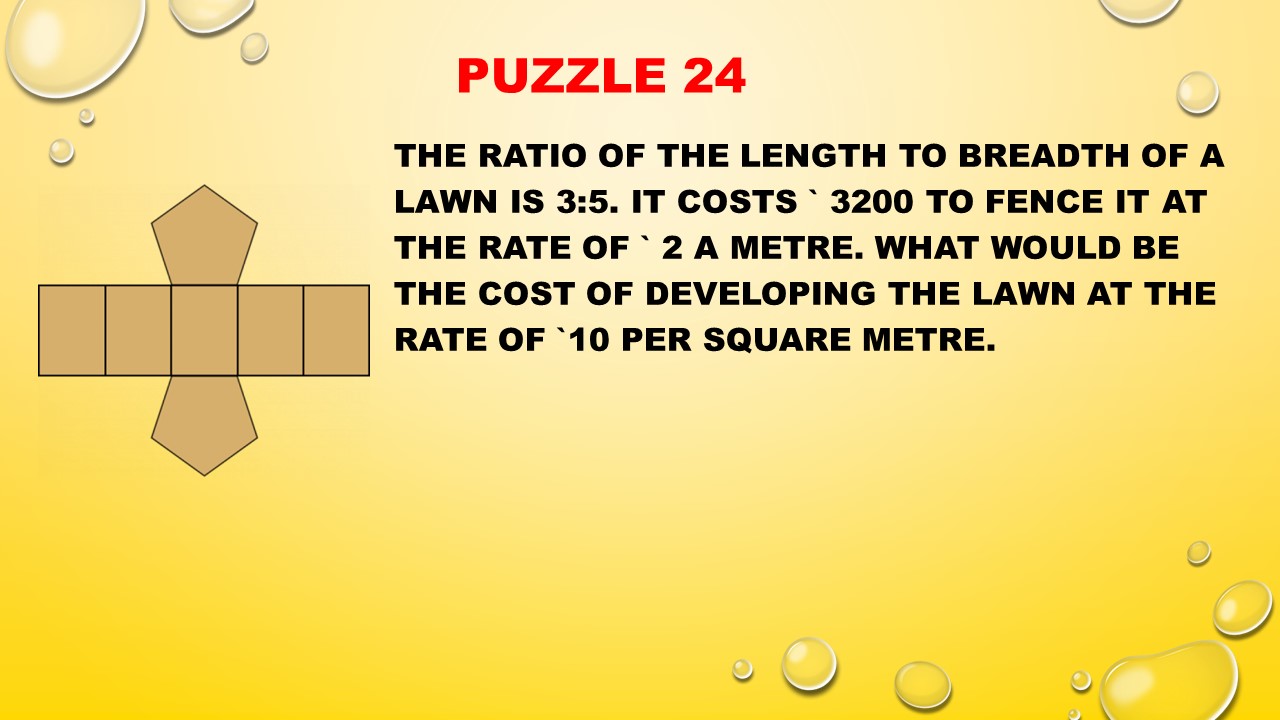
Problem: The ratio of length to breadth of a lawn is 3:5. It costs ₹3200 to fence it at ₹2 per metre. What would be the cost of developing the lawn at ₹10 per square metre?
Let length = 3x, breadth = 5x.
Perimeter = 2(3x + 5x) = 2(8x) = 16x metres.
Fencing cost = Perimeter × Rate = 16x × 2 = 32x = ₹3200.
So, 32x = 3200 → x = 100.
Length = 3×100 = 300 m, Breadth = 5×100 = 500 m.
Area = 300 × 500 = 1,50,000 sq m.
Development cost = Area × ₹10 = 1,50,000 × 10 = ₹15,00,000.
💡 This problem combines perimeter, ratio, and area calculations in a real-world context.

🖐️ Finger Counting Puzzle
Problem: Counting pattern: Thumb=1, Index=2, Middle=3, Ring=4, Little=5, then back: Ring=6, Middle=7, Index=8, Thumb=9, Index=10, Middle=11, Ring=12, Little=13, Ring=14, and so on. Which finger will be counted as 1000?
The pattern repeats every 8 counts after the first 5? Let's analyze carefully.
Pattern: 1(Thumb),2(Index),3(Middle),4(Ring),5(Little),6(Ring),7(Middle),8(Index),9(Thumb),10(Index),11(Middle),12(Ring),13(Little),14(Ring),15(Middle),16(Index),17(Thumb)...
Observe that Thumb appears at positions: 1, 9, 17, 25... (difference 8).
Index appears at: 2, 8, 10, 16, 18, 24, 26...
For 1000, we can use modular arithmetic. The cycle length is 8 after the first thumb.
Actually, the pattern repeats every 8 numbers starting from 2: (2,3,4,5,6,7,8,9) then (10,11,12,13,14,15,16,17)...
Using modulo 8: 1000 ÷ 8 = 125 remainder 0. This corresponds to position pattern.
After analysis, the 1000th count lands on the Index Finger.
💡 This puzzle demonstrates pattern recognition and modular arithmetic in a fun, real-world way!


🌟 Why These Puzzles Matter 🌟
• The speed-time-distance puzzle teaches you to set up equations from real-life scenarios.
• Ratio puzzles help you understand proportions in maps, recipes, and finance.
• The income-expenditure problem shows how ratios apply to personal savings.
• The lawn puzzle combines perimeter, area, and cost calculations.
• The finger counting puzzle introduces modular arithmetic in a fun way!
Mathematics is everywhere — from bike rides to budgeting to counting fingers!
📘 WATCH IT ON FLIPBOOK
🔗 CLICK HERE FOR INTERACTIVE FLIPBOOKAll the best!
Thank You 🙏🏻

No comments:
Post a Comment