Saturday, May 17, 2025

Class 6 NCERT bridge course Answers Activity W1.5 The Reversing Digits Magic Trick

 Activity W1.5  The Reversing Digits Magic Trick

Ask the students to write a two-digit number whose digits are not the same.

 Let them reverse the number and subtract the smaller from the larger. 

 Ask them to repeat the process with the obtained answer till they reach a one-digit number. 

 Teacher may predict the one-digit number. 

 Let them sit in group and observe their calculations and identify the patterns in the intermediate answers.

 They may be asked to identify the two-digit numbers which will lead to a one-digit number in one step.

 Motivate them to play this trick with their family members and other friends.


Activity W1.5 – The Reversing Digits Magic Trick

“Subtract and Reveal the Secret!”

Objective:

To discover number patterns through reversing and subtracting digits of 2-digit numbers.

Instructions:

  1. Think of any two-digit number (digits should not be the same).

  2. Reverse the digits to form another number.

  3. Subtract the smaller number from the larger one.

  4. If the result is not a one-digit number, repeat the process:

    • Reverse it

    • Subtract again

  5. Continue until you reach a one-digit number.

  6. Your teacher or friend will predict the final number!

Example 1:

  • Start with: 73

  • Reverse: 37

  • Subtract: 73 – 37 = 36

  • Reverse 36 → 63

  • Subtract: 63 – 36 = 27

  • Reverse 27 → 72

  • Subtract: 72 – 27 = 45

  • Reverse 45 → 54

  • Subtract: 54 – 45 =  9

 Final one-digit number is 9

Example 2:

  • Start with: 52

  • Reverse: 25

  • Subtract: 52 – 25 = 27

  • Reverse: 72

  • Subtract: 72 – 27 = 45

  • Reverse: 54

  • Subtract: 54 – 45 =  9

What’s the Pattern?

No matter which number you start with (as long as digits are different), you'll eventually end up with 9!

This is because of divisibility and digit difference:

  • The difference between a number and its reverse is always divisible by 9.

  • Eventually, all such differences reduce to 9.

Group Activity Suggestions:

  • Try it with different starting numbers.

  • Record how many steps it takes to reach 9.

  • Find which numbers reach 9 in just one step (like 91 – 19 = 72 → 72 – 27 = 45 → ... = 9).

  • Predict the number when your friend plays the trick!

Challenge:

Try with 3-digit numbers or explore what happens if the digits are the same. Does the trick still work?

Image: Flow of the Reversing Digits Trick


(Note: If you'd like a specific new image illustrating this exact flowchart — 73 → 37 → 36 → 63 → ... → 9 — just let me know and I’ll generate one for this activity.)

Class 6 NCERT bridge course Answers Activity W1.8 Length – Same Perimeter, Different Shapes

Activity W1.8  Length – Same Perimeter, Different Shapes

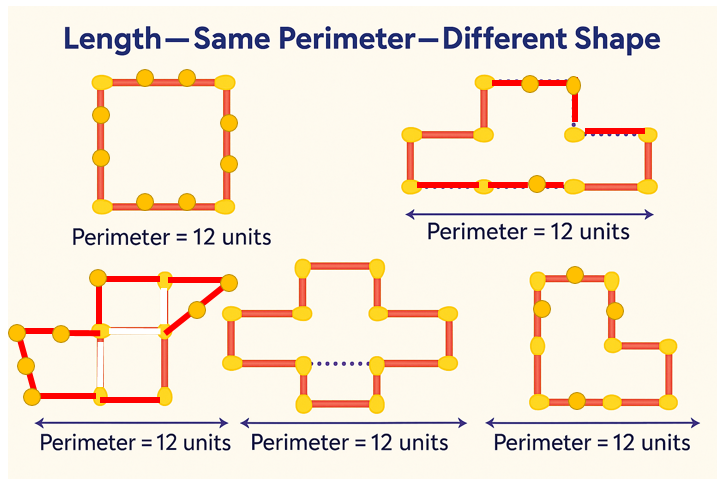
Ask the students to construct the following figures using ear buds/ matchsticks and observe the total length of their boundary. 

 The students may be asked to calculate the length of the boundary of these shapes.

 They may check if the lengths are the same. 

 Students may be encouraged to construct more shapes with the same boundary length.

 This will give them an idea that different shapes can have the same boundary length or perimeter.


Activity W1.8: Length – Same Perimeter, Different Shapes

Objective:

To help students understand that different shapes can have the same perimeter (boundary length), even if they look very different.

Instructions for Students:

  1. Use matchsticks or ear buds to construct various shapes as shown in the image.

  2. Count the number of matchsticks (or sides) used to create the boundary of each shape.

  3. Calculate the perimeter of each shape.

  4. Observe whether the perimeter is the same or different for each shape.

  5. Try creating new shapes using the same number of matchsticks to check if the perimeter stays the same.

Key Concept:

Shapes that look different can still have the same perimeter if the total length of their boundary is the same.

Understanding with the Image:

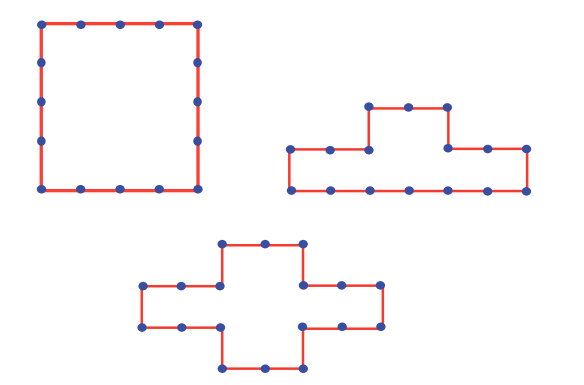
In the image you uploaded, the shapes are made using straight matchstick-like segments.

Let’s assume each red stick = 1 unit length.

Example Shapes from the Image:

Shape Description        No. of Matchsticks        Perimeter (units)
Big square (top left)        16 (4 per side × 4)                        16
Horizontal zig-zag shape (top right)        16            16
Cross-like shape (bottom)        16            16
All three shapes have the same perimeter of 16 units, though their appearances are completely different!

Encourage Students To:

  • Create new designs using 16 matchsticks.

  • Explore shapes with different areas but same perimeter.

  • Compare with shapes made from 12 or 20 matchsticks.

Example Questions and Answers:

  1. Q: Can two shapes with the same number of matchsticks have the same perimeter?
    A: Yes, if all matchsticks are of equal length, the perimeter will be the same.

  2. Q: Can their area be different?
    A: Yes, even if perimeter is the same, the area can change depending on the shape.

Suggested Activities:

  • Group challenge: Each group makes a different shape using 16 matchsticks.

  • Math art: Use matchsticks to form patterns with the same perimeter.

  • Measurement practice: Use rulers if ear buds are used instead of sticks.

Visual Summary Image :

The uploaded image is excellent. It visually shows:

  • Different shaped figures

  • Equal number of boundary segments

  • Ideal for classroom explanation


Class 6 NCERT bridge course Answers Activity W1.7 Matchstick Triangle Patterns

  Class 6 NCERT bridge course Answers Activity W1.7

Activity W1.7  

Matchstick Triangle Patterns

Matchstick activity: 

 Ask the students to make shapes using equilateral triangles with the help of matchsticks as given below: 

 Let them make more such chains by adding equilateral triangles. 

 Ask them to find out the number of matchsticks required in each step. 

Let them come up with a pattern. 

Some interactions through activities will expose students to the properties of shapes such as squares and rectangles.  


Activity W1.7 – Matchstick Triangle Patterns

Objective:

To explore patterns and geometry using equilateral triangles formed by matchsticks. Students observe how shapes grow and identify a numerical pattern.

Instructions for Students:

  1. Use matchsticks to make a chain of equilateral triangles as shown in the image.

  2. Begin with 1 triangle, then add more triangles by sharing sides where possible.

  3. Count the number of matchsticks required at each step.

  4. Identify and describe the pattern.

  5. Predict how many matchsticks will be needed for more triangles.

Step-by-Step Shape Formation:

From the image:

StepNo. of TrianglesMatchsticks Used
113
225
337
449
Pattern Observation:
  • First triangle = 3 matchsticks

  • Every new triangle shares one side with the previous one, so we add only 2 more matchsticks for each new triangle.

Formula:

Matchsticks=3+2×(No. of triangles1)\text{Matchsticks} = 3 + 2 \times (\text{No. of triangles} - 1)

or simply,

Matchsticks=2n+1where n=number of triangles\text{Matchsticks} = 2n + 1 \quad \text{where } n = \text{number of triangles}

Examples:

  • For 5 triangles:
    2×5+1=112 × 5 + 1 = 11 matchsticks

  • For 10 triangles:
    2×10+1=212 × 10 + 1 = 21 matchsticks

  • For 20 triangles:
    2×20+1=412 × 20 + 1 = 41 matchsticks

Conclusion:

This activity helps students:

  • Understand patterns in geometric growth.

  • Practice counting and reasoning.

  • Learn properties of equilateral triangles, side-sharing, and efficiency in design.

Image Explanation:

The provided image clearly illustrates the chain pattern:

  • The triangles are equilateral and connected side-by-side.

  • Each new triangle reuses a side, reducing the total number of matchsticks needed.


Class 6 NCERT bridge course Answers Activity W1.6 Another Number Game

Activity W1.6   Another Number Game

 Another number game:

 Ask the children to write 3 numbers less than 10 in descending order and don’t show it to anyone.

Let them find the following: 

- Add the first and second numbers. 

 - Add the second and third numbers. 

- Add the third and first numbers. 

 Ask them to tell the three sums they got in order.

 The teacher can tell the three numbers the child thought of.


Activity W1.6: Another Number Game

Objective:

To practice addition and reasoning skills by finding three numbers less than 10, then using sums of pairs to identify those numbers.

Instructions for the Children:

  1. Think of 3 numbers less than 10 and write them down in descending order (from largest to smallest).

  2. Don’t show your numbers to anyone.

  3. Calculate these three sums:

    • Add the first and second numbers.

    • Add the second and third numbers.

    • Add the third and first numbers.

  4. Write down the three sums in order.

  5. Share these sums with the teacher or a friend.

  6. The teacher (or friend) will try to find the original three numbers from these sums.

How the Teacher Finds the Numbers:

Suppose the three numbers are aa, bb, and cc such that a>b>ca > b > c.

The three sums given are:

  • S1=a+b

  • S2=b+c

  • S3=c+a

To find aa, bb, and cc:

  1. Add all three sums:

    S1+S2+S3=(a+b)+(b+c)+(c+a)=2(a+b+c)
  2. So,

    a+b+c=(S1+S2+S3)/2
  3. Then,

    a=(a+b+c)(b+c)=(S1+S2+S3)/2S2
  4. Similarly,

    b=(a+b+c)(c+a)=(S1+S2+S3)/2S3
  5. And,

    c=(a+b+c)(a+b)=(S1+S2+S3)/2S1
  • Child’s numbers: 7, 5, 2 (in descending order)

  • Sums:

    • 7+5=12

    • 5+2=7

    • 2+7=9

  • Sums given: 12, 7, 9

Teacher calculates:

a+b+c=(12+7+9)/2=28/2=14

a=147=7,

b=149=5,

c=1412=2

So, the numbers are 7, 5, 2.

Example 2:

  • Child’s numbers: 6, 4, 1

  • Sums:

    • 6+4=10

    • 4+1=5

    • 1+6=7

  • Sums given: 10, 5, 7

Teacher calculates:

a+b+c=(10+5+7)/2=22/2=11

a=115=6,

b=117=4,

c=1110=1

Numbers are 6, 4, 1.

Summary Table

Numbers (a,b,c)Sum 1 (a+b)Sum 2 (b+c)Sum 3 (c+a)Total Sum/2Recovered Numbers
7, 5, 21279147, 5, 2
6, 4, 11057116, 4, 1
9, 8, 3171112209, 8, 3


Class 6 NCERT bridge course Answers Activity W1.3 The Magic Number Trick!

 Activity W1.3 

The Magic Number Trick!

 Think of a number;

 multiply it by 2; 

add 6; 

take half of the number; 

 subtract 1; 

subtract the number thought of;

 I predict you now have 2. 

 Let the students play this game in pairs. 

Ask them to discuss and find out the trick behind it. 

 Encourage them to come up with similar such tricks

Activity W1.3 – The Magic Number Trick!

“No Matter What Number You Choose… I Predict the Answer!”

Objective:

To explore number patterns and reasoning by using arithmetic operations that lead to a surprising fixed result—the number 2—every time!

The Magic Trick Steps:

  1. Think of any number → Let’s call it x

  2. Multiply it by 2 → Result = 2x

  3. Add 6 → Result = 2x + 6

  4. Take half of it → Result = (2x + 6) ÷ 2 = x + 3

  5. Subtract 1 → Result = x + 2

  6. Subtract the number you started with (x)
    Result = (x + 2) – x =  2

Example:

Let's start with 7

  1. Start with: 7

  2. Multiply by 2 → 7 × 2 = 14

  3. Add 6 → 14 + 6 = 20

  4. Half of 20 = 10

  5. Subtract 1 → 10 – 1 = 9

  6. Subtract original number → 9 – 7 =  2

 It works!

Why This Trick Works (The Math Behind It):

Let the number be x

  • Multiply by 2 → 2x

  • Add 6 → 2x + 6

  • Half → (2x + 6)/2 = x + 3

  • Subtract 1 → x + 2

  • Subtract x → Answer is always 2

It’s algebra magic!

Pair Activity:

  • One student chooses a number and follows the steps.

  • The partner predicts the answer (2), then checks it.

  • Swap roles and repeat with different numbers.

Challenge Students:

  • Can you create a new trick that always results in another fixed number (like 5 or 10)?

  • Use operations like: add, subtract, double, triple, halve, etc.

  • Try writing your own step-by-step magic pattern!

Illustrative Image: Magic Number Trick Flowchart


Shows the trick path where any number always leads to 2.

Class 6 NCERT bridge course Answers Activity W1.4 The “Guess My Number” Card Trick!

 Activity W1.4 

 Take two cards (paper or cardboard cutouts). 

Write some specific numbers from 1 to 4 on each of them. 

 Ask your friend to think of a number between 1 and 4; 

then, for each card, ask: "Is your number on this card?"; 

with their two yes/no answers, you should be able to tell them the number they thought of! 

 What numbers will you write on the two cards?

 Extension: 

There are six cards (which can be printed on one sheet of paper and then cut into six pieces) - each has numbers between 1 and 50; 

ask your friend/family member to think of a number between 1 and 50; 

shuffle the cards;

 then, for each card, ask: "Is your number on this card?"; 

with their six yes/no answers, you can tell them the number they thought of!

 How does it work?

Activity W1.4 – The “Guess My Number” Card Trick!

A Number Magic Using Logic and Cards!

Objective:

Use simple YES/NO questions with specially designed number cards to guess your friend’s secret number between 1 and 4 — or even up to 50!

Part 1: Guess a Number Between 1 and 4

 Step-by-Step:

  1. Prepare 2 cards with the following numbers:

    • Card A: 1, 2

    • Card B: 2, 3

  2. Ask your friend to secretly think of a number between 1 and 4.

  3. Show each card and ask:
     “Is your number on this card?”

  4. Based on the yes/no answers, you can guess the number!

Example:

  • Friend thinks of: 2

  • Card A? →  YES

  • Card B? →  YES

  • Only number common to both cards = 2

Why It Works:

You are narrowing down possibilities using logical elimination based on presence/absence in each card!

Extension: Guess Numbers Between 1 and 50

You can create 6 cards like this:

Each card contains numbers where a specific binary digit is 1 at certain positions. For example:

Card 1 (Bit 1 = 1)1, 3, 5, 7, ..., 49
Card 2 (Bit 2 = 1)2, 3, 6, 7, ..., 50
Card 3 (Bit 3 = 1)4, 5, 6, 7, ..., 47
Card 4 (Bit 4 = 1)8, 9, 10, 11, ..., 47
Card 5 (Bit 5 = 1)16–31, 48–50
Card 6 (Bit 6 = 1)32–50
How to Guess the Number:
  1. Ask: “Is your number on this card?” for all 6.

  2. For each YES, add the number associated with that card:

    • Card 1 = 1

    • Card 2 = 2

    • Card 3 = 4

    • Card 4 = 8

    • Card 5 = 16

    • Card 6 = 32

  3. The sum of YES answers = Your friend’s number!

Example:

  • Friend thinks of: 37

  • Card 1? YES → +1

  • Card 2? NO

  • Card 3? NO

  • Card 4? YES → +8

  • Card 5? NO

  • Card 6? YES → +32

Total = 1 + 8 + 32 =  41

Why It Works:

Each number between 1 and 50 can be represented as a binary number using 6 digits. Each card corresponds to one binary digit (bit), and their presence tells you which bits are "on."

Illustrative Image: “Guess My Number Cards”


Class 6 NCERT bridge course Answers Activity W1.2 The Hailstone Number Game

 Activity W1.2   The Hailstone Number Game

 Step 1: Think of any number 

 Step 2: If the number is odd, triple it and add 1, if the number is even, halve it. 

 Step 3: Continue step 2, based on the resulting number in step 2 and continue the steps

Step 4: Write the pattern generated., 

e.g.,

 Step 1: 5 

 Step 2: 3x5+1= 16 

 Step 3: 16/2 = 8 

 Step 4: 8/2 = 4 

 Step 5: 4/2 =2 

 Step 6: 2/2 =1 

 Step 7: 3x1+1 = 4 

 Step 8: 4/2 = 2 

 Step 9: 2/2 =1 ……………………….

 Resulting pattern is 5, 16, 8, 4, 2, 1, 4, 2, 1, 4, 2, 1, ………………….

 Ask the students to play it in pairs

 Let one child give the number, the other one develops the pattern and vice versa. 

 Discuss all the patterns they developed and ask them to find out the reason for the pattern which is named as hailstone numbers.

Explore a Magical Number Pattern!

Objective:

Students discover a repeating numerical pattern using simple rules and understand the concept of hailstone numbers (also called the Collatz sequence).

How to Play:

  1. Step 1: Think of any positive number.

  2. Step 2:

    • If the number is odd → multiply it by 3 and add 1.

    • If the number is even → divide it by 2.

  3. Step 3: Repeat the process with the new number.

  4. Step 4: Observe and record the pattern.

Example: Start with 7

Let's generate the pattern:

  1. 7 (odd) → 3×7 + 1 = 22

  2. 22 (even) → 22 ÷ 2 = 11

  3. 11 (odd) → 3×11 + 1 = 34

  4. 34 → 17

  5. 17 → 52

  6. 52 → 26

  7. 26 → 13

  8. 13 → 40

  9. 40 → 20

  10. 20 → 10

  11. 10 → 5

  12. 5 → 16

  13. 16 → 8

  14. 8 → 4

  15. 4 → 2

  16. 2 → 1

  17. 1 → 4

  18. 4 → 2

  19. 2 → 1 → then continues as: 4, 2, 1...

Pattern:

7, 22, 11, 34, 17, 52, 26, 13, 40, 20, 10, 5, 16, 8, 4, 2, 1, 4, 2, 1,...

What are Hailstone Numbers?

The numbers in this sequence are called hailstone numbers because they rise and fall unpredictably—like hailstones in a storm—before eventually settling into the loop 4 → 2 → 1.

This pattern is part of a famous mathematical problem called the Collatz Conjecture. No matter which number you start with, the pattern always falls to 1!

Classroom Pair Activity:

  • Partner A: Chooses a number.

  • Partner B: Applies the rules and writes down the sequence.

  • Then switch roles!

  • Compare patterns: Who reached 1 faster? Which number had more steps?

Questions for Discussion:

  • Do all numbers eventually reach 1?

  • Which numbers take longer?

  • How do odd and even numbers affect the pattern?


Illustrative Image:

A fun and colorful visual representation of the pattern starting from 7:

hailstone number pattern image


(Image shows numbers rising and falling like hailstones, before looping into 4 → 2 → 1.)

Wrap-Up:

This activity builds logical thinking, pattern recognition, and number sense. It's exciting, unpredictable, and a great way to spark mathematical curiosity in your students!

Class 6 NCERT bridge course Answers Activity W1.1 Guess the Secret Number!

  Class 6 NCERT bridge course Answers 

Activity W1.1

Week 1 

Solves puzzles and daily-life problems involving one or more operations on whole numbers (including word puzzles and puzzles from ‘recreational’ areas, such as the construction of magic squares) in finding their own, possibly different, solutions.

 Discovers, recognises, describes, and extends patterns in 2D and 3D shapes. 

 Deduces that shapes having equal areas can have different perimeters and shapes having equal perimeters can have different areas

Week 2 

Deduces that shapes having equal areas can have different perimeters and shapes having equal perimeters can have different areas

Week 3 

Describes location and movement using both common language and mathematical v o c a b u l a r y ;

 understands the notion of map Recognises and creates symmetry (reflection, rotation) in familiar 2D and 3D shapes 

 Understands the definition and formula for the area of a square or rectangle as length times breadth.

Week 4 

Understands the definition and formula for the area of a square or rectangle as length times breadth

 Solves puzzles and daily-life problems involving one or more operations on whole numbers (including word puzzles and puzzles from ‘recreational’ areas, such as the construction of magic squares) in finding their own, possibly different solutions. 

 Selects appropriate methods and tools for computing with whole numbers, such as mental computation, estimation, or paper pencil calculation, in accordance with the context.

Activity W1.1Guess the Secret Number!

Objective:

To help students develop reasoning and questioning skills by guessing a number (between 1 and 30) through a series of logical Yes/No questions.


  •  Let the teacher start with the following game:
  •  Teacher: I have a number in my mind. 
  • It lies between 1 and 30 including both. 
  • You are expected to identify the number through a series of questions. 
  •  For each of the questions I will reply with either ‘YES’ or ‘NO’ only.
  •  Ask the question in such a way that, I can give the answer ‘YES’ or ‘NO’ only. 
  • If a child can’t hear the questions they may be written or acted out. 
  •  Teacher may ask the students to raise their hands for taking initiative in asking questions and then take up questions one by one with the above-mentioned answers.
  • Either one student or a group of 3-4 students may plan their questions and then ask them one by one before reaching a conclusion. 
  •  They should tell the class the strategy they tried for getting the number in the teacher’s mind. 
  •  If this student or the group of students succeed in locating the number, then the teacher may tell another student or group of students to take over the questioning for some other number. 
  • If the earlier student or group of students do not succeed in finding the number, then another student or group can take over the questioning and try to find that number. 
  •  The students may be encouraged to ask a varied number of questions. 

Modifications in the game: 

  •  The game can be modified by changing the final number 30 to 40, 50, 60, etc.
  •  After getting enough exposure to the game, the teacher may ask the students to note the total number of questions asked before identifying the secret number. 
  • The teacher may then suggest finding the secret number with fewer and fewer questions. 
  • This will motivate the students to improve upon their strategies. 
  •  To make the game more interesting, engrossing and competitive, two or three groups of students may be asked to participate. 
  • The group which finds the secret number in the least number of steps will be the winner.

Example Game Round:

Teacher's Secret Number (in mind): 18
(Not revealed to students until the end!)

Students begin asking:

  1. Is the number greater than 15?
    Teacher: YES

  2. Is the number greater than 20?
    Teacher: NO

  3. Is the number even?
    Teacher: YES

  4. Is the number divisible by 3?
    Teacher: YES

  5. Is the number 18?
    Teacher: YES 

Strategy Used:

The group used elimination by:

  • First cutting the range in half (greater than 15?).

  • Narrowing further by checking if it's greater than 20.

  • Then asked about even/odd and divisibility, using math properties to pinpoint the exact number.

Answer:

The number is 18

Teaching Notes & Extension Ideas:

  • After each round, ask the students:

    “How many questions did it take to find the number?”
    “Could you have found it in fewer questions?”

  • Encourage strategies like:

    • Dividing the range in half each time (binary search method)

    • Asking about divisibility, even/odd, or range (e.g., 10–20)

  • You can increase difficulty by changing the range to 1–40, 1–50, etc.

  • Make it competitive:
     Groups compete to find the number in the fewest steps

Friday, May 16, 2025

Kanakkadhiharam by (author: korukkaiyoor karinayanar)

 Kanakkadhiharam 
(author: korukkaiyoor kaarinayanar) 

கணக்கதிகாரம் 

எழுதியவர் கொருக்கையூர் காரி நாயனார்

 காரி நாயனார் என்ற புலவரால் கணக்கதிகாரம் என்னும் கணித நூல் 15ஆம் நூற்றாண்டில் எழுதப்பட்டது.

இந்நூலில் ஆறு பிரிவுகளில் 64 வெண்பாக்களும், 45 புதிர் கணக்குகளும் உள்ளன: நிலம் வழி (23 பாக்கள்), பொன் வழி (20 பாக்கள்), நெல் வழி (06 பாக்கள்), அரிசி வழி (02 பாக்கள்), கால் வழி (03 பாக்கள்), கல் வழி (01 பாக்கள்), பொது வழி (05 பாக்கள்) என்ற ஆறுவழிக் கணக்குகளையும் புலவர் அறுபது செய்யுள்களால் உணர்த்தினார் என்பதை:

“ஆதிநிலம் பொன்னெல் லாரிசி யகலிடத்து
நீதிதருங் கால் கல்லே நேரிழையாய் – ஓதி
உறுவதுவாகச் சமைத்தேன் ஒன்றெழியா வண்ணம்
அறுபது காதைக்கே யடைத்து.”

ஆறு வழிக் கணக்கு மட்டுமல்லாது வேறு பல கணக்குகளையும் இந்நூலில் நீங்கள் பார்க்கலாம். இக்கணக்குகள் கற்பவர்க்கு திகைப்பும், வியப்பும், நகைப்பும், நயப்பும் விளைவிக்கும் என்பது திண்ணம்.

தமிழ் எண்கள்: 1. தமிழ் முழு எண்களின் பெயர்கள்; 2. தமிழ் பின்ன எண்களின் பெயர்கள்;

பொழுதுபோக்கு: 3. “மாயசதுர’ கணக்குகள்” – எப்படிக் கூட்டினாலும் ஒரே விடை; 4. வினா-விடைக் கணக்குகள்;

புதிர் கணக்குகள்: 5. பூமியின் அளவு, நிலத்தின் அளவு, நீர் அளவு, சூரியன்-சந்திரன் இடையேயான தொலைவு, மலையின் அளவு;

சூத்திரக் கணக்குகள்: 6. ஒரு படி நெல்லில் எத்தனை நெல் இருக்கும்;  ஒரு பலாப்பழத்தில்  எத்தனை பலாச்சுளை இருக்கும்; ஒரு பரங்கிக்காயில்  எத்தனை விதைகள் இருக்கும்.

கணக்கதிகாரத்தில், வெண்கலம் மற்றும் பித்தளை ஒன்றாகச் சேர்த்து உருக்கி பித்தளை உருவாக்கும் விவரம் பற்றிய ஒரு செய்யுள் காணப்படுகிறது.

கணக்கதிகாரம் செய்யுள் எண்: கக (11)

“எட்டெடை செம்பி லிரெண்டை யீயமிடில்
திட்டமாய் வெண்கலமாஞ் சேர்ந்துருக்கி – லிட்டமுடன்
ஓரேழு செம்பி லொருமூன் றுதுத்தமிடில்
பாரறியப் பித்தளையாம் யார்”


உரை:

எட்டுப்பலஞ் செம்பிலே இரண்டு பலம் ஈயமிட்டுருக்க வெண்கலமாம். ஏழலரைப் பலஞ் செம்பிலே மூன்று பலந் துத்தமிட்டுருக்க பித்தளையாம்.

Two strengths of the eighty -eight copper are the bronze. The seven -year -old is the three -legged brass.

Note: Palam - Antique Tamil Weight (40.8 g).

குறிப்பு: பலம் – பழந்தமிழர் எடை அளவு (40.8 கிராம்).


A garden- lizard climbs up a palm tree of height 32 Cubits. 
It goes up 12 finger Space a day but slips 4 finger space in every move.
How many days will it take to reach the top of the tree?
I cubit = 24 finger Space.


Solution:
32 x 24 finger space = 768
Per day 12 - 4 = 8
Number of days = 768 / 8 = 96 days


A Frog had fallen into lom a well of depth Every time it tried to climb up, it climbed a distance of to cm. and slipped 20 cm. How many times should it try to Come out of that well?


The frog leaped forward to catch the insect away in Em. But It Could cover only 4 m. At second Jump half of the distance am. Third jump half of 2m. If the frog Jumps halb by hally, how many Jumps does the frog require to Catch the insect?


Pages

CH - 2 THE BAUDHĀYANA- PYTHAGORAS THEOREM GANITA PRAKASH PART 2 FIGURE IT OUT QUESTIONS & ANSWERS

 CH - 2 THE BAUDHĀYANA-  PYTHAGORAS THEOREM  GANITA PRAKASH PART 2  FIGURE IT OUT QUESTIONS & ANSWERS 2.1 Doubling a Square Doubling a S...