Sunday, July 16, 2023

Class 09 To find a hidden picture by plotting and joining the various points with given coordinates in a plane.

 Activity 12


OBJECTIVE                                                                    

To find a hidden picture by plotting and joining the various points with given coordinates in a plane.

 MATERIAL REQUIRED

Cardboard, white paper, cutter, adhesive, graph paper/squared paper, geometry box, pencil.

METHOD OF CONSTRUCTION

1.   Take a cardboard of a convenient size and paste a white paper on it.

2.   Take a graph paper and paste it on the white paper.

3.   Draw two rectangular axes XOX and YOY as shown in Fig. 1.

4.   Plot the points A, B, C, ... with given coordinates (a, b), (c, d), (e, f), ..., respectively as shown in Fig. 2.

Join the points in a given order say ABCD.....A [see Fig. 3]

DEMONSTRATION

By joining the points as per given instructions, a ‘hidden’ picture of an ‘aeroplane’ is formed.

OBSERVATION

In Fig. 3:

Coordinates of points A, B, C, D, .......................

are ........, ........, ........, ........, ........, ........, ........

Hidden picture is of ______________.

APPLICATION

This activity is useful in understanding the plotting of points in a cartesian plane which in turn may be useful in preparing the road maps, seating plan in the classroom, etc.

Class 09 To find the values of abscissca and ordinates of various points given in a cartesian plane.

 Activity 11


  OBJECTIVE                                                                   

To find the values of abscissca and ordinates of various points given in a cartesian plane.

  MATERIAL REQUIRED


Cardboard, white paper, graph paper with various given points, geometry box, pen/pencil.

 METHOD OF CONSTRUCTION

 1.   Take a cardboard of a convenient size and paste a white paper on it.

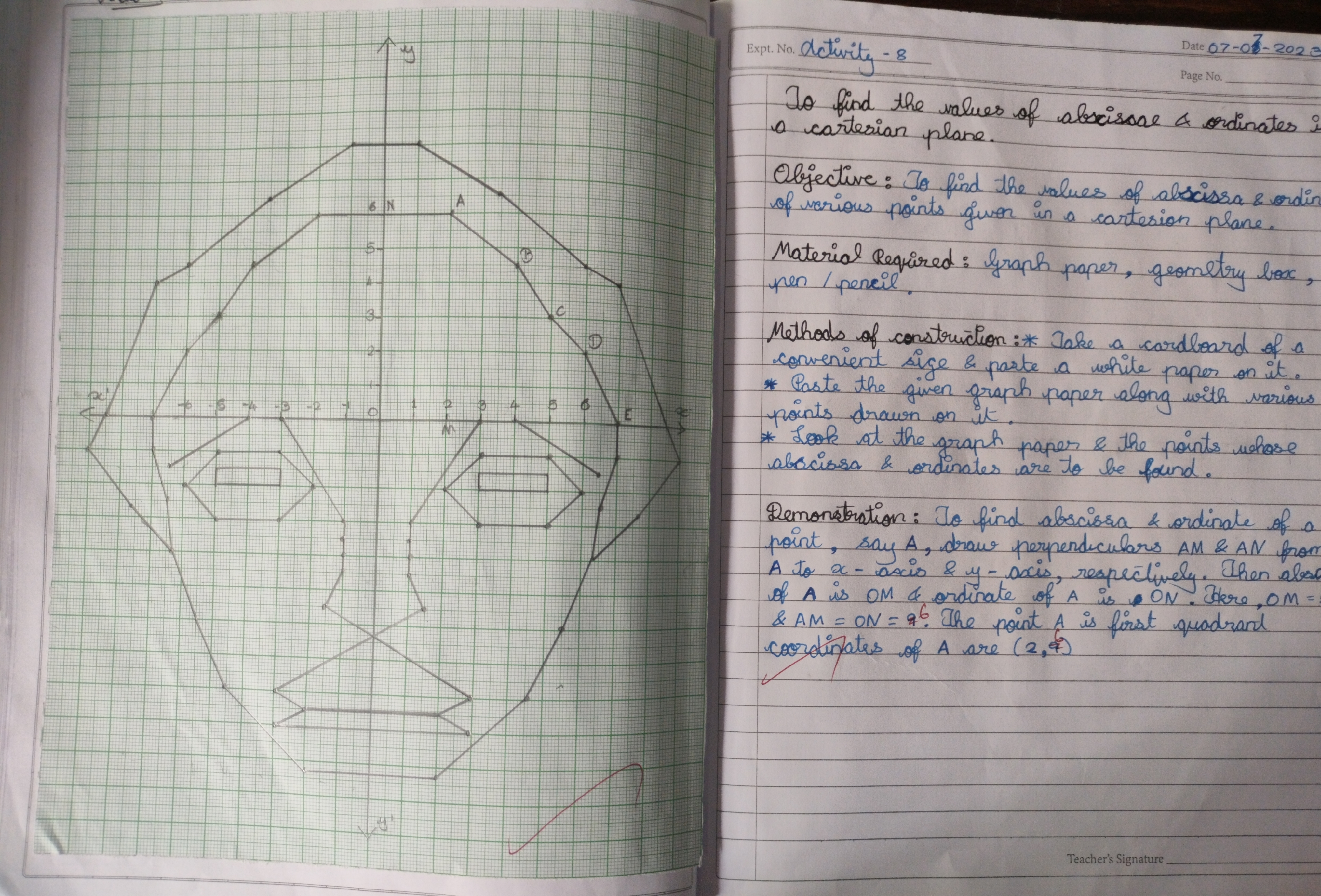
 2.    Paste the given graph paper alongwith various points drawn on it [see Fig. 1].

 3.   Look at the graph paper and the points whose abcissae and ordinates are to be found.

 DEMONSTRATION

 To find abscissa and ordinate of a point, say A, draw perpendiculars AM and AN from A to x-axis and y-axis, respectively. Then abscissa of A is OM and ordinate of A is ON. Here, OM = 2 and AM = ON = 9. The point A is in first quadrant. Coordinates of A are (2, 9)

OBSERVATION


Point

Abscissa

Ordinate

Quadrant

Coordinates


B


C


...


...


...


...


PRECAUTION


Fig. 1

The students should be careful


APPLICATION

while reading the coordinates,


This activity is helpful in locating the position

otherwise the location of the


object will differ.


of a particular city/place or country on map

Class 09 To verify the algebraic identity :a3 – b3 = (a – b)(a2 + ab + b2)


Activity 10


OBJECTIVE


To verify the algebraic identity :a3 b3 = (a b)(a2 + ab + b2)

 METHOD OF CONSTRUCTION

MATERIAL REQUIRED

Acrylic sheet, sketch pen, glazed papers, scissors, adhesive, cello-tape, coloured papers, cutter.

1.   Make a cuboid of dimensions (a–b) × a × a (b < a), using acrylic sheet and cellotape/adhesive as shown in Fig. 1.

 2.   Make another cuboid of dimensions (a–b) × a × b, using acrylic sheet and cellotape/adhesive as shown in Fig. 2.

 3.   Make one more cuboid of dimensions (a–b) × b × b as shown in Fig. 3.

 4.    Make a cube of dimensions b × b × b using acrylic sheet as shown in Fig. 4.

5.   Arrange the cubes and cuboids made above in Steps (1), (2), (3) and (4) to obtain a solid as shown in Fig. 5, which is a cube of volume a3 cubic units.

Fig. 5

 Fig. 6

 DEMONSTRATION

 Volume of cuboid in Fig. 1 = (a–b) × a × a cubic units.

 Volume of cuboid in Fig. 2 = (a–b) × a × b cubic units.

 Volume of cuboid in Fig. 3 = (a–b) × b × b cubic units.

 Volume of cube in Fig. 4 = b3 cubic units.

 Volume of solid in Fig. 5 = a3 cubic units.

 Removing a cube of size b3 cubic units from the solid in Fig. 5, we obtain a solid as shown in Fig. 6.

 Volume of solid in Fig. 6 = (a–b) a2 + (a–b) ab + (a–b) b2

 =  (a–b) (a2 + ab + b2)

 Therefore, a3 b3 = (a b)(a2 + ab + b2)

OBSERVATION

 On actual measurement:

 a = ..............,        b = ..............,

 So, a3 = ..............,       b3 = .............., (ab) = ..............,    ab = ..............,

 a2  = ..............,      b2 = ..............,

 Therefore, a3 – b3 = (a – b) (a2 + ab + b2).

 APPLICATION

 The identity may be used in simplification/factorisation of algebraic expressions.

Class 09 To verify the algebraic identity (a – b)3 = a3 – b3 – 3(a – b)ab

 Activity 8 


OBJECTIVE

MATERIAL REQUIRED


To verify the algebraic identity

Acrylic sheet, coloured papers,


(a b)3 = a3 b3 – 3(a b)ab

saw, sketch pens, adhesive, Cello-


tape.


METHOD OF CONSTRUCTION


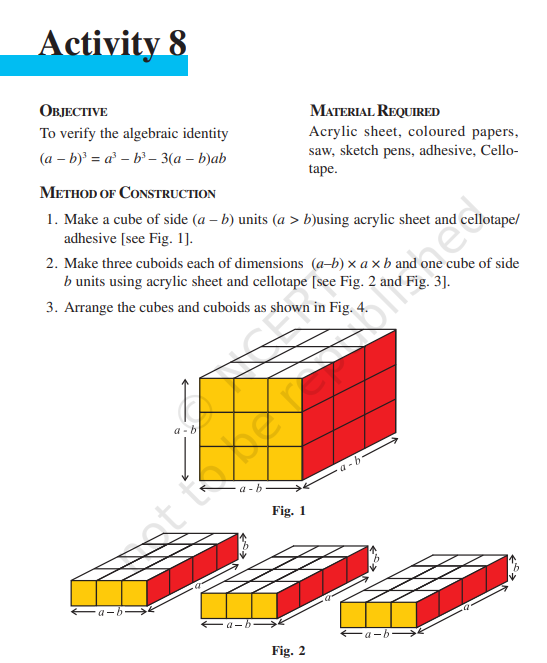
 1.   Make a cube of side (a – b) units (a > b)using acrylic sheet and cellotape/ adhesive [see Fig. 1].

2.   Make three cuboids each of dimensions (ab) × a × b and one cube of side b units using acrylic sheet and cellotape [see Fig. 2 and Fig. 3].

 Arrange the cubes and cuboids as shown in Fig. 4.

DEMONSTRATION

Volume of the cube of side (a – b) units in Fig. 1 = (a– b)3 Volume of a cuboid in Fig. 2 = (a–b) ab

Volume of three cuboids in Fig. 2 = 3 (a–b) ab Volume of the cube of side b in Fig. 3 = b3

Volume of the solid in Fig. 4 = (a–b)3 + (a–b) ab + (a–b) ab + (a – b) ab + b3

= (a–b)3 + 3(a–b) ab + b3

(1)


Also, the solid obtained in Fig. 4 is a cube of side a

Therefore, its volume = a3

(2)


From (1) and (2),


(a–b)3 + 3(a–b) ab + b3 = a3


or (a–b)3 = a3 b3 – 3ab (a–b).


Here, volume is in cubic units.


OBSERVATION

 On actual measurement:

 a = ..............,            b = ..............,       ab = ..............,

 So, a3 = ..............,       ab = ..............,

b3 = ..............,       ab(ab) = ..............,

 3ab (ab) = ..............,     (ab)3 = ..............,

 Therefore, (a–b)3 = a3 – b3 3ab(a–b)

 APPLICATION

 The identity may be used for

 1.   calculating cube of a number expressed as a difference of two convenient numbers

 simplification and factorisation of algebraic expressions.

NOTE

 This identity can also be expressed as : (a b)3 = a3 – 3a2b + 3ab2 b3.

Pages

CH - 2 THE BAUDHĀYANA- PYTHAGORAS THEOREM GANITA PRAKASH PART 2 FIGURE IT OUT QUESTIONS & ANSWERS

 CH - 2 THE BAUDHĀYANA-  PYTHAGORAS THEOREM  GANITA PRAKASH PART 2  FIGURE IT OUT QUESTIONS & ANSWERS 2.1 Doubling a Square Doubling a S...