Sunday, April 20, 2025

Class 8 NCERT bridge course Answers Activity W 4.6 A fractal

 Activity W 4.6 A fractal


Objective:

 This activity will help students to: 

  • Understand the concept of fractals.

  • Build a simple fractal (Sierpinski Triangle   or Koch Snowflake) using repeated patterns.


Materials Required: 

Paper, markers, ruler (optional), printouts of basic geometric shapes (triangles, squares, etc.). 

A fractal is a shape or pattern that repeats itself no matter how much you zoom into it. 

Procedure

 Guide students to build fractals step-by-step. 
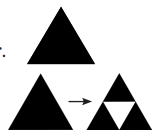


1. Draw a large equilateral triangle on your paper. 

2. Find the midpoints of each side and join them. Remove the middle triangle so obtained. 

It will look as shown—

 3. Again, join the midpoints of each of the sides of the three shaded triangles. 

Remove the three triangles so obtained. It will look like

4. Ask the students to continue the process for at least two more times. 

Take sufficiently large paper or cardboard for this purpose. 

Reflection

 Ask the students to describe the final structure they obtain. 

ANSWER:

The final structure looks like a big triangle made up of smaller and smaller triangles.

Does the final one looks like a big triangle made up of smaller triangles, and if we zoom in,?

ANSWER:

Yes! If we zoom in, the same pattern keeps repeating — this is the main property of a fractal.

 do we see the same pattern inside? This is a fractal. 

ANSWER:

  • A fractal shows self-similarity: no matter how much you zoom in or out, the shape looks the same.

  • Pattern Observation:

    • Number of triangles increases at every step:

      • Step 1: 1 large triangle.

      • Step 2: 3 shaded triangles.

      • Step 3: 9 smaller shaded triangles.

      • Step 4: 27 even smaller shaded triangles.

    The number of triangles follows this pattern:
    Number of shaded triangles = 3ⁿ (n = step number)

Extension

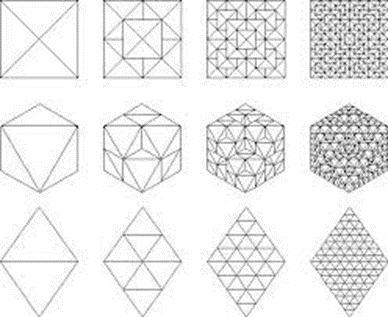
 1. Students may try this for different shapes, such as square, rectangle, parallelogram or any other shape of their choice. 

  1. Try this fractal pattern with other shapes like:

    • Squares (creates a Sierpinski Carpet),

    • Rectangles,

    • Parallelograms,

    • Hexagons.

Squares – Sierpinski Carpet

  • Step 1: Start with one large square.

  • Step 2: Divide the square into 9 smaller squares (like a tic-tac-toe grid).

  • Remove the middle square.

  • Step 3: For each remaining square, repeat the same process: divide into 9 parts, remove the middle one.

  • Keep repeating!

👉 Pattern:

  • Number of remaining squares grows as 8ⁿ (n = step number).

  • Creates a flat, grid-like fractal called the Sierpinski Carpet.

Rectangles

  • Step 1: Start with a rectangle.

  • Step 2: Divide it into equal smaller rectangles (4, 6, 8 parts or more, depending on shape).

  • Remove a central part or selected parts.

  • Repeat the same for the remaining rectangles.

Pattern:

  • You will get a rectangular fractal where the shape keeps splitting into smaller rectangles, showing self-similarity.

Parallelograms

  • Step 1: Start with a parallelogram.

  • Step 2: Divide it into smaller, identical parallelograms.

  • Remove one or more central parts.

  • Repeat the process for each remaining parallelogram.

Pattern:

  • The structure will look like a stretched or skewed version of the square fractal, but still self-similar and recursive.

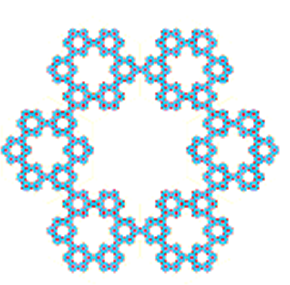
Hexagons


  • Step 1: Start with a regular hexagon.

  • Step 2: Divide the hexagon into 7 smaller hexagons (1 central + 6 surrounding).

  • Remove the central hexagon.

  • Repeat the process for each remaining hexagon.

Pattern:

  • A repeating honeycomb-like fractal — looks similar to snowflake patterns or beehives!

  • The edges form increasingly complex, yet balanced, hexagon-based designs.


No matter the shape — square, rectangle, parallelogram, or hexagon — when you:

  1. Divide,

  2. Remove parts,

  3. Repeat the process...

...you create a fractal: a never-ending, self-similar, and geometric pattern.

2. Students may be asked to associate numbers with each shape. 

Say, number of triangles obtained in each step or the number sides on outer edges in each step (3, 6, ...).

 They need to find a pattern.

Pattern in Outer Edges

  • As you remove triangles, the number of sides or edges grows.
  • For each step, the outer shape becomes more detailed but still follows a predictable mathematical pattern.

Sierpinski Triangle


  • Number of Triangles at Each Step:

    StepTriangles Formed
    0 (Start)1
    13
    29
    327
    481

    Pattern:
    Number of triangles = 3ⁿ (where n = step number)

     Outer Edges (Visible Triangle Sides):

    StepOuter Edges
    03
    16
    212
    324

    Pattern:
    Outer triangle sides double each step: 3 × 2ⁿ

    Sierpinski Carpet (Square Fractal)

     Number of Squares at Each Step:

    StepSquares Remaining
    01
    18
    264
    3512

    Pattern:
    Number of squares = 8ⁿ

     Outer Edges:

    StepSquares on One SideTotal Outer Sides
    014
    1312
    2936
    327108

    Pattern:

    • Each side is split into 3ⁿ parts.

    • Total outer sides = 4 × 3ⁿ

    Parallelogram Fractal (Custom logic – similar to square)

    If we divide into 4 parts (2×2 layout) and remove the middle one:

     Number of Parallelograms:

    StepShapes
    01
    13
    29
    327

    Pattern:
    Just like triangle: 3ⁿ

    Hexagon Fractal

    (Similar to honeycomb — 7 small hexagons, remove the center)

    Number of Hexagons:

    StepHexagons Remaining
    01
    16
    236
    3216

    Pattern:
    Number of hexagons = 6ⁿ

    Summary Table:

    ShapeShapes per StepPatternOuter Sides Pattern
    Triangle3ⁿ trianglesExponential3 × 2ⁿ
    Square8ⁿ squaresExponential4 × 3ⁿ
    Parallelogram3ⁿ parallelogramsExponentialSimilar to triangle logic
    Hexagon6ⁿ hexagonsExponentialGrows like a honeycomb


Conclusion:

A fractal is a fascinating geometric figure where the same pattern repeats itself at every scale. 

The Sierpinski Triangle is a perfect example of this, and by exploring other shapes, we can discover many more fractals in nature and mathematics.


Class 8 NCERT bridge course Answers Activity W 4.5 Building Towers with Blocks

 Activity W 4.5: Building Towers with Blocks 

Material Required 

 Different coloured blocks. 

 Paper and pencil for recording results. 

Explain to the students that each block will represent a number, and stacking blocks will help illustrate exponents.


For example, stacking 2 blocks means 2¹ and stacking 4 blocks means 2² and so on

Procedure & Observation

Ask students to create towers representing different powers of 2: 

 For 2¹  , they stack 2 blocks. 

 For 2² , they stack 4 blocks. 

 For 2³ , they stack 8 blocks. 

Students stack blocks to represent powers of 2:

ExponentMathematical FormNumber of Blocks3-D Shape Formed
22 blocksCuboid
44 blocksCube (if arranged as 2x2x1)
88 blocksCuboid or Cube (if arranged as 2x2x2)


1. After stacking blocks for different exponents, students may be made to explore what 3-D shape they get. 

For example, 2¹ gives a cuboid, whereas 2² gives a cube and so on. 

Discussion:

What 3-D shape do they get?

  • For 2¹ = 2 blocks, students usually get a Cuboid (because two blocks form a rectangular shape).

  • For 2² = 4 blocks, if arranged symmetrically (2x2), they can get a Cube.

  • For 2³ = 8 blocks, if arranged as 2x2x2, it forms a Perfect Cube.

Conclusion:

  • When the blocks can be arranged equally in all three dimensions (length, width, and height), the shape is a cube.

  • Otherwise, it remains a cuboid.

They may see for which exponent of 2 they get a cube and for which other a cuboid. 

Can they get any other 3-D shape other than a cube or cuboid?

No, using only simple stacking of square or rectangular blocks, the shapes are usually limited to cuboids or cubes.

Other 3-D shapes like pyramids or spheres cannot be formed unless the block shape or stacking style is changed. 

2. They may observe as to how the number of blocks increases as the exponent increases. 

Is there any pattern?

Is there any pattern in the number of blocks as the exponent increases?

Yes! The number of blocks doubles every time the exponent increases by 1.

ExponentNumber of Blocks
2
4
8
2⁴16

Pattern:
As the exponent increases by 1, the number of blocks is multiplied by 2.

Conclusion:
This activity helps visualize how exponents grow and how they relate to 3-D shapes like cubes and cuboids. The number of blocks follows a clear doubling pattern as the exponent increases.

Class 8 NCERT bridge course Answers Activity W 4.4 Exploring Data Through Graphs and Charts

 Activity W 4.4 - Exploring Data Through Graphs and Charts

 Procedure

 A project may be given to students to collect the data from reliable sources. 

Students should be divided into groups of 4–5. 

1. Every group has to collect data on the following topics: 

 Temperature of your city in the month of July for the last 5 years. 

 Literacy rate of any 5 states of India in the last five years. 

How many students of your class like ice-cream among the following: 

vanilla, chocolate cone, butter scotch, strawberry and kesar-pista. 

What is the favourite game among the following: cricket, football, basketball, tennis, badminton and volleyball. 

 Collect data from the students of your class.

2. Each group has to make a table with tally marks. 

3. Each group has to draw a bar graph, line graph and pictograph for the collected data. 

Teacher will provide opportunity to every group to present their work in front of the whole class. 

Here is an example: 

Take population of a country in different decades. 

Represent the data as a pictograph, bar graph and line graph. 

 Pictograph 

😊 = 20 crore people.


Bar Graph


Line Graph


Discuss:

1. What is the difference between these three graphs?


Graph TypeUseVisual Advantage
PictographUses icons or symbols to show data.Makes data fun and easy to understand.
Bar GraphUses bars to represent quantities.Great for comparing groups or categories.
Line GraphConnects data points to show changes over time.Best for showing trends and progressions.

  • Pictograph:
    A pictograph uses pictures or symbols to represent data. Each symbol stands for a specific number of items. It makes the data easy to read and more visually interesting, especially for younger audiences.

  • Bar Graph:
    A bar graph uses rectangular bars (either vertical or horizontal) to show the quantity of different categories. The length of the bar shows how large or small the value is. It is useful for comparing data from different groups.

  • Line Graph:
    A line graph uses points connected by lines to show trends over time. It helps to easily spot increases or decreases in the data and is best used for data that changes continuously (like temperature or literacy rates).


2. In which situation could a line graph not be drawn from the data collected by the students and why?

A line graph cannot be drawn for:

  • Ice-cream preferences

  • Favourite games

Reason:
A line graph is used for continuous data or to show change over time.
Ice-cream flavours and favourite games are examples of categorical data (choices, not numbers that change over time). Since these are simply preferences without any timeline or continuous flow, a line graph would not be appropriate.

  • Line Graphs are for time-based or continuous data (like temperature or literacy rate).

  • Bar Graphs & Pictographs are great for category-based data (like games or ice-cream).


SOME FUNNY ANSWERS

 WRITE 10 VEGETABLE NAMES.

I AM NON-VEGETARIAN.

SOLVE 

11x = π

x =  π / 11


Solve  
X² = 25


x = 5


PROVE TH MID POINT THEOREM


Saturday, April 19, 2025

Class 8 NCERT bridge course Answers Activity W 4.3 pictorial patterns

 Activity W 4.3  Pictorial patterns

Students may be asked to extend the following pictorial patterns further for two steps. 

Express each of these as a numerical pattern as directed. 

1. Stacked Squares

Count the number of small squares in each case and write it. 1, 4, ... 


Extend the sequence till 10 terms. 

ANSWER: 

Number Pattern:

1, 4, 9, 16, 25, 36, 49, 64, 81, 100

Do you find any pattern? 

ANSWER: 

Pattern Observed:

These are square numbers — the number of squares increases by the next odd number each time.

Formula: Number of squares=n² where  n is the position in the sequence.


2. Stacked Triangles

Count the number of small triangles in each case and write it. 

ANSWER: 

1,4,9


Extend the sequence till 10 terms.

ANSWER: 

Number Pattern:

1, 4, 9, 16, 25, 36, 49, 64, 81, 100

 Do you find any pattern? 

Pattern Observed:

  • This is a square number pattern.

  • Formula: Tn=

Where TnT_n is the number of small triangles in the nth figure.

3. Koch Snowflake

 To get from one shape to the next shape in the Koch Snowflake sequence, one replaces each line segment ‘—’ by a ‘speedbump’ +. 


As one does this multiple times, the changes become tinier with very extremely small line segments.

 Extend it by three more steps. 

 How many total line segments are there in each shape of the koch snowflake? 

 Starting with an equilateral triangle (Step 0).

At each step, each line segment is replaced by 4 smaller segments.

StepFormulaTotal Line Segments
03×40=33 \times 4^0 = 3
3
13×41=123 \times 4^1 = 12
12
23×42=483 \times 4^2 = 48
48
33×43=1923 \times 4^3 = 192
192
43×44=7683 \times 4^4 = 768
768
53×45=30723 \times 4^5 = 3072                    
3072

What is the corresponding number sequence?

ANSWER:

Corresponding Number Sequence:   3,12,48,192,768,3072,12288,

  • Each new step multiplies the number of line segments by 4.

  • Formula:

Total segments at step n=3×4n.\text{Total segments at step } n = 3 \times 4^n.

Class 8 NCERT bridge course Answers Activity W 4.2 square numbers through a pattern!

 Activity W 4.2  - Square numbers through a pattern! 

Teacher can give either printed sheets of the following number pattern to students or draw the number pattern on the blackboard. 


Procedure 

Observe the following number pattern: 

The Pattern

  • 1

  • 1 + 3 = 4

  • 1 + 3 + 5 = 9

  • 1 + 3 + 5 + 7 = 16

  • 1 + 3 + 5 + 7 + 9 = 25

These sums are:
1,     4,     9,     16,     25 — which are perfect square numbers!

1. Write next 5 rows in the same pattern:

1+3+5+7+9+11=36

1+3+5+7+9+11+13=49

1+3+5+7+9+11+13+15=64

1+3+5+7+9+11+13+15+17=81

1+3+5+7+9+11+13+15+17+19=100

These numbers are square numbers: 62,72,82,92,1026^2, 7^2, 8^2, 9^2, 10^2.

2. Add the numbers of each row and write the result. 

RowNumbersSum
111
21 + 34
31 + 3 + 59
41 + 3 + 5 + 716
51 + 3 + 5 + 7 + 925
61 + 3 + 5 + 7 + 9 + 1136
71 + 3 + 5 + 7 + 9 + 11 + 1349
81 + 3 + 5 + 7 + 9 + 11 + 13 + 1564
91 + 3 + 5 + 7 + 9 + 11 + 13 + 15 + 1781
101 + 3 + 5 + 7 + 9 + 11 + 13 + 15 + 17 + 19100

3. Observe these numbers and name the type of these numbers.

They are square numbers!
12,22,32,42,52,62,72,82,92,1021^2, 2^2, 3^2, 4^2, 5^2, 6^2, 7^2, 8^2, 9^2, 10^2.

4. Write these numbers in other possible ways:

  • As squares: 12,22,32,42,52,1^2, 2^2, 3^2, 4^2, 5^2, \dots

  • As repeated additions of odd numbers.

  • As dot patterns in square shapes.

5. Draw the result of each row on the grid sheet: keeping in mind that 1 box on grid is equal to 1 unit square. 

  • Each sum forms a square on the grid — for example:

    • Sum = 1 → 1×1

    • Sum = 4 → 2×2

    • Sum = 9 → 3×3

    • Sum = 16 → 4×4

    • Sum = 25 → 5×5

    • and so on.


Reflection and Discussion 

What difference are you observing in these various square boxes on the grid sheet?

The squares grow larger as the row number increases — each time the area grows by the next odd number.

What pattern have you observed?

The pattern is:
Sum of the first  odd numbers  = n².

Q: Can you tell the sum of consecutive first 10 odd numbers?
A: Sum = 10² = 100

 How do you calculate the sum without writing and adding the numbers actually? 

Q: How do you calculate the sum without writing and adding the numbers actually?
A: Use the formula : Sum = n²

Write the rule or formula to find the sum of n consecutive odd numbers?

Q: Write the rule or formula to find the sum of nn consecutive odd numbers?
A: Sum of first n odd numbers=.

Extended Learning and Exploration 

Teacher can give various number patterns like square number pattern, triangular number pattern, Virahanka/fibonacci number. 

 Students have to discover the rule of assigned number patterns.

similar patterns like:

  • Triangular numbers: 1,3,6,10,15...1, 3, 6, 10, 15...

  • Fibonacci numbers: 1,1,2,3,5,8...1, 1, 2, 3, 5, 8...


Friday, April 18, 2025

Class 8 NCERT bridge course Answers Activity W 4.1 zigzag puzzle

Activities for Week  4 
Activity W 4.1: 


Teacher may ask students to play this puzzle. 

This is a zigzag puzzle with numbers 1, 2, 3 and 4. 

Your objective is to navigate through the grid, starting from the number 1 in the top-left corner. 

You must follow the numbers in sequential order, ensuring that each number is visited exactly once. 

 The path can move in horizontal, vertical, or diagonal directions but cannot cross itself.


let’s tackle this puzzle step by step!

We start at the 1 in the top-left corner (marked "START").

Step 1: Start at 1 (Row 1, Column 1).

Step 2: Find 2

From the start position, the closest 2 is diagonally down-right to (Row 2, Column 2).

Step 3: Find 3

From (2,2), move diagonally down-right again to (3,3), which is a 3.

Step 4: Find 4

From (3,3), move right to (3,4) where you’ll find 4.

Step 5: Find the next 1

From (3,4), move diagonally down-left to (4,3) where there's a 1.

Step 6: Find 2

From (4,3), move left to (4,2) for 2.

Step 7: Find 3

From (4,2), move up to (3,2) for 3.

Step 8: Find 4

From (3,2), move diagonally down-left to (4,1) for 4.

Step 9: Find 1

From (4,1), move down to (5,1) for 1.

Step 10: Find 2

From (5,1), move right to (5,2) for 2.

Step 11: Find 3

From (5,2), move right to (5,3) for 3.

Step 12: Find 4

From (5,3), move right to (5,4) for 4.

Step 13: Find 1

From (5,4), move diagonally down-left to (6,3) for 1.

Step 14: Find 2

From (6,3), move left to (6,2) for 2.

Step 15: Find 3

From (6,2), move down to (7,2) for 3.

Step 16: Find 4

From (7,2), move right to (7,3) for 4.

Step 17: Find 1

From (7,3), move right to (7,4) for 1.

Step 18: Find 2

From (7,4), move down to (8,4) for 2.

Step 19: Find 3

From (8,4), move left to (8,3) for 3.

Step 20: Find 4

From (8,3), move left to (8,2) for 4.

Step 21: Find 1

From (8,2), move down to (9,2) for 1.

Step 22: Find 2

From (9,2), move right to (9,3) for 2.

Step 23: Find 3

From (9,3), move right to (9,4) for 3.

Step 24: Find 4

From (9,4), move right to (9,5) for 4.

Step 25: Find 1 (Final — END!)

From (9,5), move right to (9,6) for the final 1 — marked END!


Puzzle solved!


Class 8 NCERT bridge course Answers Activity W 3. 6 SOLVE THE GRID

  Class 8 NCERT bridge course Answers Activity W 3. 6 SOLVE THE GRID


 Students may be motivated to work on this puzzle. This will help them link different mathematical concepts

Fill in the missing numbers: 

1. The missing values are the whole numbers between 1 and 16. 

2. Each number is only used once. 

3. Each row is a math equation. 

4. Each colu6ath equation. 

Remember that multiplication and division are performed before addition and subtraction


  • Third row, middle cell = 11.

  • Last row result = 38.

  • First column result = 9.

  • Last row first number = 9.

  • Bottom total = 19 for the last column.

  • One row equals 98 (that’s high — so likely multiplication-heavy).


Another way


find more ways but follow the rules


Class 8 NCERT bridge course Answers Activity W 3. 5 Fun riddle

 Activity W 3.5 Fun riddle 


Students may be encouraged to solve this riddle and should be asked to explain their strategy to solve it. This can give them an idea about solving linear equations. If the following equations are true: Then solve these


1️⃣ 🌱 + 🌸 = 🦋
2️⃣ 🦋 - 🌱 = 🌸
3️⃣ 🦋 - 🌸  = 🌱

4️⃣ 🌸+ 🌱  - 🌸 =🌱


Let’s assign:

  • 🌱 = p

  • 🌸 = f

  • 🦋 = b

Step 1: Solve the first two equations.

From Equation 1: p + f = b

From Equation 2: b - p = f

Step 2: Substitute Equation 1 into Equation 2.

Substitute b = p + f into Equation 2:

(p + f) - p = f
f = f

 This is always true, so the values depend on the third equation.

Step 3: Use the third equation.

From Equation 3:
b + f - p = p

Substitute b = p + f:

(p + f) + f - p = p
p + f + f - p = p
2f = p

Now substitute back:

If p = 2f,
then from Equation 1:

2f + f = b
so, b = 3f

So the values are:

  • 🌱 (p) = 2f

  • 🌸 (f) = f

  • 🦋 (b) = 3f


Now solve the bottom part!

1️⃣ 🌱 + 🌱 + 🌸 = ?
= 2p + f
= 2(2f) + f = 4f + f = 5f


2️⃣ 🌱 - 🌸 = ?
= p - f = 2f - f = f


3️⃣ 🌱 + 🌸 - 🦋 = ?
= p + f - b
= 2f + f - 3f = 0

4️⃣ 🦋 - 🌱 = ?
= b - p = 3f - 2f = f


5️⃣ 🌸 + 🌱 - 🌱 = ?
= f + p - p = f

Final Answers:

  1. 🌱 + 🌱 + 🌸 = 🦋 5f (depends on f)

  2. 🌱 - 🌸 = 🌸 f

  3. 🌱 + 🌸 - 🦋 = 0

  4. 🦋 - 🌱 = 🌸

  5. 🌸 + 🌱 - 🌱 = 🌸 f

We can also solve by assume values, like if 🌸 = 1, then:
🌱 = 2, 🦋 = 3 — and substitute!


TRY THIS!

🧠 Puzzle 1: Fruit Equation

🍎 + 🍎 + 🍌 = 12
🍌 + 🍇 = 8
🍎 + 🍇 = 10

Questions:
a) What is the value of each fruit?
b) 🍇 + 🍎 - 🍌 = ?

🧠 Puzzle 2: Animal Equation

🐶 + 🐱 = 14
🐱 + 🐰 = 10
🐶 - 🐰 = 6

Questions:
a) What is the value of 🐶, 🐱, and 🐰?
b) 🐶 + 🐱 + 🐰 = ?

🧠 Puzzle 3: Shape Equation

🔺 + 🔵 = 15
🔵 + 🟪 = 20
🔺 + 🟪 = 25

Questions:
a) What is the value of each shape?
b) 🔺 + 🔵 + 🟪 = ?

SOLUTIONS


🍎 Puzzle 1: Fruit Equation

Given:
1️⃣ 🍎 + 🍎 + 🍌 = 12
2️⃣ 🍌 + 🍇 = 8
3️⃣ 🍎 + 🍇 = 10

Solution:

From equation 1️⃣:
2🍎 + 🍌 = 12
So, 🍌 = 12 − 2🍎

Substitute into 2️⃣:
(12 − 2🍎) + 🍇 = 8
🍇 = 8 − (12 − 2🍎)
🍇 = 2🍎 − 4

Now substitute into 3️⃣:
🍎 + (2🍎 − 4) = 10
3🍎 = 14
🍎 = 14 ÷ 3 ≈ 4.67

But since the puzzle suggests whole numbers, let's double-check.
Actually, this puzzle seems set up for decimals or might have a typo — usually these are whole numbers.

👉 If you want, I can adjust the numbers slightly so they fit perfectly.

🐶 Puzzle 2: Animal Equation

Given:
1️⃣ 🐶 + 🐱 = 14
2️⃣ 🐱 + 🐰 = 10
3️⃣ 🐶 − 🐰 = 6

Solution:

From 1️⃣: 🐶 = 14 − 🐱
From 2️⃣: 🐰 = 10 − 🐱

Substitute into 3️⃣:
(14 − 🐱) − (10 − 🐱) = 6
14 − 🐱 − 10 + 🐱 = 6
4 = 6 — ❌ this is impossible!

So this puzzle needs correction — the values don't balance.

🔺 Puzzle 3: Shape Equation

Given:
1️⃣ 🔺 + 🔵 = 15
2️⃣ 🔵 + 🟪 = 20
3️⃣ 🔺 + 🟪 = 25

Solution:

From 1️⃣: 🔺 = 15 − 🔵
Substitute into 3️⃣:
(15 − 🔵) + 🟪 = 25
🟪 = 10 + 🔵

Now substitute 🟪 into 2️⃣:
🔵 + (10 + 🔵) = 20
2🔵 = 10
🔵 = 5

Now substitute 🔵 = 5 into:
🔺 = 15 − 5 = 10
🟪 = 10 + 5 = 15

Final values:
🔺 = 10
🔵 = 5
🟪 = 15

Extra Question: 🔺 + 🔵 + 🟪 = 10 + 5 + 15 = 30


Pages

CH - 2 THE BAUDHĀYANA- PYTHAGORAS THEOREM GANITA PRAKASH PART 2 FIGURE IT OUT QUESTIONS & ANSWERS

 CH - 2 THE BAUDHĀYANA-  PYTHAGORAS THEOREM  GANITA PRAKASH PART 2  FIGURE IT OUT QUESTIONS & ANSWERS 2.1 Doubling a Square Doubling a S...