Wednesday, May 21, 2025

Class 6 NCERT bridge course Answers Activity W2.5: Area – Same Area, Different Shapes


Activity W2.5: Area – Same Area, Different Shapes

● Take 10 pieces of dimension 1 x 1 unit. 

● Look at some of the following arrangements


  • Do you find that all these arrangements occupy the same space, that is, they have the same area? 
  •  Make some more arrangements of squares in different ways. 
  •  What do you conclude?

Activity W2.5: Area – Same Area, Different Shapes

Objective:

To help students understand that area depends on the number of unit squares used, not the shape or arrangement. By arranging the same number of 1×1 unit squares in different ways, students see that the area remains constant.

Materials Needed:

  • 10 square tiles or paper cutouts of size 1 unit × 1 unit

  • Plain paper or grid paper

  • Scissors and glue (optional)

  • Pencil/pen for drawing shapes

Procedure:

  1. Take 10 square pieces of 1×1 unit.

  2. Arrange them in different shapes (straight line, L-shape, rectangle, zig-zag, etc.).

  3. Draw or trace the shapes on paper to compare.

  4. Observe and answer:

    • Do all the shapes cover the same area?

    • How do they look different?

Suggested Arrangements (Examples):

ShapeDescriptionArea
🔲🔲🔲🔲🔲🔲🔲🔲🔲🔲1 row of 10 tiles (10 × 1 rectangle)10 square units
🔲🔲🔲🔲🔲
🔲🔲🔲🔲🔲
2 rows of 5 tiles each (5 × 2 rectangle)10 square units
🔲
🔲
🔲
🔲
🔲
🔲
🔲
🔲
🔲
🔲
1 column of 10 tiles (1 × 10 rectangle)10 square units
🔲🔲🔲
🔲🔲🔲
🔲🔲🔲
🔲
L-shaped with pieces stacked10 square units
Custom or irregular shape using all 10 tilesVarious10 square units

Discussion Questions:
  1. Do you find that all these arrangements occupy the same space, that is, they have the same area? 
            Yes. All arrangements use 10 unit squares, so they cover 10 square units, regardless of shape.
  1. Make some more arrangements of squares in different ways. 


  1. Do they look the same?
     No. The shapes look very different, even though the area is the same.

  2. What do you conclude? What does this tell you about area?
    Area depends on the number of square units used, not how they are arranged.

  3. Can different shapes have the same area?
    Yes! That's the key insight.

Conclusion:

This activity shows that different shapes can have the same area if they are made from the same number of unit squares. Area is a measure of how many square units cover a surface, not the shape or orientation of the figure.

Encourage students to explore:

  • Creative patterns

  • Symmetry

  • New composite shapes
    All with the same total area!


Class 6 NCERT bridge course Answers Activity W2.4 Exploring Volume – Making a Triangular-Shaped Box

Activity W2.4: Exploring Volume – Making a Triangular-Shaped Box

 Discuss and Explore: 

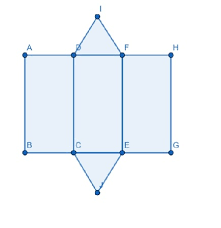
1. Do the above activity by making a triangular shaped box and discuss your observations.

Activity W2.4: Exploring Volume – Making a Triangular-Shaped Box

Objective:

To explore how the shape of the base affects the volume of a box when using the same-sized sheet of paper. In this activity, students will make a triangular prism from the same-sized sheet used in Activity W2.3 and compare its volume with rectangular-based boxes.

 Materials Needed:

  • 1 rectangular sheet of paper (same size as previous activity)

  • Power tape or glue

  • Ruler

  • Grains or rice for measuring volume

  • Empty container

 Procedure:

  1. Take a rectangular sheet (e.g., 20 cm × 16 cm).

  2. Fold or cut it to form a triangular prism box.

    • Fold the paper into a strip.

    • Roll or shape the cross-section into a triangle (e.g., equilateral or right-angled).

    • Tape or glue the edges securely.

  3. Seal one end of the prism to make a base.

  4. Pour grains/rice into the triangular box until full.

  5. Pour the contents into a measuring container or another rectangular box made from the same paper.

  6. Compare the amount of rice or volume occupied.

 A triangular prism made of paper


Example Calculation:

Let’s assume:

  • Base of triangle = 8 cm

  • Height of triangle = 5 cm

  • Length (height of prism) = 16 cm

Volume of triangular prism =

Area of triangle×Length=12×8×5×16=320 cm³\text{Area of triangle} \times \text{Length} = \frac{1}{2} \times 8 \times 5 \times 16 = 320 \text{ cm³}

Compare with:

  • Rectangular box from same paper = 640 cm³ (from W2.3)

  • Triangular box = 320 cm³

The triangular box holds less than the rectangular box made from the same paper.

Discussion Questions:

  1. Why do you think the triangular box holds less?
    Because the base of the triangle has less area than a rectangular base from the same paper.

  2. How does the shape of the base affect volume, even with the same surface area?
     Shapes with broader or fuller bases (like rectangles) tend to enclose more volume than narrow ones (like triangles), assuming the same height.

  3. What if you made a cylinder instead from the same paper? Would it hold more or less?
     You could explore this in the next activity!

Conclusion:

By folding the same-sized paper into different 3D shapes (rectangular, triangular), we observe that volume is influenced by the shape of the base. Even with identical surface area, design and folding technique can greatly impact how much a box can hold.

Class 6 NCERT bridge course Answers Activity W2.3 Volume – Making Boxes of Different Volumes

 Volume: Making boxes of different volume from same size paper: 

Activity W2.3 

 Take two rectangular papers of the same size and different colours (say blue and yellow). 

First take any paper, say blue colour, crease it along the larger side from the middle such that both parts become equal (Fig. 1).


Crease the same paper from the middle such that both parts become equal and this divides the paper in four equal parts (Fig. 2). 

 Now join the open sides of the paper with power tape and form a box (Fig. 3)

Do the same with another paper, say yellow colour, by creasing it along the shorter side and form another box (Fig. 4 and Fig.5). 


 Now put the blue box on the table vertically so that one open side faces the table and the other side upwards and fill it completely with rice/grains. 

Empty all the rice in a container and fill the yellow box with this rice. 

Does it fill the blue box completely or not?


Activity W2.3: Volume – Making Boxes of Different Volumes

Objective:
To explore how folding the same size paper in different ways creates boxes of different volumes.

 Materials Needed:

  • 2 rectangular sheets of the same size (different colors, e.g., blue and yellow)

  • Power tape or glue

  • Grains or rice

  • Container to transfer grains

 Procedure:

  1. Blue paper:
    Fold the paper in half along the longer side.
    Then fold it again along the shorter side, dividing it into four equal parts.

  2. Tape the open edges to form a tall box.

  3. Yellow paper:
    Fold it first along the shorter side, then in half again.
    Tape the open edges to form a shorter, wider box.

  4. Fill the blue box with rice.
    Pour the rice into the yellow box.

 Question:

Does the yellow box hold the same amount of rice as the blue one?

 Example Calculation:

Suppose each paper is 20 cm × 16 cm:

  • Blue box (base = 8 cm × 10 cm, height = 8 cm)
    Volume = 8 × 10 × 8 = 640 cm³

  • Yellow box (base = 16 cm × 5 cm, height = 5 cm)
    Volume = 16 × 5 × 5 = 400 cm³

Result: The blue box holds more!

Conclusion:

Even when using the same sheet size, the way you fold and form a box greatly affects its volume. Taller, narrower shapes can sometimes hold more than shorter, wider ones.


Class 6 NCERT bridge course Answers Activity W2.2 Exploring Shapes and Spaces in Our School

Activity W2.2: Exploring Shapes and Spaces in Our School

The activity can be extended to measuring rooms and other spaces of different shapes available in the school. 

Discussion may be held about that


Activity W2.2: Exploring Shapes and Spaces in Our School

Objective

Students will measure and compare the dimensions and boundaries (perimeters) of various rooms and spaces in their school using estimation and measuring tools. They will also identify the shapes of these spaces and discuss their characteristics.

Materials Needed

  • Measuring tapes or meter sticks

  • Notebooks or worksheets

  • Geometry tools (optional: rulers, chalk, string)

  • Camera or phone (optional for images)

  • Chalk for marking lengths on the floor (optional)

Instructions

Step 1: Select Spaces to Measure

Ask students to choose or assign different school areas, such as:

  • Classroom

  • Library

  • Playground

  • Corridor

  • Principal’s office

  • School garden or assembly area

Step 2: Measure Dimensions

Measure the length and width (or any relevant dimensions) of each space.

Examples:

  • Classroom: Length = 8 meters, Width = 6 meters

  • Library: Length = 10 meters, Width = 7 meters

  • Corridor: Length = 20 meters, Width = 3 meters

Step 3: Calculate the Perimeter

Use the formula based on the shape:

  • Rectangle/Square: Perimeter = 2 × (Length + Width)

  • L-Shaped or Irregular Space: Add all the outer edge lengths

Example:

  • Classroom: 2 × (8 + 6) = 28 meters

  • Library: 2 × (10 + 7) = 34 meters

Step 4: Identify the Shape

Discuss what shape each room or space is (rectangular, square, L-shape, circular, etc.).

Step 5: Compare Spaces

Create a comparison table for all the rooms:

  • Which room is the biggest?

  • Which has the longest perimeter?

  • Which has the most unusual shape?

Example

SpaceLength (m)Width (m)ShapePerimeter (m)Notes
Classroom86Rectangle28Regular shape
Library107Rectangle34Bigger than classroom
Corridor203Rectangle46Longest perimeter
GardenIrregular-Irregular~55 (estimated)Has many corners
  • Which room has the largest perimeter?

  • Which space is most difficult to measure? Why?

  • What challenges do we face when measuring curved or irregular shapes?

  • How can we estimate measurements when exact tools are not available?

  1. Diagram of a rectangular classroom with length and width labeled


Bird’s-eye view of school map, showing measured spaces


Students measuring a corridor using tape measure


Comparison chart of perimeters of different spaces

Comparison Chart: Perimeters of Different Spaces

Name of SpaceShapeDimensions (in m)Formula UsedPerimeter (in m)
ClassroomRectangleLength = 8, Width = 62 × (L + W)28
PlaygroundSquareSide = 304 × side120
GardenRectangleLength = 15, Width = 102 × (L + W)50
School BuildingIrregularSides = 10, 20, 15, 25Add all sides70
Circular FountainCircleRadius = 42 × π × r ≈ 2 × 3.14 × 4≈ 25.12
Basketball CourtRectangleLength = 28, Width = 152 × (L + W)86
Football FieldRectangleLength = 100, Width = 502 × (L + W)300
Triangle ParkTriangleSides = 20, 20, 30Add all sides70


Sketch of irregular space (like L-shape) with perimeter shown as sum of edge lengths


Perimeter Comparison Chart

🧮 Interactive Worksheet: Perimeters of Different Spaces

Name of Space Shape Dimensions (in m) Formula Used Perimeter (in m)

📝 Discussion Questions

  • Which space has the longest perimeter?
  • Which shapes have the simplest formulas?
  • How does changing dimensions (like length or radius) affect the perimeter?

Tuesday, May 20, 2025

Mazes

Maze Game

🧠 Solve the Math Maze!

⬆️
⬇️
⬅️
➡️
⏱ Time: 0s

CONSECUTIVE NUMBERS

CONSECUTIVE NUMBERS

Place -1, -2, -3,-4,-5,-6,-7,-8 in these boxes so that the boxes which have consecutive numbers do not touch. 
They should not touch at all, not even at the corners. 
How many ways are possible?


Strategy to Solve:

To solve this, we need to:

  1. Model the adjacency of the 8 boxes using the image.

  2. Generate all permutations of the numbers –1 to –8.

  3. For each permutation:

    • Check that no two adjacent boxes contain consecutive numbers.

  4. Count all valid arrangements.

Step-by-step Plan:

  1. Number the boxes in the image (top to bottom, left to right) for easier referencing:

      [0]
[1][2][3]
[4][5][6]
      [7]

2. Define adjacency (touching at sides or corners):
const adjacency = {
  0: [1, 2, 3],
  1: [0, 2, 4, 5],
  2: [0, 1, 3, 4, 5, 6],
  3: [0, 2, 5, 6],
  4: [1, 2, 5, 7],
  5: [1, 2, 3, 4, 6, 7],
  6: [2, 3, 5, 7],
  7: [4, 5, 6]
};

3.Generate all 8! = 40320 permutations of the numbers –1 to –8.

4. Check each permutation:
  • For each pair of adjacent boxes, check that their values are not consecutive (i.e. Math.abs(a - b) != 1).

Answer: 480 valid arrangements meet the puzzle's constraint.


Consecutive Negative Numbers Puzzle
🎲 Consecutive Negative Numbers Puzzle

Place the negative numbers from -1 to -8 into the boxes. The twist? No two consecutive numbers (e.g. -1 and -2) can be placed in adjacent boxes — even diagonally!

How to Play:

  • Drag and drop numbers into the puzzle boxes.
  • Consecutive numbers must NOT touch — not even corners!
  • Click Check to validate your puzzle and receive a medal!
⏱ Time: 0 sec

THE ADDITION AND MULTIPLICATION TABLES FOR CLOCK NUMBER 12

 THE ADDITION AND MULTIPLICATION TABLES FOR CLOCK NUMBER 12


THE ADDITION  TABLES FOR CLOCK NUMBER 12


THE  MULTIPLICATION  TABLES FOR CLOCK NUMBER 12


TRIGONOMETRIC SHOOTING CHALLENGE GAME

TRIGONOMETRIC SHOOTER CHALLENGE

Rule: Only shoot targets where the trigonometric ratio evaluates to a rational number! Hitting irrational targets will deduct points.

HOW TO PLAY

  • Use LEFT/RIGHT arrow keys to rotate the gun
  • Press SPACEBAR or click SHOOT button to fire
  • Only hit targets with GREEN background (rational values)
  • Avoid RED targets (irrational values)
  • Each correct hit: +10 points
  • Each wrong hit: -5 points
  • Game duration: 60 seconds

COMMON RATIONAL VALUES

sin(0°) = 0
sin(30°) = ½
sin(90°) = 1
cos(0°) = 1
cos(60°) = ½
tan(45°) = 1
cot(45°) = 1
sec(60°) = 2
🎯 Score: 0
⏱️ Time: 60s
✅ Hits: 0/0

Pages

CH - 2 THE BAUDHĀYANA- PYTHAGORAS THEOREM GANITA PRAKASH PART 2 FIGURE IT OUT QUESTIONS & ANSWERS

 CH - 2 THE BAUDHĀYANA-  PYTHAGORAS THEOREM  GANITA PRAKASH PART 2  FIGURE IT OUT QUESTIONS & ANSWERS 2.1 Doubling a Square Doubling a S...