Thursday, August 10, 2023

Class 08 Activity – Understanding Quadrilaterals

 Class 08 Activity – Understanding Quadrilaterals

Objective:

 To make the following by paper folding and cutting.(a) Kite (b) Rhombus

Materials Required:

 White sheets of paper, a pair of scissors, glue stick, geometry box, etc.

Procedure: 

(a) To make a kite

1. Take a white sheet of paper and fold it once from the middle as shown below.


2. Draw two line segments AB and BC of different lengths as shown.


3. Cut along the line a segments AB and BC and unfold the cut –out . Draw a dotted line along the  fold and mark the two other vertices as C and D.


(b) To make a rhombus

Take a sheet of paper and fold it from the middle as shown below. 
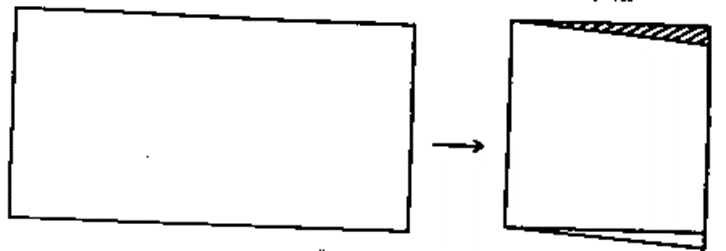


2. Draw two line segments AB and BC such that AB = BC as shown.
3. Cut along the line segments AB and BC and and unfold the cut out. Draw a dotted line along the fold and mark the two other vertices as C and D.

Observations:

On measuring the sides AB, BC, CD and DA in figure 3, we find that AB = AD and BC = DC.

Hence, ABCD in figure 3 is a kite.

2. On measuring the sides AB, BC, CD and AD in figure, we find that AB = BC = CD = AD.

Hence, ABCD  in figure 6 is a rhombus.

Class 08 Activity – Understanding Quadrilaterals2

 Class 08 Activity – Understanding Quadrilaterals2

Objective: 

To verify that the sum of the measures of the exterior angles of any polygon is 360 ° by paper cutting and pasting.

Materials Requried : 

White sheets of paper, colour pencils, a pair of scissors, glue stick, geometry box, etc.

Procedure: 

(a) Triangle

On a white sheet of paper, draw a triangle ABC and produce its each side in order as shown below. Shade the exterior angles so formed using different colours.


2. Using a pair of scissors, cut out the shaded angular regions.


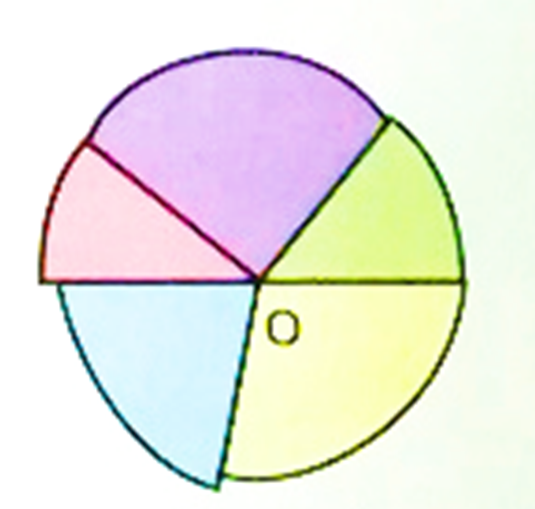
3. Mark a point O on a white sheet of paper. Paste the three cut-outs such that the vertices of these angles coincide at O, as shown below.
While pasting these cut outs, it should be noted that no two cuts should overlap and there should not be any gap between them.

(b) Quadrilateral

1. On a white sheet of paper, draw a quadrilateral ABCD and produce its sides in order as shown below. Shade the exterior angles so formed using different colours.


2. Using a pair of scissors, cut out the four shaded angular regions.
3. Mark a point on a white sheet of paper. Paste the four cut-outs such that the vertices of these angles (A, B, C, D,) coincide at O, as shown.

(c) Pentagon

On a white sheet of paper, draw a five sided polygon (pentagon) ABCDE and produce its sides in order. Shade of the exterior angles so formed using different colours. 
2. Using a pair of scissors, cut out the five shaded angular regions.
3. Mark a point O on a white sheet of paper. Paste the five cut-outs such that the vertices of these angles (A, B, C, D, E) coincide at O as shown.


(d) Hexagon

On a white sheet of paper, draw a 6 sided polygon (hexagon) ABCDEF and produce its sides in order. Shade the exterior angles so formed using different colours. 


2. Using a pair of scissors, cut out the six shaded angular regions.
3. Mark a point O of white sheet of paper.  Paste the six cut outs such that the vertices of these angles (A , B, C , D, E, F) coincide at O as shown in the fig.

Observations:

In figure, the three angular cut-outs together form a complete angle.
Thus, sum of the exterior angles of a triangle (3 sided polygon) is 360 °.
2. In figure, the four angular cut-outs together form a complete angle.
So, we can say that the sum of the exterior angles of a quadrilateral (four sided polygon) is 360°.
3. In figure, the five angular cut-outs together form a complete angle.
So, we can say that the sum of the exterior angles of a pentagon (5 sided polygon) is 360°.
4. In figure, the six angular cut-outs together form a complete angle.
So, we can say that the sum of the exterior angles of a hexagon (6 sided polygon) is 360°.

Conclusion: 

From the above activity, it is verified that the sum of the exterior angles of a polygon is 360°


Class 08 Activity – Understanding Quadrilaterals

 Based on CHAPTERs 8. Comparing Quantities 13. Direct and Inverse Proportions 3. Understanding Quadrilaterals 4. Practical Geometry

Activity – Understanding Quadrilaterals

Objective: 

To verify that the sum of the interior angles of a quadrilateral is 360 ° by paper cutting and pasting.

Materials Requried:

 White sheets of paper, colour pencils, a pair of scissors, gluestick, geometrybox, etc.

Procedure:

1. On a white sheet of paper, draw a quadrilateral ABCD. Colour its angles as shown. 
2. Using a pair of scissors, cut out the angular regions as shown below.
3. Mark a point 0 on a sheet of paper. Paste the four angular cut-outs so that the vertex of each falls at O, as shown in the figure.


Observations: 

In figure, we see that the angular cut-outs neither overlap nor leave any gap between them, i.e., the angles together form a complete angle.
∠A + ∠ B + ∠ C + ∠ D = a complete angle = 360 °
or sum of the angles of a quadrilateral is 360 °


Conclusion:

 From the above activity, it is verified that the sum of the interior angles of a quadrilateral is 360 °

Do Yourself: 

On a white sheet of paper, draw three different quadrilaterals. 
In each case, verify the angle sum property of a quadrilateral by paper cutting and pasting.


Class 08 MAZE

 Class 08 MAZE


A maze is a tour puzzle in the form of a complex branching path through which the person must find a route. 

Begin with the square marked ' start' and follow the pattern 2, 3, 4, 2, 3, 4 etc., until you get to the ' Finish'. You can only go onto a square once. 

You cannot go diagonally.


Look at the following maze. This maze has doors with operations written on them.
Start from any number and go through the doors, doing operation indicated. You can only exit with a total of 15.
Suppose we start with 4 and following path: 4 + 3 = 7 x 5 = 35 + 1 = 36 - 8 = 28
We can not exit. 
Let us try with other number.


Class 6 Mathematics - Chapter 8: Playing with Constructions

Class 6 Mathematics - Chapter 8: Playing with Constructions Class 6 Mathematics – NCERT (...