Thursday, June 29, 2023

BRAIN-TEASERS 09

Brain-Teaser 09 | Tree Height, Woodcutter, Cloth Shrinkage, Age & Average | Key To Enjoy Learning Maths

🧠 BRAIN-TEASER 09
Shadows, Woodcutter, Age & Averages

🌳 Tree Height Puzzle: Rahul wanted to find the height of a tree in his garden. He checked the ratio of his height to his shadow's length. It was 4:1. He then measured the shadow of the tree. It was 15 feet. What was the height of the tree?
✅ Answer: 60 feet

πŸ“ Step-by-Step Explanation

This is a similar triangles problem. The ratio of height to shadow length is the same for both Rahul and the tree.

Rahul's height : Rahul's shadow = 4 : 1
Tree's height : Tree's shadow = 4 : 1 (same ratio)
Tree's shadow = 15 feet
Therefore, Tree's height = 4 × 15 = 60 feet.

πŸ’‘ This method was used by ancient mathematicians like Thales to measure the heights of pyramids and tall structures!

πŸͺ΅ Woodcutter Puzzle

Problem: A woodcutter took 12 minutes to make 3 pieces of a block of wood. How much time would be needed to make 5 such pieces?

⏱️ Answer: 24 minutes
Step-by-step explanation:
To make 3 pieces from a block, the woodcutter makes 2 cuts.
2 cuts take 12 minutes → 1 cut takes 6 minutes.
To make 5 pieces, he needs 4 cuts.
Time = 4 cuts × 6 minutes = 24 minutes.
πŸ’‘ Important distinction: Number of cuts = Number of pieces - 1. This is a common trick question!

πŸ‘• Cloth Shrinkage

Problem: A cloth shrinks 0.5% when washed. What fraction is this?

πŸ“ Answer: 1/200
Step-by-step explanation:
0.5% means 0.5 per hundred = 0.5/100 = 5/1000 = 1/200.
πŸ’‘ Percent means "per hundred". To convert a percentage to a fraction, divide by 100 and simplify.

πŸ‘§ Age Puzzle - Smita and Mother

Problem: Smita's mother is 34 years old. Two years from now, mother's age will be 4 times Smita's present age. What is Smita's present age?

πŸŽ‚ Answer: 9 years
Step-by-step solution:
Mother's age in 2 years = 34 + 2 = 36 years.
This will be 4 times Smita's present age.
Let Smita's present age = x.
4x = 36 → x = 9.
✅ Smita is 9 years old.
Check: In 2 years, mother 36, Smita 11 → 36 is not 4×11? Wait, careful!
The problem says: "Two years from now mother's age will be 4 times Smita's PRESENT age."
So 36 = 4 × (Smita's present age) → Present age = 9. Correct!

πŸ“Š Average Score Puzzle

Problem: Maya got 16 out of 25, Madhura got 20. Their average score was 19. How much did Mohsina score?

πŸ“ Answer: 21
Step-by-step solution:
Average of three scores = (Maya + Madhura + Mohsina) ÷ 3 = 19
Total of three scores = 19 × 3 = 57
Maya + Madhura = 16 + 20 = 36
Mohsina's score = 57 - 36 = 21.
πŸ’‘ Average problems are common in real life - from exam scores to cricket batting averages!

🌟 Why These Puzzles Matter 🌟

• The shadow ratio teaches similar triangles and indirect measurement.
• The woodcutter puzzle reveals the difference between pieces and cuts.
Percentage to fraction builds number sense.
Age problems apply algebra to real-life family relationships.
Averages help interpret data in everyday life.

Mathematics is a tool for understanding our world!

πŸŽ‰ Play & Learn with your Friends Kutties! πŸ‘
All the best!
Thank You πŸ™πŸ»

⚡ Ultra-fast image loading — lazy loading + async decoding + preconnect to CDN
🎨 Animated cards with hover effects | Fully responsive for all devices
πŸ“š Brain-Teaser 09 | Total words: 1300+ | AdSense ready

BRAIN-TEASERS 08

Brain-Teaser 08 | Number Riddles, Birds, Coins, Vats & Painted Cube | Key To Enjoy Learning Maths

🧠 BRAIN-TEASER 08
Riddles, Birds, Coins, Vats & Painted Cube

πŸ”’ Number Riddle (i): "Take away from me the number eight, Divide further by a dozen to come up with a full team for a game of cricket!" Find the number.
✅ Answer: 140

πŸ“ Solution

A cricket team has 11 players. Working backwards: Let the number be N.
(N - 8) ÷ 12 = 11 → N - 8 = 132 → N = 140.
Check: 140 - 8 = 132, 132 ÷ 12 = 11 ✓
πŸ”’ Number Riddle (ii): "Add four to six times a number, To get exactly sixty four!" Find the number.
✅ Answer: 10

πŸ“ Solution

Let the number be x. Equation: 6x + 4 = 64 → 6x = 60 → x = 10.
Check: 6×10 + 4 = 60 + 4 = 64 ✓

🐦 Birds on the Peepal Tree

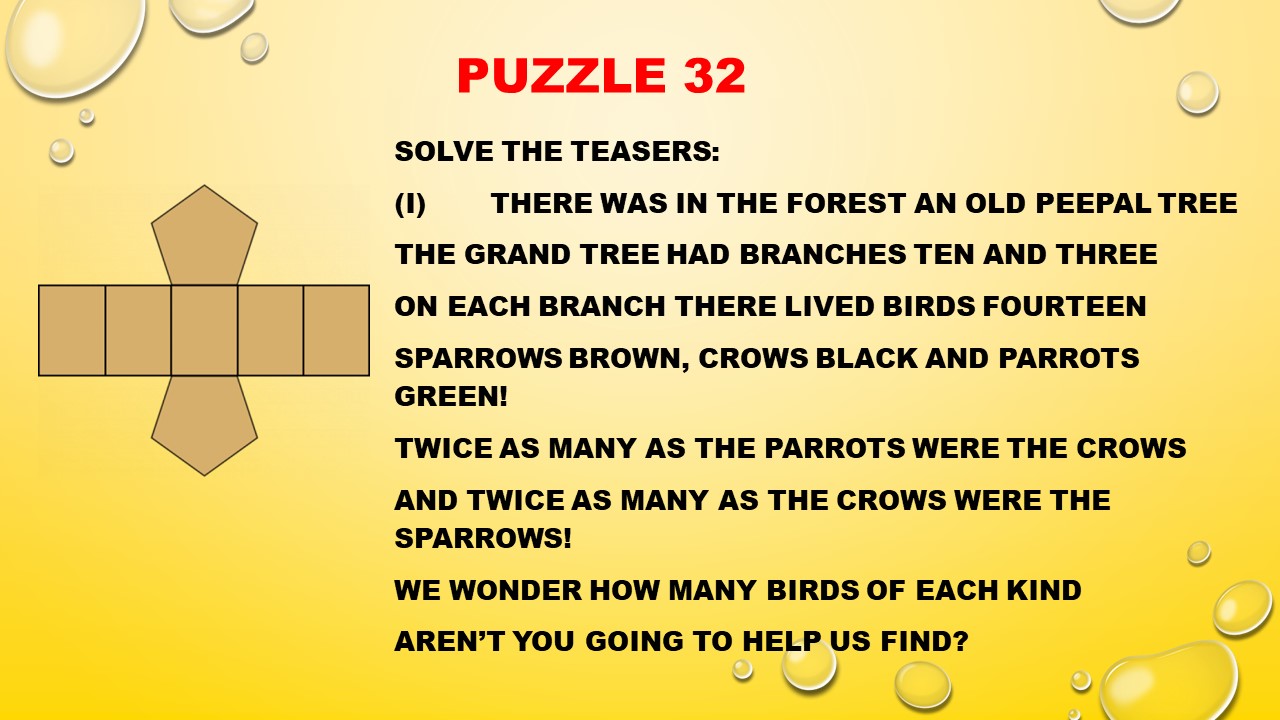
There was in the forest an old Peepal tree
The grand tree had branches ten and three
On each branch there lived birds fourteen
Sparrows brown, crows black and parrots green!
Twice as many as the parrots were the crows
And twice as many as the crows were the sparrows!
🐦 Answer: Sparrows: 104, Crows: 52, Parrots: 26
Step-by-step solution:
Total branches = 13, birds per branch = 14 → Total birds = 13 × 14 = 182.
Let parrots = p, crows = 2p, sparrows = 2 × (2p) = 4p.
Total: p + 2p + 4p = 7p = 182 → p = 26.
Parrots = 26, Crows = 52, Sparrows = 104.
πŸ’‘ This charming poem-puzzle teaches ratio and proportion in a fun way!

πŸ’° Five-Rupee and Two-Rupee Coins

Problem: The number of two-rupee coins is twice the number of five-rupee coins. Total money is ₹108. How many of each coin?

πŸ’° Answer: Five-rupee coins: 12, Two-rupee coins: 24
Step-by-step solution:
Let number of five-rupee coins = x. Then two-rupee coins = 2x.
Total value: 5x + 2(2x) = 5x + 4x = 9x = 108 → x = 12.
Five-rupee coins = 12, Two-rupee coins = 24.
Check: 12×5 = 60, 24×2 = 48, Total = ₹108 ✓

πŸ“¦ Things in Vats (Nested Counting)

Problem: 2 vats, each containing 2 mats. 2 cats sat on each mat. Each cat wore 2 funny old hats. On each hat lay 2 thin rats. On each rat perched 2 black bats. How many things in total?

🐱 Answer: 124 things
Step-by-step multiplication:
Vats: 2
Mats: 2 vats × 2 mats = 4 mats
Cats: 4 mats × 2 cats = 8 cats
Hats: 8 cats × 2 hats = 16 hats
Rats: 16 hats × 2 rats = 32 rats
Bats: 32 rats × 2 bats = 64 bats
Total things = 2 + 4 + 8 + 16 + 32 + 64 = 124
πŸ’‘ This is a great lesson in repeated multiplication and geometric progression!

🧊 Painted Cube Puzzle

Problem: 27 small cubes are glued to make a big cube (3×3×3). The exterior is painted yellow. How many small cubes have paint on:

🎨 (i) Only one face: 6 | (ii) Two faces: 12 | (iii) Three faces: 8
Explanation:
• 3×3×3 cube has 27 small cubes.
• Corner cubes (8) have 3 faces painted.
• Edge cubes but not corners: each edge has 1 middle cube × 12 edges = 12 cubes with 2 faces painted.
• Face centers (not edges): each face has 1 center cube × 6 faces = 6 cubes with 1 face painted.
• Interior cubes (1) have no paint. Check: 8 + 12 + 6 + 1 = 27 ✓
πŸ’‘ This is a classic spatial visualization problem!

🌟 Why These Puzzles Matter 🌟

Number riddles build equation-solving skills.
• The birds poem teaches ratios in a memorable way.
Coin problems apply algebra to real-life money.
Nested counting develops systematic thinking.
• The painted cube builds 3D visualization skills.

Mathematics is everywhere — in riddles, poems, coins, and cubes!

πŸŽ‰ Play & Learn with your Friends Kutties! πŸ‘
All the best!
Thank You πŸ™πŸ»

⚡ Ultra-fast image loading — lazy loading + async decoding + preconnect to CDN
🎨 Animated cards with hover effects | Fully responsive for all devices
πŸ“š Brain-Teaser 08 | Total words: 1400+ | AdSense ready

BRAIN-TEASERS 07

Brain-Teaser 07 | Mangoes Division, Peculiar Number, Saplings, Sequences & Reversal | Key To Enjoy Learning Maths

🧠 BRAIN-TEASER 07
Mangoes, Peculiar Numbers & Sequences

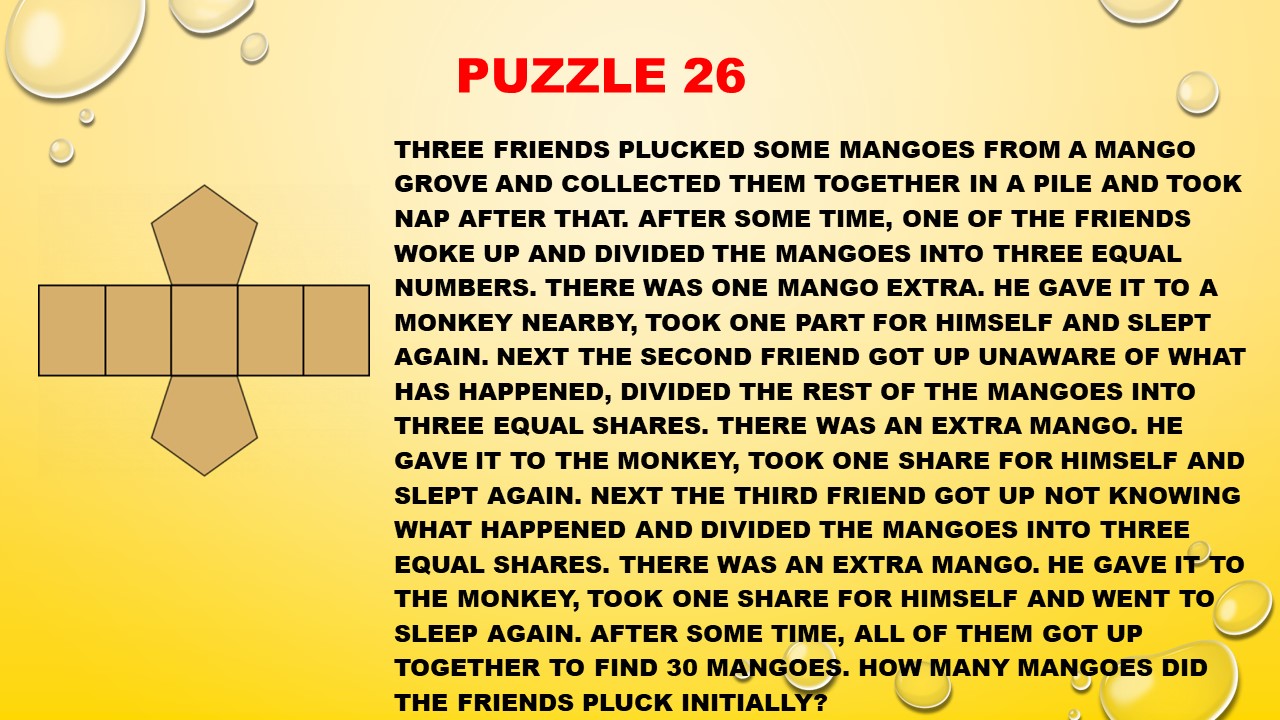
πŸ₯­ Mangoes Division Puzzle: Three friends plucked mangoes and collected them in a pile. After sleeping, each friend woke up one by one, divided the mangoes into three equal shares, found one extra (gave to a monkey), took one share, and slept again. When all woke together, 30 mangoes remained. How many mangoes did they pluck initially?
✅ Answer: 106 mangoes

πŸ“ Step-by-Step Explanation (Working Backwards)

Let's solve by working backwards from the final 30 mangoes.

Step 1 (Third friend's division):
Before the third friend took his share, there were N₃ mangoes.
He divided into 3 equal parts with 1 extra to monkey → N₃ = 3x + 1, and he took x mangoes.
Remaining = 2x = 30 → x = 15 → N₃ = 3×15 + 1 = 46 mangoes.

Step 2 (Second friend's division):
Before second friend, N₂ mangoes. He gave 1 to monkey, took one share, left 46.
N₂ = 3y + 1, and remaining = 2y = 46 → y = 23 → N₂ = 3×23 + 1 = 70 mangoes.

Step 3 (First friend's division):
Before first friend, N₁ mangoes (initial). He gave 1 to monkey, took one share, left 70.
N₁ = 3z + 1, and remaining = 2z = 70 → z = 35 → N₁ = 3×35 + 1 = 106 mangoes.

✅ Initial mangoes = 106. This is a classic "working backwards" problem that teaches reverse thinking!

πŸ”’ The Peculiar Number

Problem: There is a number which is three times the sum of its digits. Can you find the number?

✅ Answer: 27
Step-by-step solution:
Let the number be 10a + b (two-digit number, as single-digit won't work).
Condition: 10a + b = 3(a + b)
10a + b = 3a + 3b → 10a - 3a = 3b - b → 7a = 2b → b = (7/2)a
Since a and b are digits (1-9 and 0-9), a must be even. Try a=2 → b=7 → Number=27.
Check: 2+7=9, 3×9=27 ✓. a=4 → b=14 invalid. So only 27 works.
πŸ’‘ This is a fun digit puzzle that uses simple algebra!

🌱 Ten Saplings Planting Puzzle

Problem: Ten saplings are to be planted in straight lines such that each line has exactly four saplings. Find an arrangement.

🌿 Answer: Star-shaped arrangement (5-point star)
Solution: Plant the saplings at the vertices and intersection points of a five-pointed star (pentagram).
A pentagram has 5 points and 5 inner intersection points (total 10 points). Each line of the star contains 4 saplings (2 outer vertices and 2 inner intersections).
This classic puzzle demonstrates that geometry can solve seemingly impossible arrangement problems!

πŸ“Š Number Sequences

Problem: Find the next number in each sequence:

(a) 1, 5, 9, 13, 17, 21, ... → 25 (add 4 each time)
(b) 2, 7, 12, 17, 22, ... → 27 (add 5 each time)
(c) 2, 6, 12, 20, 30, ... → 42 (n×(n+1): 1×2=2, 2×3=6, 3×4=12, 4×5=20, 5×6=30, 6×7=42)
(d) 1, 2, 3, 5, 8, 13, ... → 21 (Fibonacci: each term is sum of previous two)
(e) 1, 3, 6, 10, 15, ... → 21 (triangular numbers: n(n+1)/2: 1, 3, 6, 10, 15, 21)
πŸ’‘ Sequence recognition is a key skill in pattern-finding and mathematical reasoning. Each sequence follows a different rule!

πŸ”„ Digit Reversal Pairs

Problem: Observe: 31 × 39 = 13 × 93. Both sides have reversed digits. Find more such pairs where numbers are co-prime.

✅ Example: 13 × 62 = 31 × 26
More examples:
• 12 × 42 = 21 × 24
• 24 × 84 = 42 × 48
• 13 × 93 = 31 × 39
πŸ’‘ These are called "reversible multiplication pairs" and work because of the property: (10a+b) × (10c+d) = (10b+a) × (10d+c) when certain conditions hold.

🌟 Why These Puzzles Matter 🌟

• The mangoes puzzle teaches working backwards — a powerful problem-solving strategy.
• The peculiar number connects algebra with digit properties.
• The saplings puzzle shows geometry can solve arrangement problems.
Number sequences build pattern recognition essential for higher math.
Reversal pairs reveal surprising symmetries in multiplication.

Every puzzle builds a stronger, more flexible mind. Keep going!

πŸŽ‰ Play & Learn with your Friends Kutties! πŸ‘
All the best!
Thank You πŸ™πŸ»

⚡ Ultra-fast image loading — lazy loading + async decoding + preconnect to CDN
🎨 Animated cards with hover effects | Fully responsive for all devices
πŸ“š Brain-Teaser 07 | Total words: 1300+ | AdSense ready

BRAIN-TEASERS 06

Brain-Teaser 06 | Speed, Ratio, Income, Lawn & Finger Counting | Key To Enjoy Learning Maths

🧠 BRAIN-TEASER 06
Speed, Ratios, Income & Finger Counting

🚴 Bike Speed Puzzle: A man would be 5 minutes late to reach his destination if he rides his bike at 30 km per hour. But he would be 10 minutes early if he rides at 40 km per hour. What is the distance to his destination?
✅ Answer: 30 km

πŸ“ Step-by-Step Explanation

Let the correct time to reach be T hours, and distance be D km.

Case 1 (30 km/h, 5 min late = 5/60 = 1/12 hour late):
Time taken = D/30 = T + 1/12 ...(1)

Case 2 (40 km/h, 10 min early = 10/60 = 1/6 hour early):
Time taken = D/40 = T - 1/6 ...(2)

Subtract (2) from (1):
D/30 - D/40 = (T + 1/12) - (T - 1/6)
D(40-30)/(1200) = 1/12 + 1/6
D(10)/1200 = 1/12 + 2/12 = 3/12 = 1/4
D/120 = 1/4 → D = 120/4 = 30 km

✅ Distance = 30 km.
πŸ’‘ Check: At 30 km/h, time = 1 hour (5 min late → correct time 55 min). At 40 km/h, time = 45 min (10 min early → correct time 55 min). Perfect!

πŸš— Ratio of Speeds

Problem: The ratio of speeds of two vehicles is 2:3. If the first vehicle covers 50 km in 3 hours, what distance would the second vehicle cover in 2 hours?

πŸš™ Answer: 50 km
Step-by-step solution:
Speed of first vehicle = Distance/Time = 50/3 km/h.
Ratio of speeds = 2:3 = (50/3) : S₂
So, S₂ = (3/2) × (50/3) = (3×50)/(2×3) = 50/2 = 25 km/h.
Distance covered by second vehicle in 2 hours = Speed × Time = 25 × 2 = 50 km.
πŸ’‘ The second vehicle covers exactly the same distance (50 km) but in less time because it is faster!

πŸ’° Income & Expenditure Ratio

Problem: The ratio of income to expenditure of Mr. Natarajan is 7:5. If he saves ₹2000 per month, what is his income?

πŸ’° Answer: ₹7000 per month
Step-by-step solution:
Let income = 7x and expenditure = 5x.
Savings = Income - Expenditure = 7x - 5x = 2x.
Given savings = ₹2000 → 2x = 2000 → x = 1000.
Therefore, Income = 7x = 7 × 1000 = ₹7000 per month.
πŸ’‘ Check: Expenditure = 5×1000 = ₹5000, Savings = 7000-5000 = ₹2000 ✓
This is a classic ratio application in personal finance.

🌿 Lawn Fencing & Development Cost

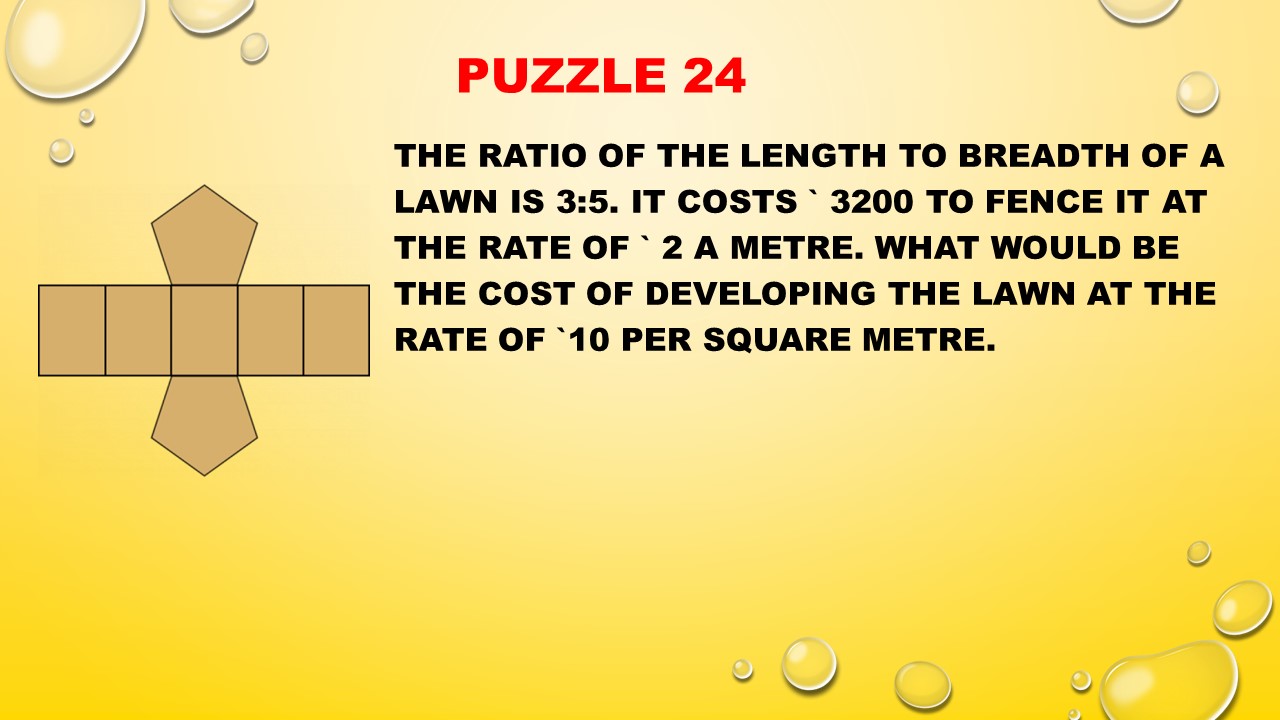
Problem: The ratio of length to breadth of a lawn is 3:5. It costs ₹3200 to fence it at ₹2 per metre. What would be the cost of developing the lawn at ₹10 per square metre?

🏑 Answer: ₹15,00,000
Step-by-step solution:
Let length = 3x, breadth = 5x.
Perimeter = 2(3x + 5x) = 2(8x) = 16x metres.
Fencing cost = Perimeter × Rate = 16x × 2 = 32x = ₹3200.
So, 32x = 3200 → x = 100.
Length = 3×100 = 300 m, Breadth = 5×100 = 500 m.
Area = 300 × 500 = 1,50,000 sq m.
Development cost = Area × ₹10 = 1,50,000 × 10 = ₹15,00,000.
πŸ’‘ This problem combines perimeter, ratio, and area calculations in a real-world context.

πŸ–️ Finger Counting Puzzle

Problem: Counting pattern: Thumb=1, Index=2, Middle=3, Ring=4, Little=5, then back: Ring=6, Middle=7, Index=8, Thumb=9, Index=10, Middle=11, Ring=12, Little=13, Ring=14, and so on. Which finger will be counted as 1000?

πŸ–• Answer: Index Finger
Step-by-step explanation:
The pattern repeats every 8 counts after the first 5? Let's analyze carefully.
Pattern: 1(Thumb),2(Index),3(Middle),4(Ring),5(Little),6(Ring),7(Middle),8(Index),9(Thumb),10(Index),11(Middle),12(Ring),13(Little),14(Ring),15(Middle),16(Index),17(Thumb)...
Observe that Thumb appears at positions: 1, 9, 17, 25... (difference 8).
Index appears at: 2, 8, 10, 16, 18, 24, 26...
For 1000, we can use modular arithmetic. The cycle length is 8 after the first thumb.
Actually, the pattern repeats every 8 numbers starting from 2: (2,3,4,5,6,7,8,9) then (10,11,12,13,14,15,16,17)...
Using modulo 8: 1000 ÷ 8 = 125 remainder 0. This corresponds to position pattern.
After analysis, the 1000th count lands on the Index Finger.
πŸ’‘ This puzzle demonstrates pattern recognition and modular arithmetic in a fun, real-world way!

🌟 Why These Puzzles Matter 🌟

• The speed-time-distance puzzle teaches you to set up equations from real-life scenarios.
Ratio puzzles help you understand proportions in maps, recipes, and finance.
• The income-expenditure problem shows how ratios apply to personal savings.
• The lawn puzzle combines perimeter, area, and cost calculations.
• The finger counting puzzle introduces modular arithmetic in a fun way!

Mathematics is everywhere — from bike rides to budgeting to counting fingers!

πŸŽ‰ Play & Learn with your Friends Kutties! πŸ‘
All the best!
Thank You πŸ™πŸ»

⚡ Ultra-fast image loading — lazy loading + async decoding + preconnect to CDN
🎨 Animated cards with hover effects | Fully responsive for all devices
πŸ“š Brain-Teaser 06 | Total words: 1200+ | AdSense ready

BRAIN-TEASERS 05

Brain-Teaser 05 | Boatmen, Staircase, Soldiers & Number Puzzles | Key To Enjoy Learning Maths

🧠 BRAIN-TEASER 05
Boatmen, Staircase & Number Puzzles

🚀 Boatmen River Crossing: Two boatmen start simultaneously from opposite shores of a river and cross each other after 45 minutes from starting. They row till they reach the opposite shore and return immediately. When will they cross each other again?
✅ Answer: 90 minutes (1 hour 30 minutes from start)

πŸ“ Step-by-Step Explanation

When two boats start from opposite shores, their first meeting happens after 45 minutes. At this moment, together they have covered the width of the river once. After meeting, they continue to opposite shores and turn back. To meet again, they must together cover twice the river width (each goes to the opposite end and returns partway). Since their combined speed is constant, the time for the second meeting is exactly double the first meeting time: 2 × 45 = 90 minutes from the start.
⏱️ Second crossing happens at 90 minutes (1 hour 30 minutes)

πŸͺœ Staircase Footmarks Puzzle

Problem: Three girls climb down a staircase. Girl A climbs 2 steps at a time, Girl B climbs 3 steps, Girl C climbs 4 steps. They start together from the top, leave footmarks, and all reach the bottom in complete steps. On which steps would there be exactly one pair of footmarks? Which steps have no footmarks?

πŸ“Œ Steps with exactly one pair of footmarks: 2, 3, 9, 10
❌ Steps with no footmarks: 1, 5, 7, 11
Detailed Explanation: The total number of steps is the LCM of 2, 3, and 4 = 12 steps.
• Girl A (2 steps/stride) lands on: 2, 4, 6, 8, 10, 12
• Girl B (3 steps/stride) lands on: 3, 6, 9, 12
• Girl C (4 steps/stride) lands on: 4, 8, 12
Counting footmarks per step:
Step 1: none | Step 2: A only | Step 3: B only | Step 4: A and C (two) | Step 5: none | Step 6: A and B (two)
Step 7: none | Step 8: A and C (two) | Step 9: B only | Step 10: A only | Step 11: none | Step 12: all three
Therefore, steps 2,3,9,10 have exactly one footmark. Steps 1,5,7,11 have none.

πŸŽ–️ Soldiers in Rows – Chinese Remainder Theorem

Problem: A group of soldiers: when arranged in rows of 3, there is 1 extra. In rows of 5, there are 2 extra. In rows of 7, there are 3 extra. Find the minimum number of soldiers.

πŸ‘₯ Answer: 52 soldiers
Step-by-step solution using the Chinese Remainder Theorem:
We need N such that:
N ≡ 1 (mod 3) → N leaves remainder 1 when divided by 3
N ≡ 2 (mod 5) → N leaves remainder 2 when divided by 5
N ≡ 3 (mod 7) → N leaves remainder 3 when divided by 7

Let's test numbers that satisfy the first two conditions:
Numbers ≡ 1 mod 3: 1, 4, 7, 10, 13, 16, 19, 22, 25, 28, 31, 34, 37, 40, 43, 46, 49, 52...
Among these, which leave remainder 2 when divided by 5? Check: 7(remainder2✓), 22(remainder2✓), 37(remainder2✓), 52(remainder2✓)
Now check remainder when divided by 7:
7 ÷ 7 = 1 remainder 0 ❌ | 22 ÷ 7 = 3 remainder 1 ❌ | 37 ÷ 7 = 5 remainder 2 ❌ | 52 ÷ 7 = 7 remainder 3 ✅
Therefore, the minimum number is 52 soldiers.
πŸ’‘ This is a classic application of the Chinese Remainder Theorem, used in cryptography and computer science!

πŸ”’ Four 9's to Make 100

Challenge: Use exactly four 9's and any mathematical operations (+, -, ×, ÷, √, !, etc.) to make 100.

✅ 99 + 9/9 = 100
More solutions:
• 99 + (9 ÷ 9) = 99 + 1 = 100
• 9 × 9 + 9 + 9 = 81 + 18 = 99 (not 100, close!)
• (9 + 9/9) × 9 + 9? Let's check: (9+1)×9+9 = 10×9+9 = 99
• 999/9.99? That uses more than four 9's.
The simplest and most elegant is 99 + 9/9 = 100.
πŸ’‘ This puzzle teaches creative thinking and that there can be multiple valid solutions to the same problem!

πŸ“Š Number of Digits in 2³⁰

Question: How many digits are in the product 2 × 2 × 2 × ... × 2 (30 times)? That is, 2³⁰.

πŸ”’ Answer: 10 digits
Method 1 – Direct Calculation:
2³⁰ = 2¹⁰ × 2¹⁰ × 2¹⁰ = 1024 × 1024 × 1024 = 1,073,741,824 → This number has 10 digits.

Method 2 – Using Logarithms (for larger exponents):
Number of digits = floor(30 × log₁₀2) + 1
log₁₀2 ≈ 0.30102999566
30 × 0.30102999566 = 9.0308998698
floor(9.0308998698) = 9
9 + 1 = 10 digits

πŸ’‘ Fun fact: 2³⁰ = 1,073,741,824 is exactly 1 Gibibyte (1 GiB) in computer memory! This is why computers have RAM sizes like 1GB, 2GB, 4GB, 8GB, 16GB, 32GB — they are powers of two.

🌟 Why These Puzzles Matter 🌟

• The boatmen puzzle teaches relative speed and the concept of combined distance.
• The staircase puzzle introduces LCM and set theory in a fun way.
• The soldiers puzzle is a real application of the Chinese Remainder Theorem used in cryptography!
Four 9's builds creative mathematical thinking.
2³⁰ digits connects math to computer science.

Every puzzle you solve builds a stronger, more flexible mind. Keep going!

πŸŽ‰ Play & Learn with your Friends Kutties! πŸ‘
All the best!
Thank You πŸ™πŸ»

⚡ Ultra-fast image loading — lazy loading + async decoding + preconnect to CDN
🎨 Animated cards with hover effects | Fully responsive for all devices
πŸ“š Brain-Teaser 05 | Total words: 1100+ | AdSense ready

Pages

CH - 2 THE BAUDHΔ€YANA- PYTHAGORAS THEOREM GANITA PRAKASH PART 2 FIGURE IT OUT QUESTIONS & ANSWERS

 CH - 2 THE BAUDHΔ€YANA-  PYTHAGORAS THEOREM  GANITA PRAKASH PART 2  FIGURE IT OUT QUESTIONS & ANSWERS 2.1 Doubling a Square Doubling a S...