Wednesday, July 26, 2023

Class 07 Fun Activity – Algebraic Expression

 Fun Activity – Algebraic Expression

Given the values a = 5, b = 3, c = 6, and d = 10.

Move from Start to finish and evaluate the algebraic expressions on the way using the given values. Take the path going from one odd number to another.


Fun Activity – Algebraic Expression - Solution
Given the values a = 5, b = 3, c = 6, and d = 10.
Move from Start to finish and evaluate the algebraic expressions on the way using the given values. Take the path going from one odd number to another.

3ab = 3 x 5 x 3 = 45


2ab= 2 x 5 x 3 = 30
9a = 9 x 5 = 45 5ac / 2 = (5 x 5 x6)/2 =150/2=75
3ac/ 2= (3 x 5 x 6)/2 = 90/2 = 45 5b2  = 5 x 3 x 3= 45 
6ab = 6 x 5 x 3 =90 abd/2 =( 5 x 3 x 10)/2=150/2=75
bcd/2 = (3x6x10)/2 =180/2=90 3acd/4= (3x5x6x10)/4=900/4=225
3cd/4=(3x6x10)/4=180/4=45 2a2 = 2x5x5=50
7ab = 7 x 5 x 3 = 105 abd = 5x3x10=150
c/2 = 6/2=3 abc/2 = (5 x 3x6)/2 = 90 /2=45
3ad/2 = 3x 5 x 10/2 = 150/2=75 bcd/4 = (3x6x10)/4= 180/4=45
7ac = 7 x 5x 6=210 6ad/4 = (6x 5x 10)/4=300/4=75
c2 + d2 = 36+100=136 a2 + b2 = 25+9 =34
2ad = 2 x 5 x 10 =100 acd/4 = 5 x 6 x 10 /4 = 300 /4 = 75
bd/6 = 3x10 /6 = 30 /6 =5 d2 /4 = 100 / 4 =25
a2 = 5 x 5 = 25 b2 = 3 x 3 =9
5b = 5 x 3 =15 6ab = 6x 5 x 3 = 90


Fun Activity – Algebraic Expression - solution


Class 07 Activity - Rational Numbers

 Activity - Rational Numbers

GROUP ACTIVITY

This activity involves finding rational numbers between two rational numbers.

Teacher will write about 20 pairs of rational numbers on the blackboard (at least half of them should be negative).

The student will pick out 2 pairs from these to work on.

(For example,) (− 1)/2 and ( 1 )/4  is one pair and  ( −7 )/11  and ( −6 )/11  is another pair.

The student  will find  two rational numbers that lie between the two rational numbers of the first pair, like (− 1)/4 and 0/4 lie between (− 1)/2 and ( 1 )/4

Now, he has to find two rational numbers that lie between (− 1)/4 and 0/4 . Suppose he writes (− 2)/12  and (− 1)/12  lie between and (− 1)/4 and 0/4 .

 Now he has to find two rational numbers that lie between (− 2)/12  and (− 1)/12. He can then find that (− 5)/36  and (− 4)/36 lie between (− 2)/12  and (− 1)/12


Similarly, he has to find two rational numbers between the two rational numbers of the second chosen pair.
Then again he has to find two  rational numbers between those two and again two more numbers between those two numbers.
Since the number of pairs (of rational numbers) given to the students to choose from are limited, many other students too would pick the same pair of numbers. 
Thus, a comparison could be made of their results. 
A whole array of numbers can thus be found between two rational numbers which are given. 
All the results for a particular pair could be written on a chart and then displayed in the room.

Class 07 PROJECT - TANGRAM

 PROJECT - TANGRAM

Objective : 

To understand the concept of ratio by activity, method.

Materials Required: 

Different coloured   triangle cutouts, geometry box, chart paper, etc.

Procedure: 

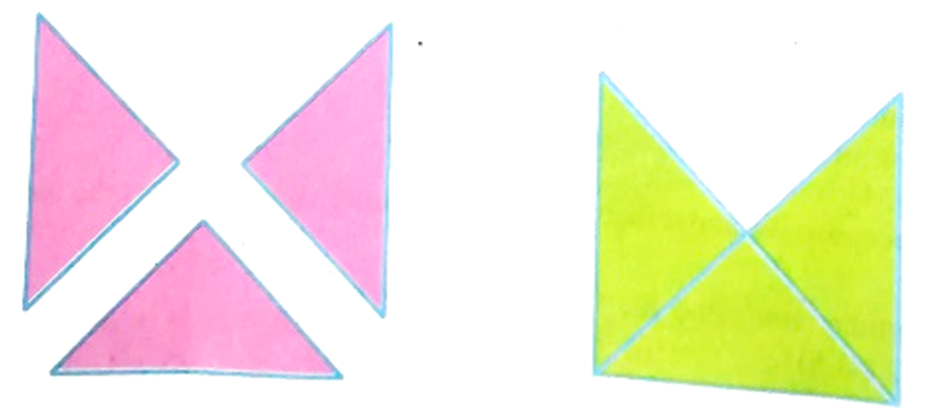
Arrange the different triangle cutouts as shown in Fig. 1.


2. Count the: different coloured triangles and record your observations. Observations :


Red triangles: Yellow triangles = ____________

2. Red triangles: Blue triangles = ______________

3. Red triangles: Green triangles = ______________

4. Red triangles: (Yellow + Blue) triangles = ______________

5. Red triangles: (Yellow + Green) triangles = ___________

6. Red triangles: (Yellow + Blue + Green) triangles = ________


Class 07 To use a 10 x 10 grid as a model for solving various types of per cent problems

 ACTIVITY – Percent Problems

Objective: 

To use a 10 x 10 grid as a model for solving various types of per cent problems.

Materials Required: 

Sketch pens, squared paper, colour pencils, geometry box, etc.

Procedure:

1. To represent the actual per cent.

1. Draw a 10 x 10 grid on a squared paper as shown in Fig. 

In the figure, one whole square represents 100 per cent and one small square represents 1 per cent. 

2. In the bottom of the big square, shade 30 small squares horizontally as shown in fig to depict 30 %


2. In the bottom of the big square, shade 30 small squares horizontally as shown in fig to depict 30 %


II. To represent the less than 1 %.
To show less than 1 per cent mark as shown in Fig. 3.

III. To represent more than 100%.
1. Make two grids of 10 x 10 each on squared papers.
2. To represent 150%, we shade one grid in full and the other 5 rows ( or 50 small squares) as shown in Fig.
100% + 50 % = 150%


Class 07 To solve a puzzle of linear equations in one variable by activity method

 ACTIVITY – Linear Equations in one Variable

Objective : 

To solve a puzzle of linear equations in one variable by activity method.

Materials Required :  

Calendar of any year. 

Procedure:

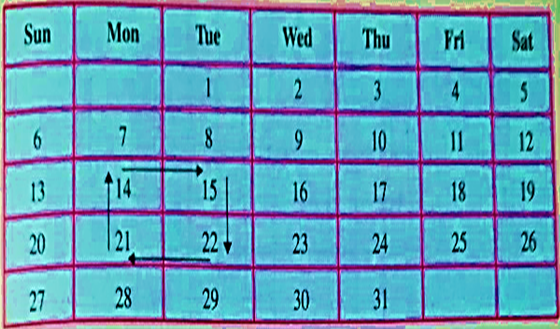
Choose four dates mentally to form a box as shown 

in the table below:

2. Find the sum of the chosen dates. Here, the sum of four chosen dates is 72. Divide 72 by 4 to get 18.

3. Now subtract 4 from 18 to get the first date, i.e., 14. To obtain other dates add 1, 7 and 8 respectively to 14.

Therefore, desired dates are 14, 15, 21 and 22.

Note: 1. This activity is done with the help of a friend.

2. Your friend would tell only the sum of the four dates.

3. After finding the dates, ask the friend whether the answer is correct or not.


Mathematical Explanation:
Let the first number (date) be x.
Then the next numbers would be x + 1, x + 7 and x + 8.
 x + x + 1 + x + 7 + x + 8 = 4x + 16
Let us say that the sum of four dates = 72
4x + 16 = 72
4 (x + 4) = 72
x + 4 = 18
x = 14
That gives you the first date. The other dates are 15, 21 and 22.


Class 07 Finding the values of 3^0, 3^1, 3^2, ........

 ACTIVITY –Exponents and Powers

Objective:

 Finding the values of 3^0, 3^1, 3^2, ........

Materials Required: 

A coloured chart paper, a scale, a pencil, an eraser, a pair of scissors.

Procedure:

1. Any rectangular piece of paper represents the base as shown in Fig. 

Number of times the rectangular piece is folded represents the exponent of the base. Cut a few equal size rectangular pieces from the chart paper. 

Let each rectangular piece represent the base 3.


2. Take one of the rectangular pieces. This piece is not folded i.e., it has been folded zero times. It represents 3^0, which is equal to 1. Hence, 3^0 = 1
3. Take another rectangular piece of chart paper.
Fold it into three equal parts along the width. 
We have folded it one time. It represents 3^1. Cut along the folds. The rectangular piece is divided into three equal parts. 
Hence, 3^1 = 3


4. Take one more rectangular piece of chart paper. Fold it once as folded in step 2 above.
Fold it once more along the width dividing it further into three equal parts. We have folded the original piece two times (Fig. 4), so it represents 3^2. Unfold it and cut along the folds. We get 9 equal pieces. Hence, 3^2 = 9
5. Take another rectangular piece of chart paper. 
Fold it as folded in step 3 above. 
Fold it now once along the length, dividing it further into three equal parts. We have folded the original piece three times , so it represents 3^3.
Unfold it and cut along the folds. We get 27 equal pieces. Hence, 3^3 = 27


Class 07 To understand the exponential growth of the triangles by activity method

 MATHS ACTIVITIES CLASS 7 Based on CHAPTERs

9.Rational Numbers

13.Exponents and Powers

12.Algebraic Expression

4.Simple Equations

8. Comparing Quantities

ACTIVITY –Exponents and Powers

Objective: 

To understand the exponential growth of the triangles by activity method.

Materials Required: 

Coloured glazed papers, a pair of scissors, pencil, white chart sheet.

Procedure:

1. Cut out a square from a coloured glazed paper.
2. Draw the diagonal. Fold it to get two triangles and paste it on a white chart sheet as shown in Fig.


3. Now, make 2 and 3 folds and count the number of triangles formed in each case.
4. Also make 4 and 5 folds. Then note down the observations in a table as shown below:
We see that the number of triangles increase exponentially corresponding to the number of folds.


Class 07 FUN ACTIVITY - FRACTION

FUN ACTIVITY - FRACTION 

You are only allowed to move from one stone to another named by a smaller fraction.

1. Copy the diagram and colour your route.

2. Can you find a different route? (Use a different colour.)


FUN ACTIVITY – FRACTION - Solution

You are only allowed to move from one stone to another named by a smaller fraction.
1. Copy the diagram and colour your route.
2. Can you find a different route? (Use a different colour.)


Class 07 VEDIC MATHEMATICS

Vedic Maths | Nikhilam Sutra | Interactive Learning Hub

🌀 VEDIC MATHEMATICS

✨ Nikhilam Navatashcaramam Dashatah ✨
Base Method Multiplication

The Nikhilam Deficiency Method - 6 Simple Steps

  1. Step 1: Identify the nearest base (10, 100, 1000, 10000) - always a power of 10.
  2. Step 2: Find the deficiency for each number = Base − Number (write as negative if below base).
  3. Step 3: Calculate the Left Hand Side (LHS) by cross-subtraction: Number₁ − Deficiency₂.
  4. Step 4: Calculate the Right Hand Side (RHS) = Deficiency₁ × Deficiency₂ (absolute values).
  5. Step 5: Ensure RHS has the same number of digits as zeros in the base (add leading zeros if needed).
  6. Step 6: Combine LHS and RHS to get the final product.

568 × 998

Base: 1000 | Deficiency Method
FINAL ANSWER
566,864
💡 Random Practice Challenge: Try 487 × 996 using the same method!

Class 07 PUZZLES - Fractions

 PUZZLES - Fractions

5. I am equivalent to 𝟏/𝟐. The sum of my numerator and denominator is 15. 

What fraction am I? 


6. I am equivalent to 𝟐/𝟓. The product of my numerator and denominator is 40.

What fraction am I?


7. I am equivalent to 𝟐/𝟑. My denominator is 10 more than my numerator. 

What fraction am I?


8. I am equivalent to 𝟖𝟎/𝟏𝟎𝟎 . My denominator is a prime number. 

What fraction am I?

PUZZLES - SOLUTION

5. Answer : 𝟓/𝟏𝟎 = 𝟏/𝟐  ( numerator +denominator = 5 + 10 = 15)

6. Answer : 𝟒/𝟏𝟎 = 𝟐/𝟓 ( numerator x denominator = 4 x 10 = 40)

7. Answer : 𝟐𝟎/𝟑𝟎𝟐/𝟑 ( 30 is 10 more than 20 numerator)

8. Answer : 𝟒/𝟓 = 𝟖𝟎/𝟏𝟎𝟎 ( denominator 5 is a prime number)


Class 07 MATHEMATICAL GAME

 MATHEMATICAL GAME

One student (the leader) writes down a decimal number.

This student does not show the number to anyone.

The rest of the students in the group have to find the number.

They do this by taking turns to ask the leader questions.

The leader may only answer Yes or No to each question.

The student who is able to correctly name the number becomes the leader for the next round.

A sample round is shown below.

The leader writes down the number 13.053

Student Question Answer

Ravi Are there 2 digits after the point? No

Raj Are there 3 digits after the point? Yes

Amit Is the number less than 1? No

Sanjay Is the number less than 100? Yes


Class 07 To perform an activity on multiplication of integers

 Activity - Integers

Objective: 

To perform an activity on multiplication of integers.

Materials Required: 

White sheet of paper, a ruler, a pencil or a pen, two black dice, two white dice and a clothespin.

Procedure: 

Make a group of two students. Each group has a number line drawn on a sheet of paper; from -100 to + 100. 

Provide a box of four dice, two in black representing negative integers and the other two in white representing positive integers to one of the group.

A student in the group takes the turn of picking up two dice randomly from the box three times. 

The student then rolls the dice and  multiplies the result.

Suppose, the student rolls two dice of different colours that is picked up.

The value of both the negative and positive integers are taken and multiplied.

For example, if the value of the black and white dice is -2 and +3,  resp., 

the result is (-2) x (+3) = (-6).

Now the student positions the clothespin accordingly on the number line.

The student again takes his turn of picking up the dice. 

Suppose the student rolls two dice of same colour (white)  in the next turn, 

the value of both the positive integers are multiplied that gives a positive result.

For example 

(+4) x (+5) = +20.

Now, the student moves the clothespin from -6 towards right and positions it on +14.

The student may also pickup two dice in black that represents negative integers

 and multiply them which begets positive result. 

This process continues until the student completes his turn and passes on the next group. 

The group with  the most  positive positions on the number line will be the winner.


Tuesday, July 25, 2023

Class 07 Activity - Decimals To find the product of two decimals using a squared paper by shading the squares.

 Activity - Decimals

Objective :  

To find the product of two decimals using a squared paper by shading the squares.

Materials Required: 

Squared papers, Colour pencils, geometry box, etc.,

Procedure : 

I. To represent 0.3 x 0.7

Take a 10 x 10 squared grid, colour its 3 rows red as shown below

2. On the same grid colour 7 columns green as shown below.


II To represent 0.5 x 0.5
1. Take a 10 x 10 square grid. Colour its 5 rows red and 5 columns green as shown below.


III To represent 0.8 x 0.6
1. Take a 10 x 10 square grid. Colour its 8 rows red and 6 columns green as shown below.


Observations:

A 10 x 10 square grid  has 100 squares.
So, 1 square represents 1/100 = 0.01 & 10 square represents 10/100 = 0.1
Or 1 row or 1 column of the grid represents 0.1
2. In figure 2 , the 3 rows (coloured red) represent 30/100 = 0.3
And, the 7 columns ( coloured green ) represent 70/100 = 0.7
So the double coloured portion represents 0.3 x 0.7
The double coloured portion contains 21 squares, so it represents 21/100 = 0.21
Hence, 0.3 x 0.7 = 0.21
3. In figure 3, the 5 rows (coloured red) represent 50/100 = 0.5
And the 5 columns (coloured green) represent 50/100 = 0.5
So the double coloured portion represents 0.5 x 0.5.
The double coloured portion contains 25 squares, so it represents 25/100 = 0.25
Hence, 0.5 x 0.5 = 0.25

Observations:

4. In figure 4 , the 8 rows (coloured red) represent 80/100 = 0.8
And, the 6 columns ( coloured green ) represent 60/100 = 0.6
So the double coloured portion represents 0.8 x 0.6
The double coloured portion contains 48 squares, so it represents 48/100 = 0.48
Hence, 0.8 x 0.6 = 0.48

Do yourself:

0.2 x 0.9
2. 0.8 x 0.3
3. 0.5 x 0.7
4. 0.4 x 0.4 
5. 0.6 x 0.9
6. 0.1 x 0.9


Class 07 To find the product of two fractions using a squared paper by shading the squares

 Activity - Fractions

Objective : 

To find the product of two fractions using a squared paper by shading the squares.

Materials Required: 

Squared papers, Colour pencils, geometry box, etc.,

Procedure :

I. To find the product 1/3 x 1/5 


On a squared paper, draw a grid of squares 

having 3 rows and 5 columns

2. Colour its 1 row red as shown 
3. Colour its1 column green as shown 

II. To find the product 3/4 x 2/3 

On a squared paper, draw a grid of squares 

having 4 rows and 3 columns

2. Colour 3 rows of this grid red as shown.


3. Colour 2 columns of this grid green as shown


 III. To find the product 2/5 x 3/7 


On a squared paper, draw a grid of squares 

having 5 rows and 7 columns


2. Colour 2 rows of this grid red as shown.

3. Colour 3 columns of this grid green as shown.


Observations:

In figure 3, grid has 3 rows and 5 columns.

 i.e., the grid has 15 squares. Each square represents 1/15 .

 So, each row represents 1/3 and each column represents 1/5 

i.e., the red coloured row represents 1/3  and the green coloured row represents 1/5 

So, the double coloured region represents 1/3 x 1/5  

Only one square is double coloured, which represents 1/15 . So, 1/3 x 1/5  = 1/15 .

2. In figure 6, the grid has 4 rows and 3 columns, i.e., the grid has 12 squares.

3 rows (red coloured) represent 3/4 and 2 columns (green coloured) represent 2/3 

So,  the double coloured region represents, 3/4 x 2/3

Double  coloured squares are 6  i.e, 6 out of 12 are double coloured.

So, 3/4 x 2/36/12 = 1/2

3. In figure 9, the grid has 5 rows  and 7 columns. i.e., the grid has 35 squares 2 rows (red coloured ) represent 2/5
3 columns (green coloured) represent 3/7
So, the double coloured portion represents 2/5 x 3/7
No. of double coloured squares = 6
i.e., 6 out of 35 squares are double shaded
Hence, 2/5 x 3/7 = 6/35

Do Yourself: 

Using squared papers by shading the squares, find the following products.


Class 07 Activity - Fractions Multiplying a fraction and a whole number

 Activity - Fractions


Objective: 

Multiplying a fraction and a whole number.

Materials Required: 

Some thick sheets of paper, sketch pen, scissors, pen, pencil, etc.

I. To find 4 x 3/4

Procedure:

On a thick sheet of paper, draw 4 congruent squares. Using scissors, cut out these square pieces.


2. Join the opposite vertices of each square to get the diagonals of the squares. 
The diagonals of each square divide the square into 4 equal parts.
 Using scissors, cut out one part of each square. 
Each remaining piece represents 3/4 of the whole square.


3. We know that multiplication is repeated addition of the same number. So, the four pieces shown above represent.


4. Take one of the pieces and using scissors, cut it out into three equal parts. Leave the remaining three pieces as such.


5. Now, rearrange the six pieces to get three complete squares as shown below.
Thus, 4 x  3/4 = 3.

II. To find 5 x  7/10
1. On a thick sheet of paper, draw 5 congruent circles. Using scissors, cut out these circular pieces.
2. Divide each circular piece into 10 equal parts. Using scissors, cut out 3 parts of each circle. Each remaining piece represents 7/10 of the whole circle. 
So, the five pieces together represent 7/10 + 7/10+ 7/10+ 7/10+ 7/10=5 x 7/10


3. Take two pieces and cut each piece into 7 equal parts. Leave the remaining 3 pieces as such.
4. Now, rearrange the pieces to get three complete circles and a half-circle (semi-circle) as shown below.
Thus, 

Do yourself: Using activity method find the following products:


Pages

photo

  https://upload.wikimedia.org/wikipedia/commons/thumb/6/6f/Compass_Rose_en.svg/512px-Compass_Rose_en.svg.png https://blogger.googleuserco...